
Why Is My Flat Roof Leaking Around an HVAC Unit?
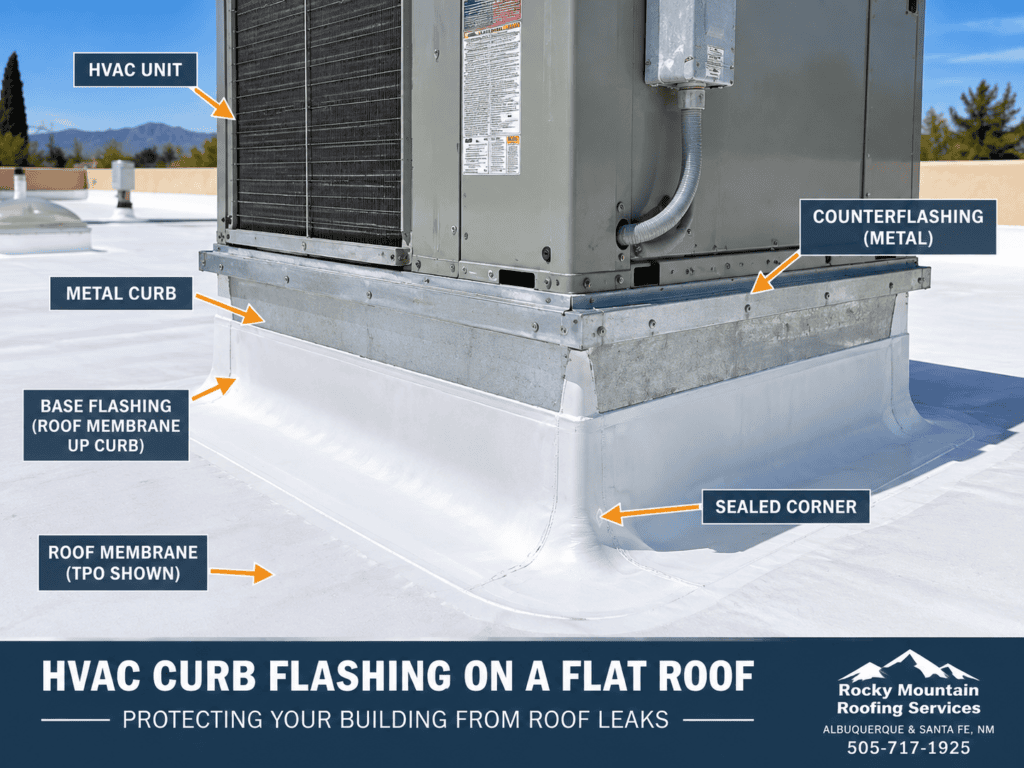
A flat roof leak that appears around a rooftop HVAC unit can come from the roof, the equipment, or the transition where the two meet. Common roof-side sources include deteriorated HVAC curb flashing, open membrane seams or corners, nearby penetrations, punctures, and water that ponds around the unit. Equipment-side sources can include condensate drainage or other mechanical water problems. The location of the drip inside the building is an important clue, but it does not prove where the water entered.
That distinction matters because sealing the most obvious spot may not solve the problem. Water can move within a roof assembly, along decking or structural components, and then appear indoors some distance from its entry point. The first job is diagnosis: determine whether the leak is weather-related, HVAC-related, or a combination of roof and equipment conditions.
Why Can a Flat Roof Leak Around an HVAC Unit?
A rooftop HVAC unit usually sits above the roof surface on a raised curb. The roofing system must transition from the horizontal roof field up the curb and terminate in a way that keeps water out while allowing the equipment and roof assembly to function as designed. That makes the curb a detail-rich transition zone rather than just another part of the open roof.
Several things meet in a small area: membrane or coating, base flashing, corners, terminations, metal components, fasteners or penetrations, equipment openings, and sometimes condensate lines. On commercial buildings there may also be frequent service traffic around the unit. Any of those conditions can deserve attention when water appears below or near rooftop equipment.
For broader context on the roofing systems and problems involved, see Rocky Mountain Roofing Services’ flat-roof problem guide. The HVAC article stays focused on the roof-to-equipment transition rather than treating every flat-roof problem as the same diagnosis.
First Determine Whether the Water Is Coming From the Roof or the HVAC System
Timing is one of the most useful clues. It does not establish the cause by itself, but it can help determine what should be inspected first.
| When the water appears | Possible source | What should be inspected |
| Only during or soon after rain | Roof-side entry is more likely, but not proven | Curb/base flashing, membrane seams and corners, penetrations, drainage, nearby roof defects |
| During wind-driven rain | Water may be entering a vulnerable flashing, termination, opening, or equipment detail | Counterflashing, curb transitions, corners, metal joints/openings, adjacent membrane |
| While the HVAC runs—even in dry weather | Condensate or another mechanical water source becomes more plausible | Condensate pan/drain, equipment cabinet/openings, mechanical components; HVAC evaluation may be needed |
| After storms, with water remaining near the unit | Drainage may be increasing exposure around a vulnerable detail | Low areas, drains/scuppers/canales, membrane condition, curb flashing and wet materials |
Leak Appears During Rain
If the interior water shows up during rain, start by looking for a weather-entry path rather than assuming the HVAC system is producing the water. The curb flashing, nearby membrane, penetrations, seams, roof drains and low areas all become relevant. A defect may be very small yet allow water into insulation or the roof assembly during a hard storm.
Water Appears While the HVAC Is Running
If water appears while the system operates during otherwise dry weather, the HVAC equipment deserves attention. Condensate is a normal byproduct of air-conditioning operation, but it needs to be collected and drained correctly. A condensate pan, drain line, cabinet opening, or other mechanical issue can create symptoms that look like a roof leak from inside the building. Roofing contractors should not diagnose or repair mechanical HVAC problems outside their scope; a qualified HVAC professional may need to evaluate the equipment.
Leak Happens During Wind-Driven Storms
Wind-driven rain changes the direction and pressure of water. A detail that remains dry during a light vertical rain may become vulnerable when wind pushes water against a curb, counterflashing, metal joint, opening, or termination. In Albuquerque and Santa Fe, high winds combined with intense storm cells make this timing clue especially useful, although it still does not identify the exact defect without inspection.
Common Roof-Side Leak Sources Around Rooftop HVAC Equipment
HVAC Curb and Base Flashing
The curb is the raised support between the roof and the rooftop unit. Base flashing ties the roofing system into that vertical surface. If the flashing is open, deteriorated, punctured, poorly terminated, or no longer integrated correctly with the surrounding roof, water can enter at the transition.
Curb details vary by roofing system. A TPO roof, for example, uses manufacturer-specific membrane and flashing details rather than a universal patching method. Carlisle SynTec’s published TPO curb detail illustrates how manufacturers provide specific curb-flashing assemblies; the installed roof system and manufacturer requirements should guide the actual repair.
Counterflashing, Corners and Terminations
Corners and terminations concentrate several transitions into a small area. Water may enter where flashing changes direction, where a membrane terminates, or where metal components no longer shed water as intended. Wind-driven rain can make weaknesses at these details more noticeable.
Membrane Seams, Punctures and Nearby Penetrations
The source may be close to the HVAC unit without being the curb itself. On TPO and other membrane roofs, a nearby open seam, puncture, pipe penetration, conduit detail, or previous repair can allow water into the assembly. Service traffic also makes the membrane around rooftop equipment worth inspecting for incidental damage, without assuming that any particular trade caused it.
If the building has a TPO roof, the related article Why Do TPO Roof Seams Fail? explains seam-specific failure mechanisms in more detail.
Ponding Water and Drainage Around the Unit
Standing water near an HVAC curb does not prove the curb flashing has failed. It does increase the amount of time water is in contact with nearby seams, flashings and penetrations. A depression created by settled insulation, deck deflection, restricted drainage, or an altered drainage path can therefore be part of the leak investigation.
For the drainage side of the problem, see What Causes Ponding or Puddles of Water on a Flat Roof?. The repair should address the reason water is collecting rather than simply covering a low spot with more material.
Why the Interior Drip May Not Be Directly Below the Roof Leak
Water follows available paths. Once it passes the exterior weatherproofing, it may move through insulation, across a cover board, along the roof deck, or along structural components before it reaches an opening into the occupied space. That is why a ceiling stain directly below an HVAC unit is not enough to conclude that the curb is leaking.
The National Roofing Contractors Association’s leak-investigation guidance makes this point explicitly: water may come from an air-conditioning unit, flashing, drains, walls, condensation or other sources, and a roof leak may not be located directly above the interior drip. A good investigation works backward from the symptom while examining plausible roof and non-roof sources.
How a Professional Inspection Narrows Down the Source
A useful inspection should answer more than “Where is the wet spot?” It should determine which system is allowing water into the building and whether moisture has spread beyond the visible symptom.
Depending on the building and roof system, the evaluation may include the HVAC curb and flashing, membrane seams and corners, nearby penetrations, previous repairs, drainage paths, ponding areas, roof surface condition, and signs that moisture has entered insulation or other roof components. If the pattern points toward the mechanical equipment, an HVAC technician may need to inspect condensate handling and the unit itself.
Rocky Mountain Roofing Services provides roof inspections in Albuquerque that include flat roofs, penetrations, HVAC curbs, flashing, drainage and leak detection. The objective is to identify the source before deciding what repair is appropriate.
What Type of Repair Might Be Needed?
The correct repair depends on what failed. A localized curb-flashing problem may call for rebuilding or repairing the flashing with materials compatible with the existing roofing system. An open seam or puncture may require a membrane repair. A drainage problem may require correcting the low area or restoring the intended drainage path. Wet insulation may change the scope because damaged material can extend beyond the visible opening.
If the water is coming from the HVAC equipment, roof repair alone will not solve it. The mechanical source must be corrected by an appropriate HVAC professional. In some cases, the most efficient path is a coordinated evaluation so the roofer and HVAC contractor are not treating separate symptoms of the same problem.
A leak around rooftop equipment also does not automatically mean the roof needs replacement. Rocky Mountain Roofing Services’ article Can a Flat Roof Leak Be Repaired Without Full Replacement? explains why localized flashing, membrane, drainage or penetration repairs may be possible when the surrounding system remains serviceable.
Why New Mexico Conditions Matter Around Rooftop Equipment
Flat and low-slope roofs are common on New Mexico homes and commercial buildings, and rooftop equipment is a familiar part of that architecture. Albuquerque and Santa Fe roofs also face intense ultraviolet exposure, large temperature swings, high winds, hail and seasonal monsoon rain. Santa Fe and higher-elevation areas add snow and freeze-thaw conditions.
Those conditions can stress membranes, sealants, seams and flashing over time, while a sudden downpour can expose a drainage weakness that was not obvious during dry weather. They do not mean every HVAC-curb leak is caused by climate. They do mean that the condition of the roof-to-equipment transition, nearby drainage and surrounding membrane deserves careful inspection.
What Should You Do If You See Water Near a Rooftop HVAC Unit?
Start with observations you can make safely from inside the building. Note when the water appears, whether it follows rain, whether wind was involved, whether it occurs while the HVAC runs in dry weather, and whether the stain or drip is changing. Photos and dates can help a roofing or HVAC professional compare the symptom with weather and equipment operation.
Do not climb onto a wet, storm-exposed, high, fragile, or unfamiliar roof to investigate. Rooftop HVAC equipment also introduces electrical and mechanical hazards. If active water is near electrical fixtures or equipment indoors, keep people away from the affected area and contact the appropriate qualified professional.
When the pattern is rain-related or the roof condition is uncertain, a professional roof inspection can evaluate the curb, flashing, membrane, penetrations and drainage. When the evidence points to condensate or equipment operation, an HVAC technician should evaluate the mechanical system. Sometimes both inspections are appropriate.
Flat Roof HVAC Leak FAQs
Can an HVAC unit leak water even when it is not raining?
Yes. Water associated with HVAC operation can come from condensate drainage or another mechanical source. If the symptom occurs during dry weather while the system is running, an HVAC evaluation becomes especially important. That timing does not rule out a roof problem, but it changes the diagnostic path.
Why does the leak happen only during wind-driven rain?
Wind can push rain against curb flashing, counterflashing, corners, metal joints and openings from directions they do not experience during light rainfall. A wind-only pattern is a clue to inspect those transitions carefully, not proof that any one detail has failed.
Can water travel under a flat roof before dripping inside?
Yes. Water can move within parts of the roof assembly or along deck and structural components before reaching the interior. The ceiling stain or drip may therefore be some distance from the exterior entry point.
Does an HVAC curb need special flashing?
Yes. The curb is a roof penetration and transition that must be integrated with the specific roofing system. The correct detail depends on the roof type, curb configuration and manufacturer requirements. TPO, built-up, modified-bitumen, foam and coated roofs do not all use the same flashing method.
Should an HVAC technician or roofer fix a leak around a rooftop unit?
It depends on the source. Roof membrane, curb flashing, penetration and drainage defects belong on the roofing side. Condensate, cabinet, drain-line and other mechanical equipment problems should be handled by a qualified HVAC professional. If the source is unclear, coordinated diagnosis may prevent one trade from repairing the wrong problem.
Schedule a Flat Roof Leak Inspection in Albuquerque or Santa Fe
If water is appearing below or near a rooftop HVAC unit, avoid assuming that the roof—or the HVAC system—is automatically responsible. Rocky Mountain Roofing Services provides residential and commercial roof repair, flat-roof leak detection, roof inspections, flashing repair, drainage improvements and preventative maintenance throughout Albuquerque, Santa Fe, and surrounding Central and Northern New Mexico communities.
Rocky Mountain Roofing Services has more than 35 years of combined roofing experience and evaluates roofing systems based on their actual condition rather than assuming that a leak requires complete replacement.
Call Rocky Mountain Roofing Services at (505) 717-1925 to schedule a professional roof inspection or leak evaluation. If the evidence points to the HVAC equipment itself, coordinate the next step with a qualified HVAC professional.
External Sources Used & Why They Matter
The following external sources were used to verify technical concepts in this article. They are included for transparency and additional reader reference.
National Roofing Contractors Association (NRCA) — leak investigation guidance: Supports the distinction between roof and non-roof water sources, including air-conditioning equipment and condensation, and explains that the visible interior drip may not be directly below the point of entry.
Carlisle SynTec Systems — U-5A Curb Flashing TPO detail: Used as an example of manufacturer-specific TPO curb-flashing detailing. It does not imply that every RMRS project uses this exact assembly.
NRCA — 2026 Architectural Metal Flashing and Condensation and Air Leakage Control manual: Confirms that NRCA’s current manual addresses architectural flashing and condensation/air-leakage control, including low-slope roof systems.