
What Are the Most Common Flat Roof Problems in New Mexico?
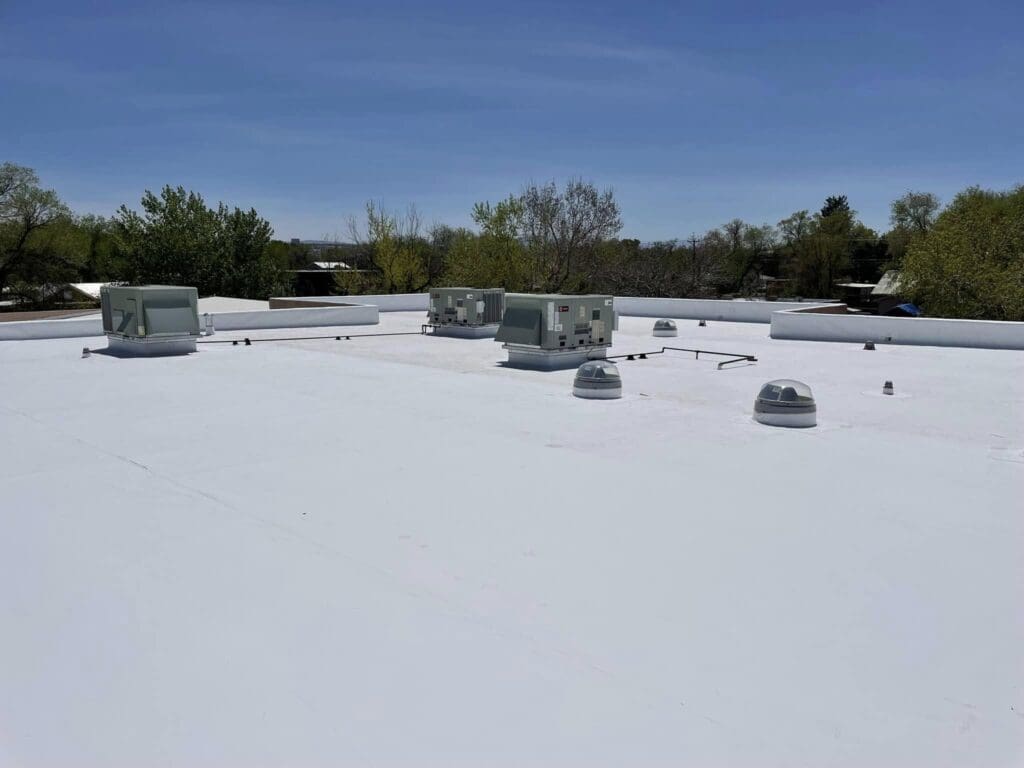
The most common flat roof problems in New Mexico include ponding water, clogged drainage, ultraviolet deterioration, failed flashings, membrane punctures, open seams, cracked coatings, wind and hail damage, wet insulation, and leaks around rooftop equipment and other penetrations.
Flat roofs in Albuquerque, Santa Fe, and surrounding communities endure an unusual combination of intense sunlight, high elevation, extreme roof-surface temperatures, large daily temperature swings, high winds, dust, hail, monsoon rainfall, snow, and freeze-thaw cycles.
These conditions do not affect every roofing system in exactly the same way. A TPO membrane may develop a puncture or open seam. A spray polyurethane foam roof may suffer coating erosion or exposed foam. An aging built-up roof may crack or blister beneath gravel. A silicone or acrylic coating may lose adhesion, become thin, or separate around drains and penetrations.
Not every visible problem requires a complete roof replacement. Many flat roofs can be repaired, maintained, or restored when deterioration is localized and the surrounding system remains stable. The important first step is determining what failed, how far moisture has traveled, and whether the roof deck and insulation remain sound.
Rocky Mountain Roofing Services has more than 35 years of combined roofing experience serving residential and commercial property owners throughout Albuquerque, Santa Fe, and Central and Northern New Mexico. The company evaluates each roof individually and recommends repair, maintenance, restoration, or replacement based on the system’s condition and long-term performance—not on a one-size-fits-all assumption.
Why Are Flat Roofs So Common in New Mexico?
Flat and low-slope roofs are a familiar part of New Mexico architecture.
They are commonly found on:
- Pueblo Revival and adobe-inspired homes
- Houses with parapet walls
- Commercial office buildings
- Retail centers
- Apartment communities
- Industrial facilities
- Churches
- Schools
- Government buildings
- Warehouses
- Restaurants
- Medical and professional buildings
Flat roofs complement Southwestern architectural styles and make it possible to place HVAC units, vents, solar equipment, and other mechanical systems above the building.
However, a roof described as “flat” should not be perfectly level.
It should have enough positive slope to direct water toward:
- Roof drains
- Scuppers
- Canales
- Gutters
- Downspouts
- Other designed drainage outlets
When the slope, drainage, membrane, coating, flashings, or penetrations stop working together correctly, water can remain on the surface or enter the roofing assembly.
How Does New Mexico’s Climate Affect Flat Roofs?
New Mexico roofing systems face environmental stresses that may accelerate material aging.
Intense Ultraviolet Exposure
Albuquerque sits at a high elevation, and Santa Fe is even higher. Strong sunlight and ultraviolet radiation can gradually dry asphalt, weaken exposed sealants, age membranes, and erode protective roof coatings.
Extreme Roof-Surface Heat
The temperature of a dark roof surface can become much hotter than the surrounding air. Heat can soften some materials and increase expansion throughout the roofing assembly.
Rapid Nighttime Cooling
Temperatures often drop considerably after sunset. This repeated heating and cooling causes roofing materials to expand and contract.
Monsoon Storms
Long dry periods can be followed by sudden heavy rainfall. A drain or scupper that seemed adequate during dry weather may quickly become overwhelmed or blocked during a monsoon storm.
Hail and High Winds
Hail can fracture coatings, bruise foam, dent flashing, crack skylights, or puncture membranes. High winds can lift loose edges, move gravel, damage metal, and drive debris across the roof.
Snow and Freeze-Thaw Cycles
Santa Fe and higher-elevation communities may experience snow, ice, and repeated freezing and thawing. Water entering a small defect may freeze, expand, and enlarge the opening.
These conditions make regular inspections and preventative maintenance particularly important for New Mexico flat roofs.
1. Ponding Water
Ponding water is one of the most recognizable flat roof problems.
Rocky Mountain Roofing Services defines ponding water as water that remains on a flat roof for more than 48 hours after rainfall.
Common causes include:
- Insufficient roof slope
- Settled insulation
- Roof-deck deflection
- Clogged drains
- Blocked scuppers or canales
- Poorly positioned drainage outlets
- Previous repairs that created high spots
- Compressed insulation
- Added mechanical equipment
- Structural movement
Standing water can keep vulnerable roofing areas wet for prolonged periods. It may also contribute to sediment buildup, biological growth, coating deterioration, and additional structural loading.
Ponding water does not automatically mean the entire roof must be replaced. The solution depends on the cause and extent of the problem.
Possible professional responses include:
- Cleaning drains and scuppers
- Correcting localized low areas
- Installing tapered insulation
- Rebuilding a drain detail
- Adding or modifying drainage outlets
- Repairing settled insulation
- Evaluating the roof deck
- Replacing a broadly defective drainage system
Simply adding roofing cement or coating to a low area may shift the water somewhere else without correcting the underlying drainage problem.
2. Clogged Drains, Scuppers, and Canales
A flat roof cannot drain properly when its outlets are blocked.
Common obstructions include:
- Leaves
- Loose gravel
- Dirt
- Roofing debris
- Bird nesting material
- Windblown trash
- Construction materials
- Snow and ice
When drainage is restricted, water may back up across the roof and rise above flashing details that were not designed for prolonged submersion.
Blocked drainage can lead to:
- Larger ponding areas
- Increased roof weight
- Leaks around drains
- Sediment accumulation
- Deteriorating coatings
- Water entry at parapet walls
- Overflow into unintended areas
Roof drains should be evaluated before monsoon season and after major storms, high winds, nearby construction, and rooftop service work.
Property owners should not climb onto a roof without appropriate safety equipment and training. Roofing involves serious fall, heat, wind, and electrical hazards.
3. Ultraviolet Deterioration
New Mexico sunlight can gradually break down exposed roofing materials.
UV exposure may:
- Dry and embrittle asphalt
- Degrade exposed spray foam
- Erode or chalk coatings
- Weaken sealants
- Accelerate cracking
- Age some single-ply surfaces
- Damage unprotected repairs
- Increase thermal movement
A roof’s protective surfacing is therefore important.
On a built-up roof, gravel or mineral surfacing protects the asphalt. On a spray foam roof, the protective coating shields the foam. On a coated roof, the coating itself becomes the weathering surface.
Problems develop when:
- Gravel has shifted
- Foam becomes exposed
- A coating becomes too thin
- Repairs are left unprotected
- Sealants dry out
- Surface preparation was inadequate
- Recoating was delayed
The correct response may involve localized repair, compatible resurfacing, recoating, or replacement when deterioration is widespread.
4. Thermal Expansion and Contraction
Flat roof materials move as temperatures change.
Metal flashings, membranes, asphalt, insulation, parapet walls, pipes, and structural decking do not always expand and contract at the same rate.
Repeated movement may contribute to:
- Open seams
- Cracked patches
- Split asphalt roofing
- Failed sealants
- Stressed flashings
- Separation at walls
- Damage around equipment curbs
- Loose termination details
This thermal cycling is especially significant in Albuquerque, where hot sunny days may be followed by much cooler nights.
A repair that is too rigid, poorly reinforced, or incompatible with the existing material may crack as movement continues.
5. Flashing Failures
Many flat roof leaks begin at flashing details rather than in the open field of the membrane.
Flashings protect locations where the roof meets or surrounds another building component.
Common flashing locations include:
- Parapet walls
- Roof edges
- Pipes
- Vents
- Skylights
- Chimneys
- HVAC curbs
- Drains
- Scuppers
- Canales
- Expansion joints
- Electrical penetrations
- Pitch pockets
These areas are vulnerable because they involve changes in direction, material transitions, concentrated water flow, and movement.
Common flashing problems include:
- Cracked wall transitions
- Loose counterflashing
- Failed sealants
- Open termination bars
- Deteriorated pitch pockets
- Separation around pipes
- Rusted metal
- Improper patches
- Inadequate flashing height
- Water entering behind the detail
Repeatedly applying roofing cement over a failed flashing may provide temporary relief, but it can also hide the true defect. A lasting repair often requires removing failed material and rebuilding the flashing correctly.
6. Membrane Punctures and Surface Damage
A surprisingly small puncture can allow water to reach insulation or the roof deck.
Common causes include:
- HVAC service
- Solar installation
- Plumbing or electrical work
- Dropped tools
- Sharp debris
- Unprotected foot traffic
- Temporary equipment
- Windblown objects
- Hail
- Improper material storage
Flat roofs often support equipment that requires regular service. A technician concentrating on an air-conditioning unit may not notice that a tool, fastener, or sharp panel edge has damaged the roofing surface.
Designated walkways and careful coordination with rooftop contractors can reduce this risk.
Once moisture enters through a puncture, it may spread beyond the original opening, making the leak more difficult to locate.
7. Open or Failed Seams
TPO and PVC are single-ply membranes commonly used on commercial and some residential flat roofs.
Their seams are typically heat welded. When properly installed, these welds create a continuous waterproof connection. Problems can develop when seams are affected by:
- Incomplete welding
- Surface contamination
- Improper equipment settings
- Aging
- Repeated movement
- Inadequate fastening
- Mechanical damage
- Poor previous repairs
- Stress around penetrations
A seam may appear closed from a distance but contain a weak or incomplete section. Professional inspection may involve visual examination, probing, and system-specific testing.
An open seam should be repaired with compatible materials and proper preparation rather than covered indiscriminately with an unrelated sealant.
8. Cracked or Deteriorated Roof Coatings
Roof coatings may be used over suitable built-up roofs, modified bitumen, metal, spray foam, and other compatible systems.
Common coating types include:
- Silicone
- Acrylic
- Elastomeric coatings
- Protective coatings over spray foam
Warning signs of coating deterioration include:
- Cracking
- Peeling
- Blistering
- Chalking
- Thin areas
- Exposed substrate
- Exposed foam
- Loss of adhesion
- Damage around drains
- Separation near penetrations
- Ponding-related deterioration
A coating can extend the useful service life of an appropriate roof, but it is not a universal solution.
Coatings should not be used to conceal:
- Saturated insulation
- Unstable roofing layers
- Structural damage
- Broad membrane failure
- Severe drainage deficiencies
- Incompatible existing materials
Surface preparation, repair, cleaning, dryness, adhesion, and product compatibility all matter.
9. Spray Foam Roof Damage
Spray polyurethane foam is applied as a liquid that expands and hardens into a continuous insulating layer. A protective coating is then installed over the foam.
Common spray foam problems include:
- Coating erosion
- Exposed foam
- Punctures
- Bird damage
- Hail impact
- Improper drainage
- Poorly repaired penetrations
- Mechanical damage
- Delayed recoating
- Thin coating in vulnerable areas
Exposed foam should be addressed promptly because sunlight and moisture can degrade it.
The good news is that localized foam damage may often be repaired when the surrounding roof remains stable. Damaged foam can be removed, rebuilt, and recoated with compatible materials.
The roof’s overall coating thickness and condition should also be reviewed rather than focusing only on one visible defect.
10. Cracking and Splitting in Asphalt-Based Roofs
Built-up roofing and modified bitumen systems may develop cracks or splits as they age.
Possible causes include:
- Ultraviolet exposure
- Loss of flexibility
- Thermal movement
- Structural movement
- Inadequate surfacing
- Failed previous patches
- Freeze-thaw conditions
- Repeated ponding
- Movement at insulation joints
Tar and gravel roofs present an additional challenge because aggregate can conceal membrane deterioration.
An aging asphalt roof should be inspected around:
- Bare areas
- Parapet walls
- Drains
- equipment curbs
- Penetrations
- Previous patches
- Roof edges
- Areas of repeated ponding
Localized splitting may be repairable. Widespread brittleness, cracking, or moisture may indicate that a broader restoration or replacement plan is needed.
11. Blistering and Trapped Moisture
Blisters are raised areas caused by air, moisture, or gases trapped within or beneath roofing materials.
They may occur in:
- Built-up roofing
- Modified bitumen
- Roof coatings
- Single-ply assemblies
- Spray foam coating systems
As the roof heats, trapped moisture or air expands and places pressure on the surrounding material.
A blister may remain stable for some time, but it becomes more vulnerable when exposed to:
- Foot traffic
- Hail
- Sharp debris
- Standing water
- Freeze-thaw cycles
- Mechanical service
- Repeated thermal movement
Property owners should not cut open or puncture a blister. Doing so may create a direct water-entry point and make a repair more difficult.
A roofing professional should evaluate the blister’s location, size, stability, moisture content, and relationship to the surrounding system.
12. Hail Damage
Hail damage to a flat roof is not always obvious from the ground.
Depending on the roofing system and storm severity, hail may cause:
- Membrane punctures
- Fractured coatings
- Bruised spray foam
- Dented metal flashing
- Damaged drains
- Cracked skylights
- Loose rooftop components
- Surface fractures
- Hidden damage beneath coatings or aggregate
A roof may not leak immediately after a hailstorm. Small fractures or weakened areas may deteriorate later under heat, rain, and freeze-thaw conditions.
A post-storm inspection can help document visible conditions and determine whether repairs are needed.
13. Wind Damage and Uplift
High winds place significant stress on roof edges, corners, flashings, and membrane attachment.
Potential wind-related problems include:
- Lifted membrane edges
- Loose flashing
- Damaged metal
- Displaced gravel
- Open seams
- Torn membrane
- Wind-driven debris impact
- Loose rooftop equipment
- Air entering beneath poorly secured roofing
Perimeters are especially important because pressure can concentrate at roof edges and corners.
Once wind gets beneath a loose component, additional sections may be pulled upward. Early repair of loose edges and flashings can prevent a localized problem from spreading.
14. Wet Insulation
Moisture can travel beneath a roof surface and remain trapped after the visible area dries.
Wet insulation may contribute to:
- Reduced thermal performance
- Higher energy use
- Blistering
- Corrosion
- Roof-deck deterioration
- Added weight
- Repeated leaks
- Difficult repairs
- Moisture damage to susceptible building materials
An interior ceiling stain does not necessarily appear directly beneath the roof opening. Water may travel through insulation, along the deck, or around structural components before becoming visible.
Depending on the roofing system and project, professionals may use:
- Visual inspection
- Infrared evaluation
- Electronic moisture detection
- Core samples
- Examination from inside the building
The goal is to determine whether moisture is limited to a repairable area or affects a larger portion of the roofing assembly.
15. Poor Installation
A relatively new flat roof can fail early when it was not installed correctly.
Installation-related problems may include:
- Inadequate slope
- Poor seam welding
- Improper flashing
- Incompatible materials
- Weak substrate preparation
- Insufficient fastening
- Improper foam application
- Missing reinforcement
- Unprotected penetrations
- Drains installed too high
- Inadequate coating thickness
- Roofing installed over wet materials
These defects can be difficult to correct with surface patches alone.
An inspection should evaluate both the visible symptom and the construction detail that allowed it to develop.
16. Neglected Maintenance
Many major flat roof problems begin as small maintenance issues.
Examples include:
- A blocked drain
- A loose flashing edge
- A small puncture
- A thin coating area
- An exposed foam spot
- A weak seam
- Displaced gravel
- A failed sealant joint
When these defects remain unaddressed, moisture can reach insulation and decking, increasing the scope and cost of repairs.
Preventative maintenance may include:
- Drain and scupper cleaning
- Debris removal
- Flashing inspections
- Seam evaluations
- Coating inspections
- Penetration checks
- Gravel redistribution
- Repairing small punctures
- Monitoring ponding areas
- Reviewing previous repairs
- Documenting storm damage
- Limiting unnecessary roof traffic
Rocky Mountain Roofing Services emphasizes long-term maintenance and extending useful roof life whenever practical.
Common Flat Roof Problems at a Glance
| Flat roof problem | Common causes | Warning signs | Typical professional response |
| Ponding water | Poor slope, blocked drainage, settled insulation | Water remaining after 48 hours | Drain cleaning, slope correction, tapered insulation, localized repair |
| UV deterioration | Intense sunlight and exposed materials | Cracking, chalking, brittleness | Repair, resurfacing, compatible coating, or replacement if widespread |
| Flashing failure | Movement, age, poor installation | Leaks near walls or penetrations | Rebuild or replace the failed detail |
| Membrane puncture | Foot traffic, tools, debris, hail | Small opening, wet insulation, interior stain | Compatible reinforced membrane repair |
| Open seam | Poor weld, movement, contamination | Loose edge or leak near a seam | Seam testing and system-specific repair |
| Coating failure | Aging, poor preparation, ponding, UV | Peeling, cracking, exposed substrate | Surface preparation, repairs, and recoating when appropriate |
| Wet insulation | Unrepaired leak or trapped moisture | Soft areas, recurring leaks, reduced performance | Moisture survey and localized or broader replacement |
| Wind damage | High winds or weak edge attachment | Lifted edges, loose flashing, displaced gravel | Reattachment, flashing repair, storm assessment |
| Hail damage | Severe storms | Dents, punctures, coating fractures | Post-storm inspection and system-specific repair |
| Blistering | Trapped air or moisture | Raised membrane areas | Condition evaluation and controlled repair |
Warning Signs Property Owners Should Watch For
Possible warning signs include:
- Ceiling stains
- Bubbling or peeling interior paint
- Water dripping after storms
- Musty odors
- Water remaining on the roof after 48 hours
- Cracked or peeling coating
- Exposed spray foam
- Open seams
- Loose flashing
- Gravel collecting around drains
- Membrane wrinkles
- Raised blisters
- Soft roof areas
- Repeated patching
- Rusted metal or deck components
- Leaks near HVAC equipment
- Unexplained increases in energy use
These signs do not establish the full extent of a problem. They indicate that a professional inspection may be appropriate.
Can a Flat Roof Be Repaired?
Yes. Many flat roof problems can be repaired when the damage is localized and the surrounding system remains stable.
Repair may be practical when:
- The leak source can be identified.
- Damage is limited to one area.
- Most insulation remains dry.
- The roof deck is sound.
- Drainage can be corrected locally.
- Flashing failure is isolated.
- Previous repairs have performed well.
- The roof has useful remaining service life.
- Compatible repair materials are available.
Possible repairs include:
- Rebuilding flashings
- Repairing seams
- Patching punctures
- Replacing localized wet insulation
- Correcting drain details
- Restoring foam
- Repairing coating defects
- Reinforcing splits
- Replacing damaged membrane sections
An inspection should come before the recommendation.
When Does Replacement Make More Sense?
Replacement may provide better long-term value when deterioration is widespread or recurring.
Replacement may be considered when:
- Leaks occur in multiple areas.
- Large portions of insulation are wet.
- The deck is deteriorated.
- Flashings are failing across the roof.
- Drainage deficiencies affect large areas.
- The membrane or coating is failing broadly.
- Repairs are frequent and short-lived.
- Several incompatible layers are present.
- Additional roof weight is a concern.
- The property owner wants improved insulation or reflectivity.
- Major building renovations are planned.
| Roof condition | Repair may be practical | Replacement may be more appropriate |
| Leak pattern | One identifiable source | Multiple recurring leaks |
| Moisture | Small localized wet area | Widespread saturated insulation |
| Membrane | Mostly stable | Extensive cracking, seam failure, or brittleness |
| Flashing | One failed detail | System-wide flashing deterioration |
| Drainage | Correctable local obstruction | Broad slope or deck problems |
| Repair history | Few successful repairs | Repeated short-lived patches |
| Future goals | Short-term service extension | Long-term ownership or major renovation |
Roof age alone should not decide the issue. A well-maintained older system may remain repairable, while a newer roof with installation defects may require extensive corrective work.
How Often Should a New Mexico Flat Roof Be Inspected?
A professional inspection should generally be considered at least once each year.
Additional inspections may be appropriate:
- Before monsoon season
- After significant hail
- After high winds
- After heavy rain
- After snow or freezing weather
- After HVAC service
- After solar installation
- After electrical or plumbing work
- When an interior stain appears
- When ponding changes
- When the roof has a history of leaks
Older roofs, high-traffic roofs, and buildings with sensitive operations may need more frequent evaluation.
Rocky Mountain Roofing Services’ maintenance guidance includes annual inspections, post-storm inspections, drain cleaning, flashing checks, debris removal, coating maintenance, and prompt repair of minor leaks.
Frequently Asked Questions
What are the most common flat roof problems in New Mexico?
The most common problems include ponding water, clogged drainage, UV deterioration, flashing failures, membrane punctures, open seams, coating damage, hail and wind damage, wet insulation, and poor maintenance.
Why does water collect on a flat roof?
Water may collect because of insufficient slope, settled insulation, roof-deck movement, blocked drains, high previous repairs, or poorly located drainage outlets.
How long can water remain on a flat roof?
Water remaining for more than approximately 48 hours is commonly described as ponding and should be evaluated.
Why do flat roofs leak around flashings?
Flashings are located where different materials and building components meet. These areas experience movement, water concentration, and frequent service activity.
Can UV exposure damage a flat roof?
Yes. Intense UV exposure can dry asphalt, weaken sealants, age membranes, erode coatings, and damage exposed spray foam.
Can hail puncture TPO or damage foam roofing?
Yes. Hail may puncture or weaken membranes, bruise foam, fracture coatings, dent flashing, and damage rooftop components.
Why do roof coatings crack or peel?
Possible causes include aging, inadequate preparation, incompatible materials, trapped moisture, ponding water, insufficient thickness, and repeated thermal movement.
Can wet roof insulation dry by itself?
Some moisture may evaporate under certain conditions, but insulation can remain wet beneath a dry-looking surface. Professional moisture evaluation may be needed.
Can a leaking flat roof be repaired?
Often, yes. Localized leaks may be repairable when the surrounding roof, insulation, and deck remain stable.
Does every leaking flat roof need replacement?
No. The correct recommendation depends on the number of leaks, moisture extent, membrane condition, drainage, repair history, and roof-deck condition.
Is TPO better than spray foam?
Neither is best for every building. The appropriate system depends on the structure, drainage, insulation goals, rooftop traffic, maintenance plan, and owner priorities.
Can a damaged foam roof be recoated?
Possibly. Damaged areas must first be repaired, and the remaining foam and coating must be suitable for restoration.
Internal Linking Recommendations
This long-form article should include contextual internal links to the most relevant service, roofing-system, city, educational, and conversion pages. The internal linking guide recommends approximately 10–15 links for cornerstone articles of this length.
Recommended placements include:
- Link flat roofing systems to the Flat Roofing pillar page.
- Link New Mexico roofing contractor to the homepage or About page.
- Link flat roof ponding water to The Flat Roof Ponding Problem.
- Link roof drainage repair to Ponding Water Repair.
- Link flat roof leak repair to the appropriate repair page.
- Link roof leak detection to Commercial Leak Detection.
- Link TPO roofing to the TPO Roofing page.
- Link spray foam roofing to the Foam Roofing page.
- Link tar and gravel roof problems to What Are the Pitfalls of a Tar and Gravel Flat Roof?
- Link silicone roof coatings to Roof Coatings.
- Link flat roof inspection to Roof Inspections.
- Link preventative roof maintenance to Roof Maintenance.
- Link flat roof replacement to Flat Roof Replacement.
- Link Albuquerque roofing contractor to the Albuquerque city page.
- Link Santa Fe roofing contractor to the Santa Fe city page.
- Link schedule a professional roof inspection to Contact or Schedule an Inspection.
- Link request a free roofing estimate to the estimate page.
Suggested Video
What Are the Most Common Flat Roof Problems in New Mexico?
Recommended Length: Three to five minutes
Suggested Topics:
- Explain why flat roofs are common in New Mexico.
- Show how a properly designed flat roof drains.
- Demonstrate ponding water and blocked drains.
- Show UV-damaged asphalt or coating.
- Identify common flashing failures.
- Demonstrate a TPO puncture or open seam.
- Explain hail and wind damage.
- Show spray foam or coating deterioration.
- Explain how wet insulation can remain hidden.
- Discuss repair versus replacement.
- Recommend annual and post-storm inspections.
- Invite viewers to schedule a professional evaluation.
Schedule a Flat Roof Inspection in Albuquerque or Santa Fe
Flat roof problems rarely correct themselves.
Ponding water, clogged drains, failed flashings, small punctures, open seams, exposed foam, cracked coatings, and wet insulation may continue deteriorating even when the roof is not actively leaking into the building.
The earlier a problem is identified, the more options the property owner may have. A localized repair, drainage improvement, coating restoration, or maintenance service may be enough when the surrounding roof remains stable. Replacement may become more appropriate when deterioration, trapped moisture, or structural damage affects a large portion of the system.
Rocky Mountain Roofing Services provides professional flat roof inspections, leak detection, repairs, preventative maintenance, restoration, and complete replacement throughout Albuquerque, Santa Fe, and surrounding New Mexico communities.
With more than 35 years of combined roofing experience, the company evaluates each roof individually and provides recommendations based on the roofing system, drainage, moisture condition, building needs, and long-term performance goals.
Rocky Mountain Roofing Services
100 Mountain Park Place, Suite A
Albuquerque, New Mexico 87114
Santa Fe Office
150 Washington Avenue, Suite 201
Santa Fe, New Mexico 87501
Phone: 505-717-1925
Schedule a professional flat roof inspection before a small defect becomes a major building repair.
Conclusion
The most common flat roof problems in New Mexico are closely connected to the region’s climate and architecture.
Ponding water, blocked drainage, intense UV exposure, temperature movement, failed flashings, punctures, open seams, coating deterioration, spray foam damage, cracked asphalt, blisters, hail, wind, wet insulation, poor installation, and neglected maintenance can all contribute to leaks or premature roof failure.
However, a visible problem does not automatically mean the entire roofing system must be replaced.
Many localized defects can be repaired when they are identified early. Drainage may be improved. A puncture may be reinforced. A failed flashing can be rebuilt. Damaged foam may be restored. A compatible coating may extend the useful life of a suitable roof.
Replacement becomes more likely when leaks occur throughout the building, insulation is broadly saturated, drainage problems affect large areas, the roof deck is deteriorated, or repairs repeatedly fail.
The most reliable answer comes from a thorough inspection.
An experienced New Mexico roofing contractor can evaluate the visible surface, drainage, flashings, seams, coatings, insulation, penetrations, previous repairs, and roof deck before recommending repair, restoration, maintenance, or replacement.
That accurate diagnosis helps property owners protect their buildings, control long-term roofing costs, and avoid paying for work the roofing system does not yet require.