
Why Do TPO Roof Seams Fail?
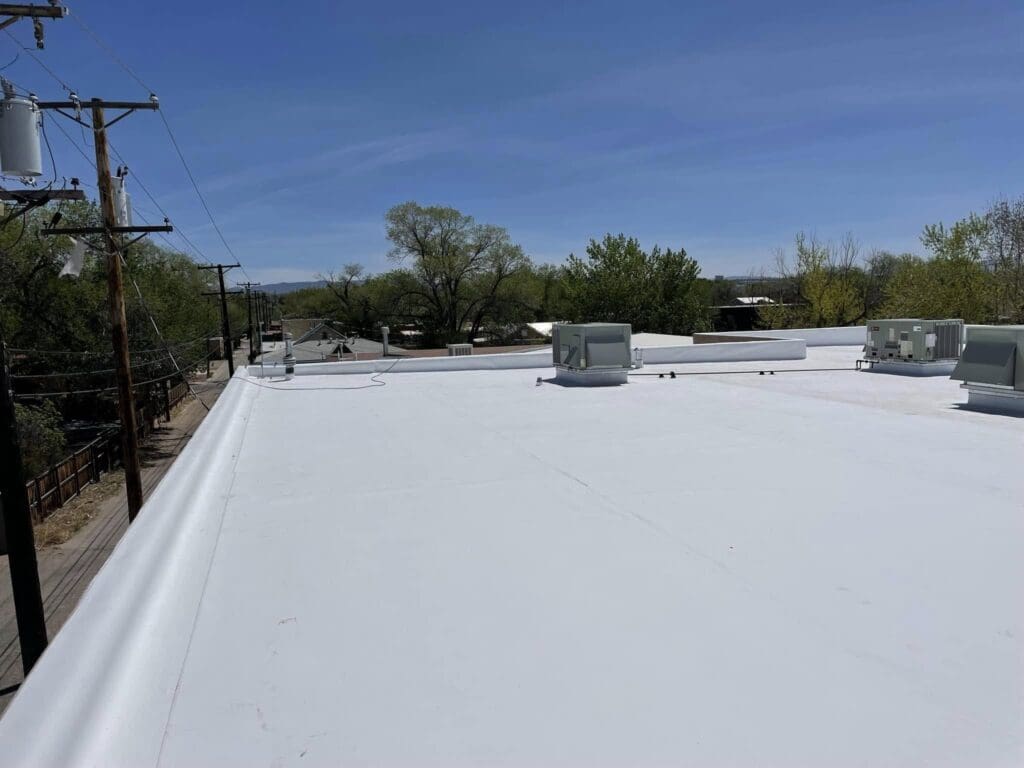
TPO roof seams can fail because of incomplete heat welding, contamination, improper welding conditions, insufficient pressure, membrane movement, aging, wind stress, rooftop damage, or poor previous repairs. An isolated failed seam may often be repaired, but repeated seam failures can indicate a broader problem involving installation, moisture, attachment, or the overall roofing system.
For property owners in New Mexico, seam condition deserves particular attention. Albuquerque and Santa Fe roofs are exposed to intense ultraviolet radiation, hot roof surfaces, substantial day-to-night temperature changes, high winds, hail, monsoon storms, and—in higher elevations—snow and freeze-thaw cycles.
A TPO roof may look perfectly normal from the ground while a relatively small opening at a seam allows water into insulation and other parts of the roofing assembly.
The important question is not simply, “Is there an open seam?”
It is:
Why did the seam fail, how much of the roof has been affected, and is this an isolated problem or evidence of something larger?
That distinction helps determine whether the appropriate response is a localized TPO roof repair, additional leak investigation, preventative maintenance, restoration, or evaluation of the entire roofing system.
What Is a TPO Roof Seam?
TPO, or thermoplastic polyolefin, is a single-ply roofing membrane widely used on commercial and low-slope roofs.
Unlike roofing systems made from multiple layers of asphalt-based materials, a TPO roof generally consists of large membrane sheets installed over the roof assembly.
Where two sheets meet, they overlap.
Those overlapping sections must be joined together to create a watertight roofing surface.
This is where heat welding comes in.
A professional TPO installation uses controlled hot air to heat the overlapping membrane surfaces. Pressure is applied while the material is at the appropriate temperature so the two surfaces fuse together.
When properly installed, the resulting seam essentially becomes a continuous part of the membrane.
This is one of the major characteristics of TPO roofing.
However, the quality and long-term performance of that seam depend on several factors, including proper installation, clean materials, appropriate equipment settings, weather conditions, membrane condition, roof movement, and continued maintenance.
Why Do TPO Roof Seams Fail?
There is rarely one universal reason.
Some failures begin during installation. Others develop because of environmental exposure, building movement, physical damage, drainage problems, or years of service.
| Cause of TPO Seam Failure | What Can Happen | Typical Professional Response |
| Incomplete original weld | Part of the seam never fully bonds | Inspect extent and repair compatible membrane |
| Contamination | Dirt, moisture, oxidation, or other material interferes with welding | Evaluate, clean and prepare membrane using appropriate procedures |
| Incorrect welding conditions | Membrane does not fuse correctly | Determine extent of weak weld and repair affected areas |
| Improper overlap or wrinkles | Seam may contain weak or stressed areas | Evaluate seam geometry and reconstruct where necessary |
| Thermal movement | Repeated expansion and contraction stresses roofing details | Repair damage and determine why movement is concentrating there |
| High winds | Perimeters, edges, membrane, or attachments may experience additional stress | Inspect seam, attachment, flashing, and surrounding roofing |
| Ponding water | A vulnerable seam remains exposed to water for extended periods | Repair seam and evaluate drainage problem |
| Rooftop traffic | Tools, equipment, or service activity can damage membrane or seams | Repair physical damage and inspect nearby areas |
| Aging/weather exposure | Older membrane can become more difficult to repair | Determine whether localized repair remains practical |
| Poor previous repairs | Incompatible materials or inadequate preparation can fail again | Remove or correct failed repair as appropriate |
Understanding the cause matters because repairing the visible opening without correcting the condition that created it can lead to another leak.
Can Poor Heat Welding Cause TPO Seams to Fail?
Yes.
An incomplete or improperly executed weld is one potential source of TPO seam failure.
Creating a reliable heat-welded seam requires a combination of appropriate heat, speed, pressure, surface preparation, overlap, equipment, and field conditions.
For example, if welding equipment moves too quickly, the membrane surfaces may not receive the conditions necessary to fuse correctly.
If the process is too slow or excessive heat is applied, the membrane can potentially be adversely affected.
Insufficient pressure can also contribute to an inadequate weld.
However, there is no single welding temperature or speed that should be applied to every TPO roof.
The appropriate procedures can vary according to the membrane manufacturer, material, equipment, ambient conditions, membrane temperature, wind, and other job-site factors.
That is why TPO welding should be performed according to the applicable roofing-system and manufacturer requirements rather than a universal setting.
Can Dirt or Contamination Cause a TPO Seam to Fail?
Yes.
The surfaces being joined need to be appropriately prepared for welding.
Potential contaminants can include:
- Dirt
- Dust
- Moisture
- Oils
- Construction debris
- Residue
- Weathered surface material
- Contamination from rooftop activity
If material interferes with the surfaces being fused, the resulting weld may not perform as intended.
This issue becomes especially important when repairing an older TPO roof.
New membrane being installed during original construction and membrane that has spent years exposed to New Mexico’s sun, dust, weather, and rooftop activity are not necessarily in the same condition.
An older seam repair may require specific cleaning and preparation procedures or other manufacturer-approved methods before compatible repair material can be installed.
Simply placing new TPO material over a dirty or weathered surface is not a substitute for proper preparation.
Can Improper TPO Membrane Overlap Cause Seam Problems?
Potentially.
TPO sheets need to be positioned so the seam can be properly constructed.
Wrinkles, irregular overlap, poor substrate conditions, or other installation problems can create areas that are difficult to weld consistently.
The membrane also needs to lie appropriately within the roofing system.
If the roof assembly or membrane attachment creates excessive stress in one location, that stress can eventually affect seams and other details.
This is one reason a professional seam investigation should look beyond the few inches immediately surrounding the visible opening.
The seam may be where the problem became visible without necessarily being the only part of the roof contributing to it.
How Do New Mexico’s Temperature Swings Affect TPO Roof Seams?
Roofs move.
During a hot New Mexico afternoon, a roofing surface can become considerably hotter than the surrounding air. As temperatures fall at night, the roof cools.
This heating and cooling cycle causes roofing materials and building components to expand and contract.
The process repeats day after day and season after season.
A properly designed and installed TPO roofing system is intended to accommodate normal movement. Problems can arise, however, where excessive stress becomes concentrated around seams, roof edges, penetrations, curbs, transitions, or other details.
Albuquerque’s hot sunny conditions can create substantial roof-surface temperatures, while Santa Fe’s higher elevation can add colder winter conditions and freeze-thaw cycles to the equation.
A seam that is already weak because of installation or previous damage may become more vulnerable as the roofing system repeatedly moves.
Does New Mexico’s Intense UV Exposure Damage TPO Seams?
TPO roofing is commonly selected partly because of its performance as a reflective single-ply roofing membrane.
But no exterior roofing system is isolated from long-term weather exposure.
New Mexico receives substantial sunlight, and high elevation increases ultraviolet exposure.
Over many years, weathering can change the condition of roofing materials. This matters when evaluating not only the existing roof but also whether an older membrane remains suitable for a particular repair procedure.
UV exposure is rarely useful as a stand-alone explanation for every open seam.
The better approach is to inspect the seam, surrounding membrane, flashing, attachment, drainage, and overall roof condition.
The objective is to determine what actually failed rather than assuming age or sunlight alone caused the problem.
Can High Winds Cause TPO Roof Seam Failure?
High winds can contribute to roofing-system stress.
Roof edges, corners, parapets, flashings, and perimeter areas can experience particularly demanding wind conditions.
If membrane attachment, flashing, or another component moves excessively, that movement can transfer stress into nearby seams.
After a significant New Mexico wind event, a professional inspection may therefore need to look at more than one visibly open seam.
A roofing professional may evaluate:
- Roof edges
- Perimeter details
- Membrane attachment
- Flashing
- Seams
- Corners
- Penetrations
- Rooftop equipment
- Areas showing movement or uplift
An open seam following a windstorm may be the obvious damage, but the surrounding roofing system should also be considered.
Can Hail Damage TPO Roof Seams?
Hail can damage roofing systems in several ways depending on hail size, wind, roof condition, membrane characteristics, underlying materials, and impact location.
An existing weak seam or detail may deserve particular attention following a significant hailstorm.
The membrane itself, flashings, rooftop equipment, drains, penetrations, and other components should also be considered during a storm-damage inspection.
Not every hailstorm creates TPO seam failure, and the presence of hail in the area does not prove that a particular seam problem was caused by hail.
The actual roof condition needs to be evaluated.
Can Ponding Water Cause a TPO Seam to Leak?
Ponding water can make an existing seam problem more consequential.
On a properly functioning low-slope roof, water should move toward drains, scuppers, or other designed drainage points.
When water remains in one area for an extended period, any vulnerable seam, flashing detail, puncture, or penetration within that area experiences prolonged water exposure.
Suppose a seam contains a small opening.
If rainwater quickly drains away, the opening is exposed to water for a relatively short time. If several inches of water repeatedly collect over the same location, that vulnerable seam can remain exposed much longer.
The appropriate response may therefore require two questions:
- Why is the seam leaking?
- Why is water remaining around the seam?
Repairing the seam without addressing a significant drainage problem can leave one of the contributing conditions in place.
Why Are TPO Seams Near HVAC Units and Roof Penetrations Vulnerable?
Commercial roofs are working environments.
HVAC technicians, electricians, plumbers, communications contractors, solar installers, maintenance personnel, and other trades may need access to rooftop equipment.
That activity tends to concentrate around HVAC curbs, conduits, pipes, vents, and other penetrations.
These areas are also more complicated than the uninterrupted field of the roof.
They may contain:
- Membrane transitions
- Flashing
- Corners
- Curbs
- Pipes
- Supports
- Fasteners
- Sealants
- Multiple roofing details
Movement can also occur between the roofing system and mechanical components.
Tools can be dropped. Equipment can be moved. Sharp components can contact the membrane. Repeated foot traffic can place additional stress on the roofing surface.
When a seam failure develops near rooftop equipment, the investigation should consider both the seam itself and the surrounding activity and details.
Can Rooftop Service Work Damage TPO Seams?
Yes.
A roof may have performed normally for years before a new piece of mechanical, electrical, communications, or solar equipment is installed.
That does not mean every leak appearing afterward was necessarily caused by the service contractor.
But the timing is relevant.
If a leak begins shortly after substantial rooftop work, roofing professionals should consider whether membrane, seams, penetrations, flashings, or drainage were altered or damaged.
Property owners and facility managers can reduce risk by coordinating rooftop work and arranging a roofing inspection when significant modifications have been made.
Preventative maintenance is much easier when damage is found before the next monsoon storm.
What Are the Warning Signs of a Failing TPO Seam?
Some seam problems are visible during a professional roof inspection.
Others first become apparent because water enters the building.
Potential warning signs include:
- Visible seam separation
- Lifted seam edges
- Open seam ends
- Recurring leaks near the same roof area
- Previous seam patches that are separating
- Moisture staining inside the building
- Wet ceiling tiles
- Damp insulation
- Soft areas of the roof
- Membrane movement or wrinkles near seams
- Problems around roof edges or penetrations
- Repeated leaks after wind-driven rain
The absence of an obvious opening does not necessarily mean the seam is watertight.
Likewise, finding an open seam does not automatically prove it is responsible for a particular interior stain.
Water can travel beneath roofing materials before becoming visible inside.
Professional roof leak detection is therefore about connecting exterior conditions with the actual moisture path.
Can Water Enter Through One Seam and Show Up Somewhere Else?
Yes.
This is an important characteristic of flat-roof leak investigation.
Once water gets beneath the membrane, it can travel through or along:
- Roof insulation
- Cover board
- Roof decking
- Structural components
- Mechanical penetrations
- Pipes
- Conduits
- Wall assemblies
The ceiling stain may therefore appear several feet away from the actual entry point.
This is why repairing the seam directly above an interior stain without investigating the surrounding roofing system can fail to solve the leak.
The visible interior damage tells the contractor that water is entering the building.
It does not necessarily identify where water first crossed the TPO membrane.
How Do Roofing Professionals Inspect TPO Seams?
A professional TPO roof inspection begins with understanding the roof as a complete system.
Depending on the circumstances, the inspection may include visual evaluation of:
- Field seams
- Seam ends and transitions
- Roof edges
- Flashings
- Parapets
- HVAC curbs
- Pipes and penetrations
- Drains
- Scuppers
- Ponding areas
- Previous repairs
- Membrane condition
- Areas of heavy rooftop traffic
Roofing professionals may carefully probe seams where appropriate to identify areas that are not properly bonded.
They may also look for evidence of moisture within the roof assembly or building interior.
Rocky Mountain Roofing Services’ knowledge base includes moisture-detection equipment and infrared leak detection when applicable as tools that may be used during roofing work. The correct method depends on the roof and the problem being investigated.
A seam inspection should answer more than:
“Can we find an opening?”
It should help answer:
“Is this one isolated opening, or is the roof showing a pattern of seam failure?”
Can an Open TPO Roof Seam Be Repaired?
Often, yes.
One isolated failed seam does not automatically mean the entire TPO roof needs replacement.
If the surrounding membrane remains serviceable and the problem can be properly addressed, professional TPO roof repair may be appropriate.
Depending on the roofing system and condition, professional repair may involve evaluating and preparing the existing membrane, addressing failed material where necessary, installing compatible TPO repair membrane, heat welding the repair, and checking the completed work.
The exact procedure depends on the membrane, manufacturer requirements, roof age, existing condition, weather, equipment, and nature of the failure.
Older or contaminated TPO membrane may require additional system-specific preparation or another manufacturer-approved repair approach.
The goal is not simply to cover the opening.
It is to create a compatible repair tied into suitable roofing material.
Why Do Some TPO Seam Repairs Fail?
A repair can fail for many of the same reasons an original seam can fail.
Possible causes include:
- Inadequate surface preparation
- Contamination
- Incompatible repair materials
- Improper welding
- Failure to remove unsuitable material
- Continued movement
- An unresolved attachment problem
- Persistent ponding
- Damage from rooftop traffic
- A deteriorated surrounding membrane
There is another possibility: the repaired seam may not have been the only leak.
A contractor can successfully repair one opening while water continues entering through another seam, flashing detail, penetration, or drain connection.
That can create the impression that “the patch failed” when the building actually has multiple leak sources.
Accurate diagnosis matters just as much as repair workmanship.
Can an Older TPO Roof Still Be Heat-Welded?
Sometimes, but the existing membrane has to be evaluated.
A membrane that has been exposed to years of weather, UV radiation, dirt, rooftop activity, repairs, and environmental contamination is different from new TPO coming off a roll.
Professional preparation becomes particularly important.
The repair approach may depend on the manufacturer, membrane condition, age, contamination, and compatibility of the materials.
This is one reason property owners should avoid generic DIY repair products.
A material that appears to stop water temporarily may not be appropriate for the TPO system and can complicate a later professional repair.
Does One Failed TPO Seam Mean the Whole Roof Is Bad?
No.
An isolated open seam can occur on a roof that otherwise has significant useful service remaining.
For example, the problem may be limited to:
- One seam
- One penetration
- One HVAC area
- One roof edge
- One previous repair
- One storm-damaged location
If the surrounding membrane, insulation, attachment, flashing, drainage, and roof deck remain serviceable, localized repair may be the most practical solution.
This fits Rocky Mountain Roofing Services’ broader approach to roof evaluation: do not assume a damaged roof automatically needs replacement.
The goal should be to identify the extent of the problem and select the least extensive solution that can reasonably provide dependable long-term performance.
When Do Multiple TPO Seam Failures Indicate a Larger Problem?
The situation changes when seam failures are widespread or keep appearing in unrelated areas.
Repeated failures can indicate:
- Poor original installation
- Widespread weak welds
- Aging or weathered membrane
- Attachment problems
- Excessive membrane movement
- Moisture within the roofing system
- Broad flashing deterioration
- Drainage deficiencies
- Numerous poor previous repairs
- A roofing system approaching the end of its practical service life
At that point, repeatedly repairing one seam at a time may no longer be the best long-term strategy.
A broader commercial roof inspection can help determine how much of the roof remains serviceable.
| Isolated Seam Problem | Possible Widespread Roofing Problem |
| One identifiable open seam | Open seams in multiple unrelated areas |
| Surrounding membrane remains serviceable | Broad membrane deterioration |
| Insulation appears dry outside localized area | Moisture detected across larger roof sections |
| No significant movement nearby | Wrinkles, movement, or attachment concerns across roof |
| One damaged penetration or detail | Multiple failing flashings and transitions |
| Repair history is limited | Repeated short-lived repairs |
| Drainage generally functions | Significant ponding or drainage deficiencies |
The existence of multiple problems still does not automatically dictate replacement.
It does mean the decision should be based on the condition of the entire roofing system rather than another isolated patch.
How Does New Mexico Weather Affect TPO Seam Performance?
New Mexico creates a demanding combination of roofing conditions.
Intense Sun and UV
Albuquerque and Santa Fe receive substantial sunshine. Long-term UV exposure contributes to roofing-material weathering and can affect the condition of older membrane being evaluated for repair.
Hot Roof Surfaces
Summer roof surfaces can become substantially hotter than ambient air. Roofing systems must tolerate repeated heating and cooling.
Large Temperature Changes
Day-to-night temperature changes cause roofing and building components to expand and contract. Areas already experiencing stress can become more vulnerable over time.
High Winds
New Mexico wind can place substantial stress on roof edges, perimeters, flashings, membrane, and attachments.
Hail
Hail can damage roofing membrane and details, particularly when accompanied by strong winds.
Monsoon Rain
Sudden heavy rainfall can quickly expose a vulnerable seam and reveal drainage problems.
Snow and Freeze-Thaw Cycles
Santa Fe and higher-elevation areas of northern New Mexico experience colder winter conditions. Water entering vulnerable roofing details can be subjected to freezing and thawing.
None of these conditions means a properly installed TPO roof is inappropriate for New Mexico.
They demonstrate why installation quality, professional inspections, and preventative maintenance are important to long-term performance.
How Often Should TPO Roof Seams Be Inspected?
Rocky Mountain Roofing Services recommends annual roof inspections as part of routine maintenance, along with post-storm inspections when appropriate.
Commercial property owners should also consider an inspection after:
- Significant hail
- High-wind events
- Major rooftop HVAC work
- Solar installation
- Electrical or communications work
- New roof penetrations
- Equipment replacement
- A newly discovered interior leak
Routine preventative roof maintenance can identify small seam, flashing, drainage, and membrane problems before water intrusion becomes extensive.
A small repair made while surrounding insulation remains dry can be a very different project from repairing the same opening after moisture has spread through a large portion of the roofing system.
Should Property Owners Check TPO Seams Themselves?
Property owners should avoid unnecessary rooftop inspection or attempts to probe seams themselves.
Roofing is inherently hazardous.
Potential hazards include:
- Falls from roof edges
- Slippery surfaces
- High winds
- Extreme roof temperatures
- Electrical equipment
- HVAC equipment
- Trip hazards
- Hidden wet or soft areas
- Weak roof decking
There is also a risk of turning a small roofing issue into a larger one by walking on vulnerable areas or using incompatible repair materials.
A professional roof inspection provides a safer and more useful way to evaluate suspected seam problems.
How Can TPO Seam Problems Be Prevented?
No maintenance program can eliminate every future roofing problem, but preventative maintenance can reduce the chance that small defects remain unnoticed.
Useful practices include:
- Schedule annual professional inspections
- Inspect after significant storms
- Keep drains and scuppers clear
- Remove unnecessary roof debris
- Monitor high-traffic areas
- Inspect around rooftop equipment
- Check flashing and penetrations
- Address punctures promptly
- Evaluate ponding-water areas
- Coordinate with contractors performing rooftop work
- Inspect the roof after equipment installation or modification
- Maintain records of previous repairs
Commercial property owners may also benefit from documenting leak locations and repair history.
A pattern that is difficult to recognize from one service visit can become obvious when several years of maintenance records are reviewed together.
Frequently Asked Questions About TPO Roof Seam Failure
Why do TPO roof seams separate?
TPO seams can separate because of incomplete welding, contamination, improper installation conditions, membrane movement, attachment problems, weather exposure, physical damage, or poor previous repairs.
How are TPO roof seams supposed to be joined?
Overlapping TPO membrane sheets are generally joined using controlled hot air and pressure so the compatible surfaces fuse together into a watertight seam.
What causes a weak TPO weld?
Potential causes include inadequate heat, excessive or improper heat, incorrect welding speed, insufficient pressure, contamination, poor membrane overlap, wrinkles, weather conditions, or improper surface preparation.
Can dirt cause a TPO seam to fail?
Contamination between membrane surfaces can interfere with proper welding. Appropriate cleaning and preparation are particularly important when repairing older, weathered TPO.
Can New Mexico heat cause TPO seams to open?
Heat alone does not mean a properly installed seam will fail. However, repeated heating and cooling creates movement within roofing and building components. Existing weak seams or stressed details may become more vulnerable.
Can high winds damage TPO seams?
High winds can stress membrane, attachment, roof edges, flashings, and seams. Following significant wind damage, the surrounding roofing system should be inspected rather than looking only at one visible opening.
Can ponding water cause a TPO seam leak?
Ponding water can increase exposure at an already vulnerable seam. If ponding contributes to a leak, both the seam and the underlying drainage problem should be evaluated.
Can HVAC work damage TPO seams?
Rooftop service work can potentially puncture membrane or damage seams, flashing, and penetrations. An inspection after substantial rooftop modifications can identify problems before they produce interior leaks.
How do roofers inspect TPO seams?
Roofing professionals may visually inspect seams, transitions, flashings, penetrations, and surrounding membrane and carefully probe appropriate seams. They may also investigate moisture within the roofing assembly when conditions warrant.
Can an open TPO seam be repaired?
Often, yes. If the problem is localized and surrounding roofing remains serviceable, compatible professional TPO seam repair may be possible.
Why do TPO seam repairs sometimes fail?
Poor preparation, incompatible materials, improper welding, unresolved movement, ponding water, surrounding deterioration, or another unidentified leak source can contribute to recurring problems.
Does one open seam mean I need a new TPO roof?
No. One isolated seam problem does not automatically justify replacement. The roof should be inspected to determine whether the problem is localized or part of broader deterioration.
When should multiple seam failures be a concern?
Seam failures appearing across unrelated portions of a roof may indicate poor original installation, aging, widespread weak welds, membrane movement, attachment issues, moisture, or broader roofing-system deterioration.
Should TPO roofs be inspected after major storms?
Post-storm inspections can be valuable after significant hail, high winds, or other severe weather, especially if the building develops new leaks or visible roofing damage.
What Should You Do If You Suspect a TPO Seam Is Leaking?
Do not assume that one open seam means you need a new roof.
At the same time, do not assume that applying another patch will solve a recurring leak.
A professional inspection should determine:
- Where water is actually entering
- Why the seam failed
- Whether surrounding membrane remains serviceable
- Whether moisture has entered the insulation
- Whether attachment or movement contributed to the problem
- Whether ponding water is involved
- Whether other seams have similar defects
- Whether previous repairs remain sound
- Whether the problem is isolated or widespread
For an otherwise serviceable roof, professional seam repair may be all that is necessary.
When seam problems appear repeatedly across large portions of the roof, a broader evaluation can determine whether continued repairs, restoration, or eventual TPO roof replacement provides better long-term value.
The objective should always be an accurate diagnosis before making that decision.
Schedule a TPO Roof Inspection in Albuquerque or Santa Fe
If your TPO roof is leaking, showing separated seams, or has required repeated seam repairs, a professional inspection can help determine the source and extent of the problem before additional water reaches insulation, decking, or interior building materials.
Rocky Mountain Roofing Services provides TPO roofing, commercial roofing, roof leak detection, roof inspections, TPO roof repair, roof maintenance, and roof replacement throughout Albuquerque, Santa Fe, and surrounding Central and Northern New Mexico communities.
With more than 35 years of combined roofing experience, Rocky Mountain Roofing Services evaluates each roofing system individually, with an emphasis on honest recommendations, quality workmanship, preventative maintenance, and long-term roof performance.
Call Rocky Mountain Roofing Services at (505) 717-1925 to request a free roof inspection or free roofing quote.