
Why Is Water Backing Up Around My Roof Canale?
A New Mexico guide to canale drainage, ponding, flashing problems, and roof leaks
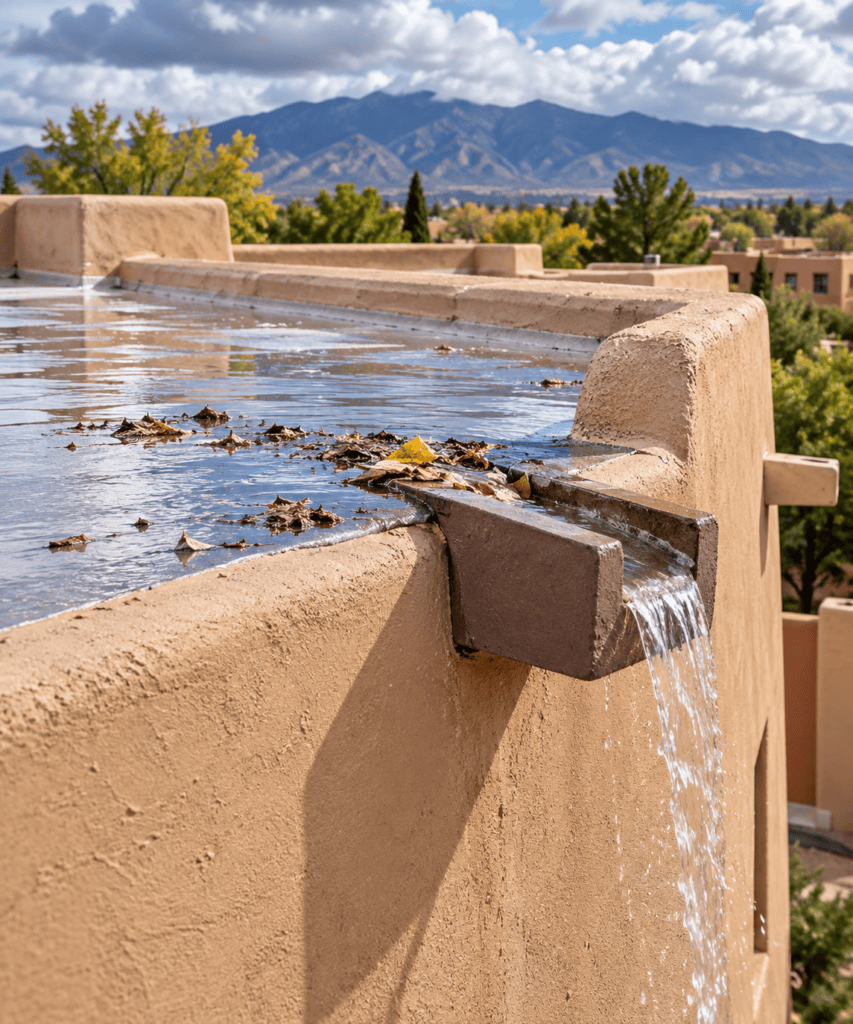
Water backing up around a roof canale usually means water is not moving through that drainage outlet as intended. A partial blockage is one possibility, but it is not the only one. The opening may be restricted, the roof may not be directing water toward the canale correctly, or the canale lining, flashing, roof membrane, or parapet transition may be deteriorated. In some cases, the canale itself is open and the real problem is a low area elsewhere on the roof.
That distinction matters on the flat and low-slope parapet roofs common in Albuquerque, Santa Fe, and other parts of New Mexico. A canale is supposed to carry water through the parapet and away from the roof. When water repeatedly collects at the opening instead, it can remain against roofing details that were not meant to stay submerged, increase ponding, and create a path for moisture into the roof or wall assembly.
If you are seeing a broader pattern of standing water rather than backup concentrated at the outlet, see what causes ponding or puddles of water on a flat roof for a separate look at roof-wide drainage problems.
| Quick answer: Water should flow toward and through a canale, not remain backed up around it. Look first for an obstruction or restricted opening. If the outlet is clear but water still remains, the problem may involve roof slope, a low spot, the canale pan/lining, flashing, the membrane, or the parapet transition. Persistent backup, interior staining, or uncertain roof access warrants a professional roof evaluation. |
What Is a Roof Canale?
A canale is a drainage outlet used on flat or low-slope roofs with parapet walls. Instead of allowing rainwater to spill randomly over the edge of the building, the roof is shaped so water moves toward an opening through the parapet and discharges to the exterior. Canales are a familiar feature of Pueblo Revival, adobe-inspired, and other Southwestern roof designs.
RMRS has a separate background article explaining why roof drains are called canales in New Mexico. For the present problem, the important point is simple: a canale is part of the roof drainage system, not just an architectural detail.
A roof described as flat should still direct water toward its drainage points. The drainage path may depend on subtle slope, crickets, valleys, tapered materials, or other transitions that are not obvious from the ground. If any part of that path is blocked or altered, water can collect before it reaches the opening.
Why Does Water Back Up Around a Canale?
The location of the water is a clue, but it does not identify the cause by itself. A puddle immediately in front of the canale can come from a simple obstruction, a problem with the roof surface, or a defect where the roof and parapet meet.
1. Debris Is Restricting the Opening
Leaves, dirt, loose gravel, roofing debris, windblown trash, bird nesting material, and other material can collect at a drainage opening. New Mexico winds can move debris across a roof, and a sudden heavy rain can carry that material toward the canale. The opening does not have to be completely plugged to create a problem. A partial obstruction can slow discharge enough for water to spread backward across the roof surface during a storm.
After the rain stops, a partially blocked canale may continue to drain slowly, which can make the problem look less serious than it was during the storm. Repeated sediment or debris at the same outlet is worth investigating rather than assuming every backup is a one-time event.
2. The Roof Is Not Providing Positive Drainage Toward the Canale
Sometimes the canale is open but the water cannot reach it efficiently. A localized low spot, settled insulation, deck movement, a previous repair that created a high area, or an inadequate transition into the outlet can leave water sitting beside the canale instead of flowing through it.
This is why clearing the opening does not always solve the problem. If water remains in the same area after the outlet is unobstructed, the drainage path itself needs to be evaluated.
3. The Canale Pan, Lining, or Flashing Detail Is Deteriorated
The canale passes through a vulnerable transition: the horizontal roof surface meets a vertical parapet and then opens to the exterior. Metal lining, flashing, membrane terminations, seams, coatings, and sealant details all have to manage moving water at that location. Corrosion, separation, cracks, failed seams, deteriorated coating, or a poor transition can allow water to enter even when the canale still appears to drain.
If the problem appears concentrated at the parapet rather than the roof field, the RMRS guide to Albuquerque parapet wall roof leaks and flashing explains why these wall-to-roof transitions deserve separate attention.
4. The Opening Is Too Restricted for the Water Reaching It
A canale may drain normally during a light rain and struggle during a heavier event. That does not automatically prove the opening was designed incorrectly. Debris, later roof modifications, accumulated sediment, altered slope, added rooftop equipment, or deterioration can change how water reaches the outlet. A professional evaluation looks at the whole drainage area rather than judging the canale by the opening alone.
5. Snow, Ice, or Freeze-Thaw Conditions Are Affecting Drainage
This is more relevant in Santa Fe and higher-elevation parts of northern New Mexico. Snowmelt can feed water toward a canale while shaded areas remain cold, and ice can temporarily restrict an outlet. Repeated freezing and thawing can also stress cracks and transitions around parapets and drainage details. A problem that appears only in winter may therefore require a different diagnosis than a canale that backs up during summer rain.
What Water Around a Canale May Mean
| What You Notice | Possible Cause | Why It Matters | Practical Next Step |
| Debris visible at the opening | Partial or complete blockage | Flow can slow and water can spread back across the roof | Observe from a safe location; arrange cleaning/inspection if roof access is unsafe |
| Outlet looks clear but water remains beside it | Low spot, poor slope, settled material, or restricted transition | The drainage path may be the problem, not the opening | Have the slope and surrounding roof assembly evaluated |
| Staining or dampness below the canale/parapet | Canale lining, flashing, membrane, or wall transition may be leaking | Water may be entering before it reaches the exterior discharge point | Schedule leak diagnosis; do not assume a surface patch will correct the cause |
| Backup happens mainly in heavy rain | Restricted flow, debris, drainage-area issue, or roof geometry | The system may drain in light rain but fall behind during higher flow | Document when it happens and have the drainage area inspected |
| Problem appears with snowmelt or freezing weather | Ice restriction or freeze-thaw deterioration | Drainage and cracks can behave differently in winter | Avoid unsafe roof access; arrange inspection when conditions permit |
Does New Mexico Building Code Address Canales?
Yes. New Mexico does more than simply recognize the term. The current New Mexico Residential Building Code specifically addresses canales and scuppers. For built-up roofs, Section R905.9.5 requires a metal pan lining that extends at least six inches past the inside of the parapet and at least six inches to each side of the opening, and it requires positive drainage. The same chapter also addresses roof-deck transitions that form drainage crickets or valleys leading to canales for several low-slope roofing systems.
New Mexico commercial building provisions likewise address canales/scuppers and positive drainage. These requirements are useful context because they show how important the outlet and the transition into it are to the roof assembly. They are not, however, a do-it-yourself diagnostic rule. An older roof may have been built under a different code, and the presence of water does not by itself prove a code violation. The actual condition, age, construction, jurisdiction, and scope of any repair have to be evaluated.
Can Water Backing Up at a Canale Cause a Roof Leak?
It can. When drainage is restricted, water can spread farther across the roof and remain in contact with seams, flashings, coatings, penetrations, and parapet transitions for longer periods. If one of those details is already deteriorated, backed-up water can expose the weakness.
Water can also enter near the canale itself if the lining or surrounding flashing is compromised. From there, moisture may travel within the roof or wall assembly before it becomes visible indoors. That is why an interior stain does not always appear directly below the exterior defect.
At the same time, backup does not mean a leak is inevitable, and it does not automatically mean the roof needs replacement. The appropriate response depends on whether the problem is a removable obstruction, a localized drainage defect, damaged flashing, deterioration in the roofing system, or a broader slope or moisture problem.
For the broader list of drainage, flashing, membrane, and weather-related issues that affect low-slope roofs, see the most common flat roof problems in New Mexico.
What Should I Do If Water Is Backing Up Around My Canale?
Start with what you can observe safely. From the ground or another secure location, note whether water is discharging from the canale, whether staining is visible on the exterior wall, and whether the problem occurs during every rain or only during heavy storms. If you can do so without entering a hazardous area, photograph the condition while it is happening. Those details can be useful later because the roof may look very different after the water drains.
Do not climb onto a wet, icy, high, fragile, or otherwise unsafe roof to clear an outlet. Roofing work involves fall hazards, wind exposure, electrical hazards, heat, and slippery surfaces. A drainage problem is not worth turning into a personal injury.
If safe access is already available to a qualified maintenance person, visible loose debris may be part of the problem. But repeated backup should not be treated as a cleaning issue until the drainage path and surrounding roof details have been considered. If the outlet is clear and the water still returns, adding sealant or roofing cement around the canale may hide the symptom without correcting the cause.
How a Roofer Determines Whether the Problem Is the Canale, Flashing, or Roof Slope
A useful inspection follows the water path rather than starting with a predetermined repair. The roofer may examine the canale opening and lining, the membrane or coating immediately around it, parapet flashing and wall transitions, nearby seams and penetrations, visible debris or sediment patterns, and the way the roof surface slopes toward the outlet.
The inspection may also look beyond the canale. If there are several ponding areas, signs of settled insulation, repeated interior leaks, or evidence that water is traveling beneath the roof surface, the drainage issue may be part of a larger roof condition. RMRS lists leak detection, roof inspections, drain cleaning, flashing inspection, and roof drainage improvements among its roofing services and maintenance capabilities.
Property owners in the Albuquerque area can review Albuquerque roof inspection services, while northern New Mexico property owners can review Santa Fe roof inspection services.
Canale Backup: Simple Obstruction or Larger Roof Problem?
| Clue | More Consistent With a Simple Obstruction | Reason to Look Deeper |
| Visible debris | Debris is concentrated at the opening and drainage returns after proper cleaning | Debris repeatedly returns or water remains after the opening is clear |
| Where water sits | Water is concentrated immediately behind a blocked outlet | A broad low area remains wet away from the opening |
| Interior symptoms | No known interior staining or wall moisture | Stains, dampness, peeling finishes, or repeated leakage appear near the roof/wall area |
| When it happens | A one-time event after unusual debris accumulation | Backup occurs during ordinary rains, after multiple storms, or during snowmelt |
| Condition of details | Canale lining and surrounding roof appear intact to a professional inspector | Cracks, separated flashing, deteriorated coating, open seams, or wall damage are present |
When Should You Call a Roofer?
A professional roof evaluation makes sense when the canale repeatedly backs up, water remains after the outlet should have drained, you see interior or exterior staining, the parapet or canale detail appears deteriorated, or the cause is not obvious from a safe location. It is also appropriate when the roof cannot be accessed safely.
For an active leak, the priority is locating the entry point and limiting further water intrusion—not assuming the visible canale is automatically the failed component. Albuquerque property owners can review RMRS roof leak repair services, and Santa Fe property owners can review Santa Fe roof leak repair.
Frequently Asked Questions About Roof Canale Backup
Should water remain around a canale after rain?
The roof should be directing water toward and through its drainage outlets. A small amount of residual surface moisture is different from a recurring puddle or backed-up area. If water repeatedly remains concentrated at the canale, especially after the opening is clear, the drainage path should be evaluated.
Can a clogged canale cause water to leak into a parapet wall?
Yes, restricted drainage can keep water against the roof-to-parapet transition and may expose defects in flashing, lining, membrane, coating, or wall details. But the location of the backup does not prove which component is leaking; inspection is needed to identify the actual entry point.
What commonly clogs roof canales in New Mexico?
Leaves, dirt, loose gravel, roofing debris, bird nesting material, windblown trash, and—in colder areas—snow or ice can restrict drainage. Conditions vary by property, so the cause should be confirmed rather than assumed.
Can I clean a clogged canale myself?
Only if the drainage point can be reached without unsafe roof access and you are qualified to work in that location. Wet or icy roofs, heights, wind, heat, electrical equipment, and fragile roofing surfaces create serious hazards. When access is uncertain, use a roofing professional.
Does a canale need positive drainage?
New Mexico residential code specifically requires positive drainage for canales and scuppers in the roof provisions discussed above. Commercial code provisions also address positive drainage. Code applicability to a particular existing building or repair should be confirmed for that project and jurisdiction.
The Bottom Line
Water backing up around a canale is a drainage symptom, not a diagnosis. The cause may be as straightforward as debris at the opening, or it may involve a low area, inadequate drainage path, damaged lining, failed flashing, deteriorated membrane or coating, or a parapet transition that is allowing water into the building.
The best next step is to determine why the water is not moving through the outlet normally. That keeps a localized drainage problem from being confused with a broader flat-roof failure—and helps avoid repairs aimed at the wrong part of the roof.
If water repeatedly backs up around a canale, ponds near a parapet, or is showing up as stains or leaks inside your property, Rocky Mountain Roofing Services can evaluate the roof and drainage details in Albuquerque and Santa Fe. Call 505-717-1925 to request a professional roof evaluation.
Sources & Further Reading
- New Mexico Administrative Code, 14.7.3 NMAC – Residential Building Code – Official state code source. Chapter 9 addresses roof assemblies, including canale/scupper pan lining, roof-deck transitions, and positive drainage.
- New Mexico Office of the State Engineer – Roof-Reliant Landscaping guide – State educational guide describing canales as parapet-roof drainage features and discussing roof drainage considerations in New Mexico.