
Can a Cracked Canale Cause Water to Leak Into a Wall?
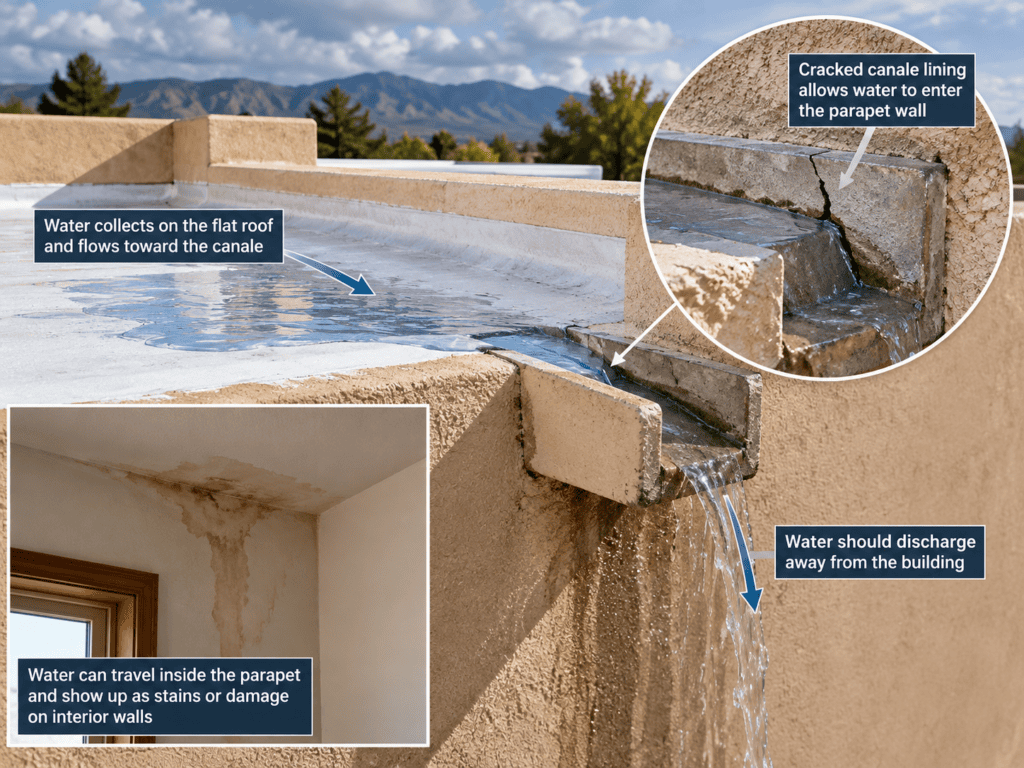
Yes. A cracked, deteriorated, or poorly flashed roof canale can allow rainwater to enter a parapet or exterior wall instead of carrying it safely away from the building. The risk is greater when the damage affects the water-carrying pan or lining, the canale throat where it passes through the parapet, or the flashing that ties the drainage opening into the roofing system.
But a visible crack is a clue, not a diagnosis. Water showing up in a wall near a canale can also come from failed parapet flashing, coping, the roof membrane, backed-up drainage, stucco or another part of the exterior wall. Water can travel inside a roof or wall assembly before it becomes visible indoors, so repairing the first crack you see may leave the real entry point untouched.
How Can Water From a Canale Get Into a Wall?
A canale is a drainage outlet used on many New Mexico flat and low-slope roofs with parapet walls. Roof water is directed toward the opening, passes through or beyond the parapet, and discharges away from the wall. That means the canale is not just a decorative spout. It is part of the transition between the roof drainage system and the building envelope.
The critical area is often the roof-side throat of the canale and the lined passage through the parapet. If the water-carrying surface is cracked, separated, corroded, poorly drained, or no longer watertight at its connection to the surrounding roof and wall, rain can move into the parapet instead of out through the opening.
New Mexico building rules recognize how important this detail is. Current state residential and commercial provisions require canales and scuppers to have metal pan lining that extends beyond the inside of the parapet and to each side of the opening, and they require positive drainage. Those requirements do not tell you why a particular existing canale is leaking, but they show why the lined transition and drainage path matter.
For a broader explanation of drainage outlets and flat-roof problems, see What Are the Most Common Flat Roof Problems in New Mexico? from Rocky Mountain Roofing Services.
Four Ways a Canale Area Can Send Water Into a Parapet or Wall
1. The Canale Pan or Lining Is Cracked or Deteriorated
If a crack or open joint reaches the part of the canale that actually carries water, rain can escape the intended drainage path. Instead of moving completely through the parapet and away from the building, some of that water can enter surrounding materials. The visible exterior spout may not tell the whole story because the vulnerable area can be farther back inside the opening.
2. The Canale Throat or Flashing Has Separated
A canale must connect to the roof and parapet in a way that keeps concentrated runoff from getting behind the roofing system. Separation at the throat, failed flashing, an open termination, or a deteriorated seal can create a path into the wall even when the outer portion of the canale looks relatively normal.
That is closely related to the failure paths discussed in Albuquerque Parapet Wall Roof Leaks: How to Fix Flashing—but the canale needs to be inspected as its own drainage detail rather than assumed to be part of a general parapet leak.
3. Water Is Backing Up at the Canale
A canale does not have to be cracked to contribute to a wall leak. Leaves, dirt, roofing debris, bird material, snow or ice can restrict an outlet. A low area or poor drainage path can also leave water standing near the opening. When water backs up, it can rise against flashing, seams and parapet details that normally see much less water.
If the main symptom is standing water rather than a visible canale defect, the related guide What Causes Ponding or Puddles of Water on a Flat Roof? explains the broader drainage problem in more detail.
4. The Leak Is Near the Canale but Starts Somewhere Else
This is the possibility that is easiest to miss. Water can enter higher on a parapet, at a coping joint, behind wall flashing, through a roof-membrane defect, or through an exterior-envelope opening and then travel until it appears near the canale. Plumbing, windows and condensation can also produce wall moisture that has nothing to do with the roof drainage outlet.
That is why the question is not simply, “Is the canale cracked?” The better question is, “Where is water getting into the assembly, and what path is it taking before I see the stain?”
What Clues Suggest the Canale Area Is Involved?
The timing and location of the moisture can help narrow the investigation. None of these signs proves the source by itself, but patterns can make one path more plausible than another.
| Symptom or timing | Possible source | What should be inspected |
| Wall stain directly below or beside the canale after rain | Canale pan/lining, throat flashing, or adjacent parapet detail | Roof-side canale opening, lining, flashing, parapet and nearby membrane |
| Leak occurs mainly during heavy rain | Restricted drainage or a defect exposed by higher water flow | Backup at the outlet, low areas, flashing height, open joints and drainage path |
| Leak occurs during wind-driven rain | Parapet, coping, wall or canale transition may be vulnerable from a particular direction | Coping joints, wall flashing, canale throat, stucco/exterior envelope and roof edge |
| Visible crack but no interior moisture | Crack may be cosmetic or outside the primary water-carrying layer | Determine whether the crack reaches the pan/lining or waterproof transition |
| Wall stays wet even without rain | A non-roof source becomes more plausible | Plumbing, condensation, windows, wall systems and other building components |
Can a Canale Leak Even If I Cannot See a Crack?
Yes. The visible portion of a canale can look intact while a concealed pan, lining, flashing joint or roof-side connection has deteriorated. The reverse is also possible: a visible crack in an outer component may not penetrate the waterproof layer below it.
This is one reason photographs taken from the ground can be useful for documenting changes but are not enough for a final diagnosis. A roof inspection may need to examine the inside edge of the opening, the drainage path feeding it, adjacent flashing and the condition of the surrounding roof membrane.
How Can You Tell a Canale Leak From a Parapet or Stucco Leak?
Start with the water path rather than the appearance of the stain. A stain below a canale makes the drainage outlet an obvious suspect, but water follows gravity and available cavities. A leak at the top of a parapet or behind coping can descend inside the same wall and emerge near the canale. Stucco or another exterior wall system can also admit water independently of the roof.
A useful inspection therefore works outward from the symptom. The canale opening and lining should be checked, but so should the parapet, coping, roof-to-wall flashing, adjacent roof membrane, drainage pattern and exterior wall. If those roof-side details are dry or the moisture appears without rain, the investigation should broaden beyond roofing.
Rocky Mountain Roofing Services provides roof inspections in Albuquerque that include leak detection, flashing, roof penetrations and drainage evaluation. The purpose is to identify the entry path before choosing a repair.
Can a Cracked Canale Be Repaired Without Replacing the Roof?
Often, a localized drainage or flashing problem can be repaired without replacing an otherwise serviceable roof, but the repair depends on what is actually damaged. The scope could involve the canale pan or sheet metal, flashing at the throat, compatible roofing membrane or coating, drainage correction, or repair to an adjacent parapet or wall component.
The presence of a wall leak also raises a second question: did water damage extend beyond the exterior roof detail? Wet insulation, framing, drywall, stucco or electrical components may require evaluation by the appropriate trade. A roofing repair can stop roof-side water entry, but it does not automatically repair every material affected inside the wall.
For active roof-side leakage in Albuquerque, review the company’s Albuquerque roof leak repair service. Santa Fe property owners can use the corresponding Santa Fe roof leak repair service for local service information.
Why Albuquerque and Santa Fe Conditions Matter
Canales are especially relevant in New Mexico because they are common on flat-roof, parapet and Pueblo-influenced architecture. The drainage detail also has to perform through conditions that can expose small weaknesses: strong ultraviolet exposure, high winds, windblown debris, abrupt temperature changes and intense seasonal rain. In Santa Fe and other higher-elevation areas, snow and freeze-thaw cycles add another variable.
These conditions do not prove why a particular canale cracked or why a wall is wet. They do explain why drainage, flashing and parapet transitions deserve attention. A hard monsoon can move much more water through a canale than a light shower, while wind can push rain against wall and coping details from a different direction. Debris can also turn a normally free-flowing outlet into a temporary dam.
What Should You Do If Water Is Leaking Into the Wall Near a Canale?
Document what you can safely observe. Note whether the moisture appears only after rain, whether the storm was heavy or wind-driven, whether water was visibly backing up at the canale, and where the stain sits in relation to the opening. Photos taken from a safe location can help compare conditions over time.
Do not climb onto a wet, high, fragile or unfamiliar roof during a storm to inspect or seal a canale. Roof work involves fall hazards, and water intrusion can create additional electrical concerns inside a building. If water is near wiring, outlets, fixtures or electrical equipment, keep people away from the affected area and contact an appropriate qualified professional.
If the wall moisture follows rain or the source is unclear, a professional roof inspection is the next logical step. The inspection should determine whether the canale, its lining and flashing, backed-up drainage, the parapet, the roof membrane or another building component is responsible before repair work begins.
Frequently Asked Questions
Why does my canale leak only during heavy or wind-driven rain?
Higher water volume can expose a restricted outlet or allow water to rise against a vulnerable flashing detail. Wind can also push rain against the canale, parapet, coping or wall from directions that a light vertical rain does not. The pattern is useful evidence, but the exact entry point still needs to be inspected.
Can water from a canale travel inside a parapet wall?
Yes. Once water gets behind the intended drainage or flashing layer, it can move through cavities, joints or materials inside the parapet and wall before becoming visible. The interior stain may therefore be below or beside the exterior entry point rather than directly behind it.
Can a leaking canale damage stucco or drywall?
Repeated water entry can wet exterior and interior finish materials. The amount of damage depends on how much water entered, how long materials stayed wet and what is inside the wall. A stain alone cannot determine whether framing, insulation or other concealed components are damaged.
Should a roofer or stucco contractor repair a canale leak?
The diagnosed source determines the trade. Canale lining, roof flashing, membrane and drainage problems are roofing concerns. Damage confined to stucco or another wall-envelope component may require a stucco or building-envelope contractor. When the source crosses both systems, coordinated repairs may be necessary.
Can a clogged canale force water into a wall?
It can contribute. A blockage can cause water to back up and rise against flashing, parapet or membrane details. The blockage itself may not create the opening; it may expose a weakness that remains dry when water drains normally.
Schedule a Canale or Roof Leak Inspection in Albuquerque or Santa Fe
If water is appearing in a wall below or near a roof canale, do not assume the visible crack is the only problem. Rocky Mountain Roofing Services provides residential and commercial roof inspections, leak detection, flat-roof repair, flashing repair and roof-drainage improvements throughout Albuquerque, Santa Fe and surrounding Central and Northern New Mexico communities.
The company has more than 35 years of combined roofing experience and works with flat roofing systems common throughout New Mexico. The goal of a leak evaluation is to identify the actual water-entry path and determine whether the canale, parapet, roof membrane, drainage system or another component needs attention.
Call Rocky Mountain Roofing Services at (505) 717-1925 to schedule a professional roof inspection or leak evaluation. You can also request a roofing quote online.
External Sources Used & Why They Matter
The following primary sources were used to verify New Mexico-specific drainage requirements. They are provided for transparency and additional reference; code applicability can depend on the building, project scope and adopted code in effect for that work.
New Mexico Administrative Code 14.7.3 NMAC — Residential Building Code: Verifies the state provision requiring metal pan lining at canales/scuppers and positive drainage in the residential code amendments.
New Mexico Administrative Code 14.7.2 NMAC — Commercial Building Code: Verifies comparable New Mexico commercial provisions addressing canale/scupper pan lining and positive drainage.