
How Can I Tell If Roof Flashing Is Causing a Leak?
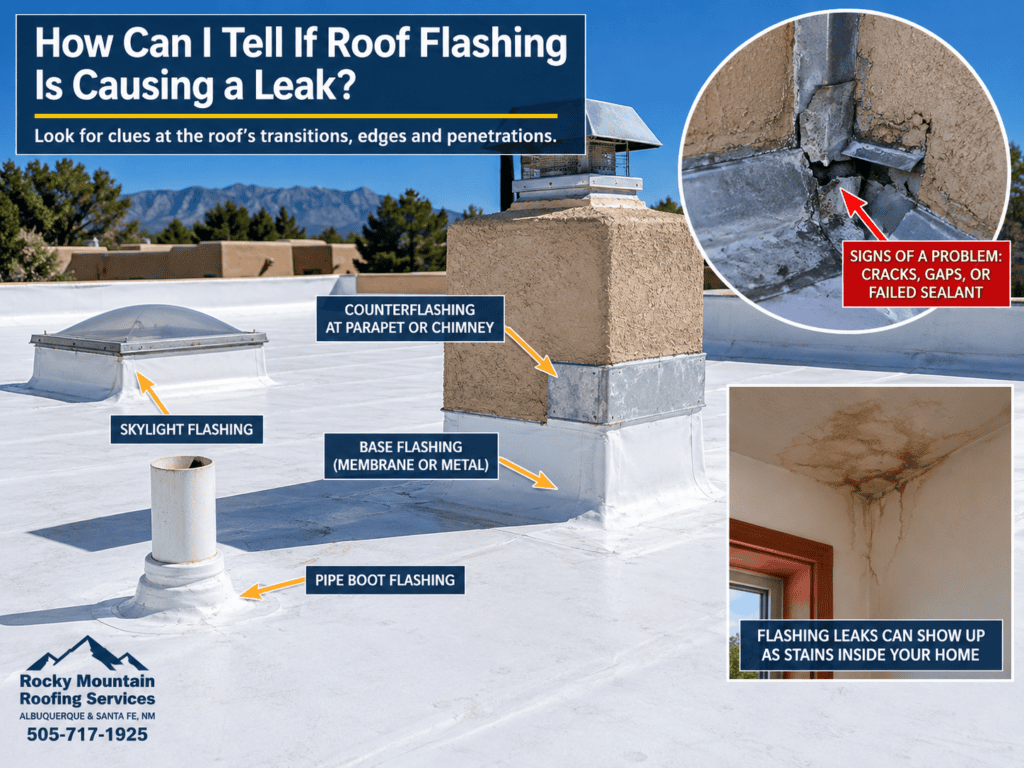
Roof flashing is a strong suspect when a leak appears near a place where the roof changes direction, meets a wall, or surrounds a penetration such as a chimney, skylight, plumbing vent, or rooftop HVAC curb. Visible separation, an open lap, cracked or hardened sealant, corrosion, a deteriorated pipe boot, loose metal, or membrane pulling away from a transition can all raise suspicion.
But there is an important difference between finding a clue and finding the actual leak source. Water can enter the roof several feet away, travel beneath roofing materials or along the roof deck, and finally show up indoors near a flashing detail. A ceiling stain below a chimney does not automatically prove the chimney flashing failed. The surrounding roofing, the flashing assembly, nearby drainage, and the likely path of the water all need to be evaluated.
That distinction matters because the correct repair depends on what actually failed. A small, localized flashing problem may be repairable without replacing the roof. A leak that appears to be flashing-related may instead involve deteriorated underlayment, a membrane seam, a damaged skylight, a plumbing vent component, a parapet or wall detail, or moisture that has traveled from another area.
What Roof Flashing Actually Does
Flashing is the material and detailing used to manage water at the roof’s most complicated transitions. The open field of a roof is relatively straightforward. The difficult areas are where that roof has to turn upward, terminate at an edge, meet another material, or fit around something that passes through it.
On a pitched residential roof, flashing may be found along walls and chimneys, around skylights and plumbing vents, in valleys, and at roof edges. On flat and low-slope roofs, flashing is also critical at parapet walls, equipment curbs, drains, scuppers, canales, pipes, expansion joints, and other penetrations.
Rocky Mountain Roofing Services’ Albuquerque roof inspection service evaluates these transition and penetration areas along with the surrounding roof system because the detail only works when all of its components work together.
Start With Location: Where Is the Nearest Flashing Detail?
A useful first question is not simply, “Does the flashing look bad?” Ask instead: “Where is the interior moisture in relation to the nearest roof transition or penetration?” That location can help establish where an inspection should begin.
Walls, Chimneys and Parapets
When a roof meets a vertical wall, water has to be kept from getting behind the roofing system at that change in direction. Pitched roofs may use step flashing and counterflashing. Flat roofs may use membrane base flashing, termination bars, counterflashing, coping, or other system-specific details.
Clues that deserve attention include flashing pulling away from the wall, open joints, failed sealant at a termination, loose counterflashing, corrosion, membrane separation, or staining that becomes worse during wind-driven rain. On New Mexico flat roofs, parapet transitions deserve particular attention because the horizontal roof and vertical wall are exposed to movement, sun, wind, and concentrated water flow.
For a deeper look at this specific condition, see Albuquerque Parapet Wall Roof Leaks: How to Fix Flashing.
Skylights, Plumbing Vents and Other Penetrations
Every opening through a roof has to be integrated with the roofing around it. A plumbing vent on a shingle roof may use a pipe boot or collar. A skylight may use a manufactured flashing system. Other penetrations can require combinations of metal, membrane, sealant, boots, curbs, or specialty flashing.
A cracked rubber boot, separated collar, open edge, displaced flashing piece, failed sealant joint, or deteriorated material around the penetration may provide a path for water. The penetration itself can also be part of the problem, so the inspection should not stop at the first visible crack.
HVAC and Equipment Curbs on Flat Roofs
Commercial and residential flat roofs often contain rooftop mechanical equipment. The roof membrane has to transition from the horizontal roof field up the curb that supports the equipment. That transition may include welded or adhered membrane flashing, termination details, corners, seams, and sealants.
A leak beside an HVAC unit can involve curb flashing, but it can also come from a nearby membrane seam, ponding water, equipment condensation, a drain or another penetration. This is a good example of why location raises suspicion but does not establish proof.
Roof Edges, Valleys, Drains, Scuppers and Canales
Not all flashing is wrapped around an obvious object. Roof edges, valleys and drainage transitions also depend on correctly integrated materials. On New Mexico flat roofs, scuppers and canales move water through or beyond parapet walls. A drainage restriction can also back water up against flashing that normally performs well under ordinary flow.
The broader common flat roof problems in New Mexico include ponding, drainage issues, flashing failures, membrane damage and movement at roof transitions.
Signs That Make Flashing a Stronger Suspect
No single symptom confirms a flashing leak, but several clues together can move flashing higher on the list. The strongest pattern is usually a leak that repeatedly appears near a transition or penetration and changes with weather conditions.
| Leak location or clue | Why flashing may be involved | What else should be ruled out |
| Below a chimney or roof-to-wall transition | Step flashing, counterflashing, wall termination, or adjacent sealant may be open or displaced. | Masonry, stucco, siding, underlayment, shingles, or water entering higher on the roof. |
| Near a skylight | Flashing around the skylight may be separated, damaged, or poorly integrated with the roofing. | Skylight frame/glazing problem, condensation, nearby roofing or upslope water travel. |
| Near a plumbing vent | Pipe boot, collar, flashing flange, sealant, or surrounding roofing may be deteriorated. | Pipe/plumbing issue, nearby shingle or membrane damage, water entering upslope. |
| Beside an HVAC curb | Curb flashing, corners, seams, or termination details may have failed. | Equipment condensation, mechanical drain issue, ponding, membrane seam, or another penetration. |
| Along a parapet or exterior wall | Base flashing, counterflashing, termination, coping, or membrane transition may admit water. | Stucco/wall-envelope defect, coping joint, drainage backup, or water traveling inside the wall. |
| Only during wind-driven rain | Wind can push water into an open lap, joint, termination, or poorly protected transition. | Wall/window leakage or another weather-facing building-envelope defect. |
A Visible Flashing Defect Is Evidence – Not Proof
This is one of the most important rules in roof-leak diagnosis. A cracked bead of sealant, a rust spot, or a lifted piece of metal deserves attention, but it should not automatically be labeled the leak source.
The National Roofing Contractors Association’s current roof-leak investigation guidance emphasizes verifying the leakage path before deciding where repairs are required. Unsuccessful “repairs” often happen when a visible condition is patched without confirming how water is actually entering the building.
A practical way to think about the evidence is in three levels:
Suspicion: The leak appears near a flashing detail, penetration, wall, curb, edge, or other transition, or it occurs during a weather pattern that can challenge that detail.
Physical evidence: Inspection finds an open lap, separated membrane, deteriorated boot, displaced flashing, loose termination, corrosion, crack, failed sealant, or another plausible opening.
Confirmation: The inspection establishes a credible water path from the exterior condition to the interior symptom. When the source is not obvious, controlled testing or moisture investigation may be needed.
How Flashing Problems Differ by Roof Type
“Flashing repair” is not one universal procedure. The materials and water-shedding strategy change with the roofing system.
Asphalt Shingle Roofs
Shingle roofs may use step flashing where a sloped roof meets a wall, counterflashing at masonry, apron or head flashing around certain features, pipe boots at plumbing vents, and manufactured flashing kits around skylights. The flashing has to work with the shingle courses and underlayment so water continues moving downslope instead of behind the roof covering.
Tile Roofs
Tile is the visible roof covering, but the water-management system also depends heavily on the underlayment and properly integrated flashing beneath and around the tiles. A leak near a wall, chimney or penetration may require inspecting more than the visible metal. Broken tiles, displaced components or deteriorated underlayment can contribute to the same symptom.
Flat, TPO/PVC and Coated or Foam Roofs
Low-slope roofs rely on membrane or coating continuity at curbs, parapets, pipes, drains, scuppers, canales and other transitions. Manufacturer details can specify how flashings, seams, terminations and corners are constructed. Carlisle’s current inspection guidance for TPO, PVC and EPDM systems, for example, specifically calls for inspection of penetrations, curbs, drains, seams, securement and terminations.
On these roofs, a problem may involve a membrane flashing seam, a corner, a termination bar, a penetration pocket, a curb detail, an adjacent roof seam, or moisture already present beneath the system. The surrounding roof field matters as much as the visible flashing.
Metal Roofs
Metal roofs use formed flashings and transition pieces around penetrations, walls, edges, ridges and other details. Fasteners, sealants, panel movement and the geometry of the flashing all matter. Because metal expands and contracts with temperature changes, a repair has to account for movement rather than simply immobilizing a joint with a surface patch.
What Can Look Like a Flashing Leak but Is Not?
The closer an interior stain is to a flashing detail, the easier it is to assume that detail failed. Several other conditions can create the same appearance.
Water can enter through damaged roofing upslope and travel beneath shingles or along underlayment. On a flat roof, it can move within insulation, along deck flutes, or beneath a membrane before reaching an interior opening. A wall or stucco defect can send water behind a parapet. A skylight can develop condensation. Rooftop HVAC equipment can produce moisture. Plumbing can leak. Drainage backup can expose a transition to water levels it does not normally see.
This is why a good roof-leak investigation works outward from the symptom rather than jumping directly to a patch.
Why the Interior Water Stain May Be Away From the Entry Point
Water follows gravity, but it also follows surfaces. After it passes the exterior weather barrier, it may run along framing, roof decking, insulation, fasteners, pipes, membrane layers, or other building components before it reaches the ceiling or wall where you finally see it.
NRCA guidance specifically warns that the point where water drips indoors may not be directly below the roof entry point. On low-slope roofs, investigators may need to examine areas higher than the location directly above the interior leak.
That explains a frustrating situation many property owners encounter: a roofer patches the spot directly above the ceiling stain, the next storm arrives, and the leak returns. The patch may have been placed where the water exited the roof assembly rather than where it entered.
What Should a Professional Flashing-Leak Inspection Include?
A flashing inspection should be part of a broader leak investigation, not a quick glance at one bead of caulk. The exact process varies by roof type and building, but the evaluation should connect the interior symptom to the exterior roof geometry.
Important areas include the flashing itself, adjacent shingles or tile, underlayment where accessible, membrane seams, corners, boots, collars, curbs, termination bars, counterflashing, coping, sealant joints, drainage, previous repairs and the roof surface upslope from the leak.
For Albuquerque properties, a professional roof inspection can document the condition of penetrations, transitions, drainage and the surrounding roof. Rocky Mountain Roofing Services also provides Santa Fe roof inspections for residential and commercial properties.
Roof inspection is hazardous work. Wet surfaces, steep slopes, fragile tile, skylights, electrical equipment, high winds and deteriorated decking can all create fall or injury hazards. Property owners can safely document when and where a leak appears from inside the building, but rooftop diagnosis is best left to qualified roofing professionals.
Can Failed Flashing Be Repaired Without Replacing the Roof?
Often, yes – if the flashing problem is localized and the surrounding roofing system remains serviceable. A repair may involve rebuilding or replacing the failed flashing detail, repairing adjacent roofing, correcting a termination, or restoring a compatible membrane transition.
Replacement becomes a broader discussion when the problem extends beyond one detail. Wet insulation or decking, widespread membrane deterioration, failing underlayment, repeated repairs, extensive corrosion, multiple leaking transitions, or a roof near the end of its useful service life can change the economics and scope of the work.
The same condition-based approach applies to other roofing systems. For example, RMRS explains in its TPO repair-versus-replacement guide that localized damage can sometimes be repaired while broader deterioration or moisture can make replacement more appropriate.
The presence of a flashing leak by itself is not a reason to assume the whole roof needs replacement.
Why New Mexico Conditions Matter
Albuquerque and Santa Fe roofs operate in a demanding environment. Intense sun and UV exposure, high elevation, large temperature swings, wind, monsoon storms, hail, and colder freeze-thaw conditions at higher elevations can all add stress to roofing materials and transition details over time.
Different materials also move at different rates. Metal flashing, roofing membranes, sealants, masonry, wood decking, foam, tile assemblies and structural components do not expand and contract identically. Repeated movement can expose weaknesses at joints, corners and terminations.
That does not mean New Mexico weather automatically caused a flashing leak. It means climate and roof design should be part of the diagnosis. A flashing detail on a Santa Fe tile roof, an Albuquerque shingle roof and a commercial TPO roof may all fail differently even when the interior symptom looks similar.
What Should You Do If You Suspect Flashing Is Leaking?
Start by documenting the symptom from a safe location. Note where the stain or drip appears, when it happens, whether wind direction or rain intensity changes it, and whether the problem occurs only during storms or continues afterward. Photographs of the interior condition can be useful.
Avoid climbing onto a wet or unfamiliar roof to investigate the flashing yourself. Also avoid assuming that adding another layer of caulk or roofing cement will solve the problem. Surface sealant can be appropriate in some designed details, but it is not a universal substitute for correctly integrated flashing.
If the leak is active or recurring, Rocky Mountain Roofing Services provides roof leak repair in Albuquerque and evaluates residential and commercial roof systems throughout its New Mexico service area. The goal is to identify the actual water-entry path before deciding whether the solution is localized flashing repair, a related roof repair, or a broader roofing project.
Frequently Asked Questions
What are the most common signs of leaking roof flashing?
Common clues include water appearing near a wall, chimney, skylight, vent, curb or other transition; open or separated flashing; loose counterflashing; deteriorated pipe boots; corrosion; cracked or failed sealant; open membrane laps; and leakage that becomes worse during heavy or wind-driven rain. These signs raise suspicion but do not confirm the source by themselves.
Can roof flashing leak even if it looks intact?
Yes. Some failures are concealed beneath roofing, counterflashing, tile, membrane layers or wall finishes. Water may also enter somewhere else and emerge near flashing that appears to be the problem. A visual inspection of the exposed surface is only one part of leak diagnosis.
Does rust on roof flashing mean it is leaking?
Not necessarily. Corrosion can indicate aging or material deterioration, but the flashing may not yet have an opening that allows water through. Significant corrosion, holes, failed joints or loss of material deserve professional evaluation, especially when they align with an active leak.
Can old or cracked sealant cause a flashing leak?
It can, depending on how the flashing detail was designed. Sealant may be an important part of some terminations and joints. However, repeatedly covering a failed flashing assembly with surface caulk does not correct poor integration, an open lap, damaged membrane, deteriorated underlayment or another underlying defect.
Why does my roof leak around flashing only during heavy or wind-driven rain?
Heavy rain can increase water volume around a transition, while wind can push rain toward joints and vertical surfaces from directions that ordinary rainfall does not. The pattern can be an important diagnostic clue, but walls, windows, coping, siding and other building-envelope components may also admit wind-driven water.
Can flashing be repaired without replacing the roof?
Yes, many flashing problems can be repaired when the failure is localized and the surrounding roofing remains in serviceable condition. If moisture or deterioration extends well beyond the flashing, a larger repair or replacement may be more practical. Inspection should determine the scope before the decision is made.
Should I call a roofer if I suspect flashing failure?
A roofing professional is appropriate when the suspected source involves the roof covering, flashing, roof penetration, parapet, curb, drainage detail or another roofing transition. If the investigation points to plumbing, HVAC, masonry, stucco, windows or another building system, the roofer may recommend coordinating with the appropriate trade.
Schedule a Roof Leak Inspection in Albuquerque or Santa Fe
A leak near flashing does not automatically mean the flashing is the confirmed source – and it does not automatically mean you need a new roof. The useful question is where the water is entering and what condition allowed it to get there.
Rocky Mountain Roofing Services provides residential and commercial roof inspections, leak detection, roof repair, flashing repair and preventative maintenance throughout Albuquerque, Santa Fe and surrounding New Mexico communities. The company works with flat roofs, TPO and PVC systems, foam roofing, metal roofs, asphalt shingles and tile roofing.
If water is showing up near a wall, chimney, skylight, vent, parapet, equipment curb or another roof transition, call Rocky Mountain Roofing Services at 505-717-1925 to schedule a professional roof inspection and leak evaluation.
You can also request a roofing quote online.
External Sources Used & Why They Matter
National Roofing Contractors Association (NRCA) – How to Investigate a Roof Leak (2026). Used for the leak-investigation principle that the actual leakage path should be verified before repair and that the interior drip location may not identify the exterior entry point.
NRCA: How to Investigate a Roof Leak
GAF – Understanding Roof Flashing: Essential Protection for Every Home (2026), plus GAF roof-damage guidance. Used for current manufacturer descriptions of flashing locations at walls, chimneys, vents, skylights and roof edges. The article does not use GAF’s percentage claim about how many leaks occur at flashing because that statistic is not necessary to answer the reader’s question.
GAF: Understanding Roof Flashing
Carlisle SynTec Systems – current low-slope inspection and TPO curb-flashing documentation. Used to verify that penetrations, curbs, drains, seams, securement and terminations are distinct inspection points on TPO/PVC/EPDM roof systems.