
Why Is My Roof Leaking Around a Plumbing Vent Pipe?
Rocky Mountain Roofing Services | Albuquerque & Santa Fe, New Mexico
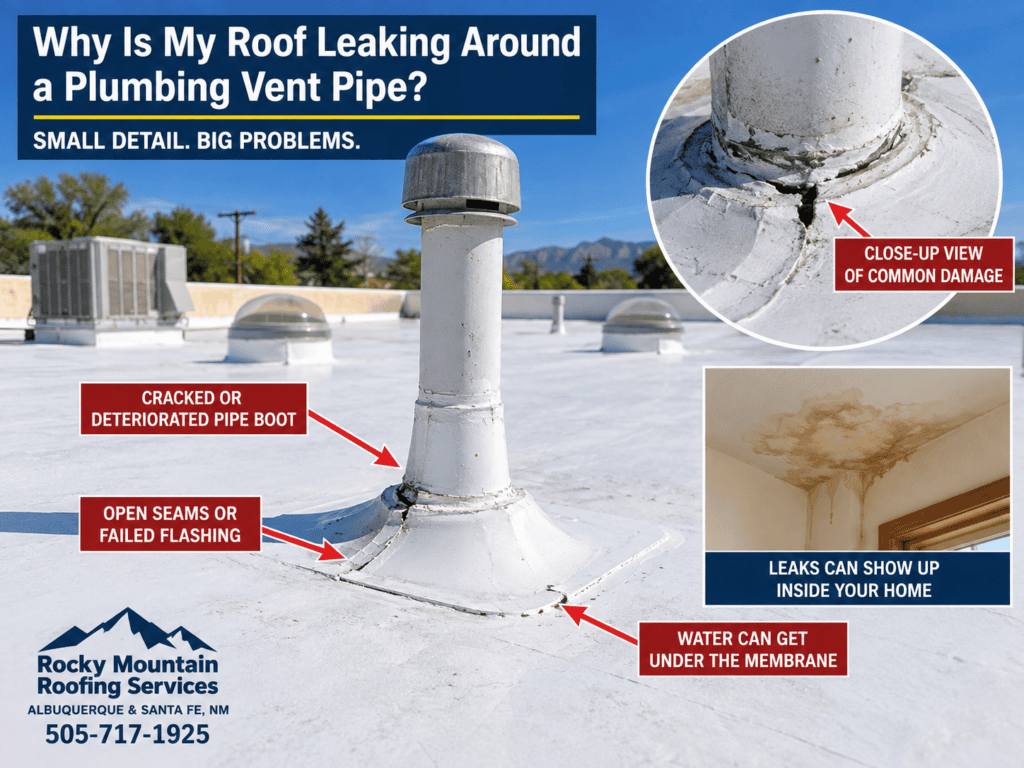
| Direct answer: A roof leak near a plumbing vent pipe usually means water is getting past the weatherproofing where the pipe penetrates the roof—not that the plumbing vent itself is necessarily leaking. On a shingle roof, the problem may involve a cracked pipe boot, collar, flashing flange, or surrounding shingles. On a flat or membrane roof, the leak may involve a system-specific pipe flashing, seal, termination, seam, coating, or nearby membrane. The stain inside is an important clue, but water can travel before it appears, so the vent area and the surrounding roof should be inspected before the cause is assumed. |
A plumbing vent pipe has to pass through the roof, which makes the area around it a natural inspection point when water appears on a ceiling or wall. The important distinction is that the pipe and the roof flashing around the pipe perform different jobs. The plumbing vent serves the drainage system. The roofing detail around that pipe is what keeps rainwater from entering the roof assembly.
That distinction matters because a quick patch of caulk around a pipe is not a reliable diagnosis. The actual entry point may be a deteriorated collar, a flashing flange that is no longer integrated correctly with the roof covering, a membrane detail that has opened, or a defect a short distance upslope. On some roofs, the visible problem is localized and repairable. On others, moisture has affected surrounding roofing materials and the inspection needs to extend beyond the vent.
Why Can a Plumbing Vent Pipe Area Start Leaking?
Every plumbing vent that exits through a roof creates a vertical penetration. That penetration has to be weatherproofed while still allowing the pipe to remain open and functional. The exact detail depends on the roof system.
On asphalt-shingle roofs, a plumbing vent commonly passes through a flanged roof flashing or pipe boot that is integrated with the shingles. A collar or sealing portion fits around the pipe. Oatey, for example, describes roof flashings specifically as components designed to create a watertight seal around plumbing vent-pipe penetrations.
On TPO and other membrane roofs, the penetration is handled differently. Roofing manufacturers publish system-specific details for pre-molded or field-fabricated pipe flashings. Carlisle SynTec, for example, publishes a dedicated TPO pre-molded pipe-flashing detail. This is why a flat-roof vent leak should not automatically be treated as if it were a cracked rubber boot on a shingle roof.
The National Roofing Contractors Association (NRCA) also identifies vertical penetrations such as soil vents as areas that should be checked during leak investigation, including the condition of boots, caulking, clamps, and flashing.
Common Reasons a Roof Leaks Around a Plumbing Vent Pipe
1. A cracked or deteriorated pipe boot or collar
On many shingle roofs, the sealing material around the vent pipe is exposed to sunlight, temperature changes, wind, and weather. If the collar cracks, separates, or no longer seals tightly around the pipe, rainwater may reach the roof opening. A visible crack is meaningful evidence, but it still does not prove that it is the only leak path.
2. The flashing flange is loose, lifted, damaged, or poorly integrated
The flange beneath the pipe collar has to work with the surrounding roof covering. On a shingle roof, water should be directed over the flashing in a way that sheds it downslope. Damage, movement, exposed fasteners, improper layering, or deterioration around the flange can create a path for water.
3. A membrane pipe flashing or termination has failed
Flat and low-slope roofs may use pre-molded pipe flashings, field-fabricated details, clamps, sealants, membrane patches, or other system-specific components. A separation at the base, an open seam, a failed termination, a puncture, or deterioration in the adjacent membrane can allow water into the assembly.
4. The roofing next to the vent is actually the problem
A stain near a plumbing vent does not guarantee the vent flashing is leaking. Damaged shingles, an open membrane seam, cracked coating, puncture, previous repair, or another penetration nearby may be the actual entry point. Water can then travel within the roof assembly before it becomes visible indoors.
5. Ponding or concentrated water is increasing exposure
On a flat roof, water that remains around a pipe penetration can keep the flashing and surrounding membrane wet longer. That does not prove the pipe flashing has failed, but it changes what should be inspected: drainage, low areas, membrane condition, seams, previous repairs, and the penetration detail itself.
What the Timing and Location of the Leak Can Tell You
Symptoms can narrow the investigation, but they should not be treated as a final diagnosis. A useful first question is: when does the moisture appear?
| What you notice | What it may suggest | What should be checked |
| Stain grows after ordinary rain | Weather entry near the vent or another roof defect | Pipe boot/flashing, surrounding shingles or membrane, nearby penetrations and upslope roof area |
| Leak is worse with wind-driven rain | Water may be reaching a vulnerable flashing edge, collar, seam, termination, or nearby detail | All sides of the penetration, flashing laps/terminations, adjacent roof covering and other wind-exposed details |
| Water appears on a flat roof around the vent after storms | Drainage or ponding may be increasing exposure | Pipe flashing plus slope, drains/scuppers, low areas, membrane seams and coating condition |
| Moisture appears even without rain | The source may not be roof weatherproofing | Plumbing, condensation, or another interior/mechanical source may need to be ruled out |
| Ceiling stain is offset from the vent location | Water may have traveled before dripping inside | Vent penetration first, then surrounding and upslope roof areas; attic/deck conditions where safely accessible |
Why the Ceiling Stain May Not Be Directly Below the Leak
Water does not always move straight down from the first opening it finds. NRCA leak-investigation guidance notes that roof leaks may not be directly above the interior drip. Water can travel within a roof system or along the deck before it reaches a point where it can enter the building.
That is why a brown ring near a bathroom or a stain close to a plumbing stack should be treated as a starting point—not a map pin. The vent flashing deserves close attention, but if that detail is sound, the inspection should expand to nearby roof transitions, penetrations, seams, fasteners, previous repairs, and higher roof areas that could feed water toward the same interior location.
How a Professional Roof Inspection Tracks Down a Vent-Pipe Leak
A useful inspection should identify both the visible defect and the path that water could take. Rocky Mountain Roofing Services lists pipe flashings, roof penetrations, flashing repair, leak detection, and roof inspections among its roofing capabilities. Its Albuquerque inspection information also specifically calls out pipe boots, vent collars, roof penetrations, and the fact that interior leak locations may not match the exterior entry point.
Identify the roof system. A shingle pipe boot, tile-roof penetration, foam/coating detail, and TPO pipe flashing should not be evaluated as if they are the same assembly.
Inspect the pipe-to-flashing connection. Look for deterioration, separation, cracks, inadequate clamping or termination, movement, and other visible weaknesses appropriate to that system.
Inspect the flashing-to-roof connection. The base or flange has to remain integrated with the surrounding shingles, membrane, coating, or other roof covering.
Expand the search around and upslope from the vent. Nearby seams, punctures, flashing, prior patches, roof transitions, and drainage conditions may explain a stain that appears to be centered on the pipe.
Consider non-roof sources when the pattern does not fit rainfall. If moisture continues during dry weather and the roof penetration appears watertight, plumbing or condensation should be considered rather than repeatedly patching the roof.
Is the Vent-Pipe Leak Usually Repairable Without Replacing the Roof?
Often, a localized penetration problem can be repaired without replacing the entire roof—but only if the surrounding roofing system remains serviceable and the leak has not revealed a broader problem. A deteriorated pipe boot on an otherwise sound shingle roof is a different situation from a vent penetration surrounded by widespread underlayment failure, deteriorated membrane, wet insulation, or repeated repairs.
The repair decision should be based on the condition of the penetration detail and the roof around it. On membrane roofs, the installed system also matters because the repair should be compatible with that roofing material and its current detailing requirements. A small visible opening should not automatically trigger a full replacement recommendation, but a small opening also should not be assumed to be the entire problem until the surrounding roof has been checked.
Why New Mexico Weather Matters Around Roof Penetrations
Albuquerque, Santa Fe, and surrounding New Mexico communities put roof details through a wide range of conditions. Intense UV exposure, high elevation, large temperature swings, wind, monsoon rain, hail, and—especially around Santa Fe and higher elevations—freeze-thaw cycles can all add stress to roofing materials over time. The effect depends on the roof system and the specific material at the penetration.
The local point is not that New Mexico weather automatically caused the leak. It is that pipe collars, sealants, flashings, membranes, coatings, and surrounding roofing should be evaluated in the context of the conditions they have actually been exposed to. Flat and low-slope roofs are also common throughout the region, so an accurate diagnosis cannot assume that every plumbing vent uses the same shingle-style pipe boot.
What Can You Safely Check Before Calling a Roofer?
Start with observations that do not require unsafe roof access. Note whether the stain appears only after rain, whether wind direction seems to matter, whether the stain is growing, and whether moisture is present during dry weather. If an attic or interior access point can be viewed safely, note the location of visible moisture without touching electrical components or climbing into unsafe areas.
Avoid walking on a wet, steep, fragile, unfamiliar, or otherwise unsafe roof. A vent-pipe leak is a diagnosis problem first. The goal is to find the actual entry path before deciding what should be sealed, flashed, repaired, or replaced.
Frequently Asked Questions
Does a cracked plumbing vent boot always mean it is leaking?
No. A crack or separation can be an important warning sign, but the leak may also be entering at the flashing flange, surrounding roofing, an adjacent penetration, or an upslope defect. The visible condition should be evaluated in the context of the entire leak path.
Can rain going down the open plumbing vent cause a roof leak?
The open top of a plumbing vent is part of the plumbing drainage and vent system. A roof leak around the vent is usually related to how the roof is weatherproofed around the penetration, not simply to rain entering the top of the pipe. If moisture occurs without rain, plumbing or condensation sources may also need evaluation.
Can a flat roof leak around a plumbing vent pipe?
Yes. Flat and low-slope roofs have plumbing vent penetrations too, but the flashing detail may be a membrane-specific pipe flashing rather than the boot-and-flange assembly commonly seen on shingle roofs. The surrounding membrane, seams, coating, drainage, and penetration termination should all be considered.
Why is the ceiling stain several feet away from the vent pipe?
Water can travel along decking or within parts of the roof assembly before it drips into the interior. The stain location helps narrow the search, but it does not necessarily identify the exact exterior entry point.
Should I call a roofer or a plumber?
If the moisture appears after rain and the suspected area is where the vent passes through the roof, a roofing inspection is a logical first step. If moisture occurs in dry weather or the roof penetration is found to be watertight, a plumbing or condensation source may need to be investigated by the appropriate professional.
Schedule a Roof Leak Inspection in Albuquerque or Santa Fe
If water is showing up near a plumbing vent pipe, the most useful next step is to identify the entry point before adding another patch or assuming the entire roof needs replacement. Rocky Mountain Roofing Services provides residential and commercial roof inspections, leak detection, roof repair, flashing repair, and service for shingle, tile, flat, TPO, foam, metal, and other roofing systems throughout Albuquerque, Santa Fe, and surrounding Central and Northern New Mexico communities.
Rocky Mountain Roofing Services has more than 35 years of combined roofing experience. Call 505-717-1925 to request a roof inspection or leak evaluation.
Related Rocky Mountain Roofing Services Resources
Roof Inspection Albuquerque — How RMRS evaluates penetrations, pipe boots, vent collars, drainage, and leak paths.
Roof Leak Repair Albuquerque — Roof-leak repair information for shingle, tile, flat, foam, and metal roofs.
Roof Leak Repair Santa Fe — Santa Fe leak-repair information, including leaks around vents and pipe boots.
Common Flat Roof Problems in New Mexico — Context for membrane, flashing, penetration, and drainage problems on flat roofs.
Roofing Services — Overview of RMRS residential and commercial roofing services.
Request a Roofing Quote or Inspection — Contact and inspection request page.
External Sources Used & Why They Matter
National Roofing Contractors Association (NRCA) — Leak Investigation Guidance — Supports the discussion of vertical penetrations such as soil vents, deficient boots/caulking/clamps/flashing, and the fact that interior drip locations may not be directly below the roof entry point.
Oatey — No-Calk Roof Flashings — Confirms the purpose of plumbing vent-pipe roof flashing: creating a watertight seal around the roof penetration. Product details are used only to explain the function of this type of flashing, not to prescribe a repair for an unknown roof.
Carlisle SynTec — U-8A TPO Pre-Molded Pipe Flashing — Demonstrates that TPO roofs use system-specific pipe-flashing details, supporting the article’s distinction between membrane-roof penetrations and conventional shingle pipe boots.