What Is a TPO Roof? Is It Good for New Mexico Buildings?
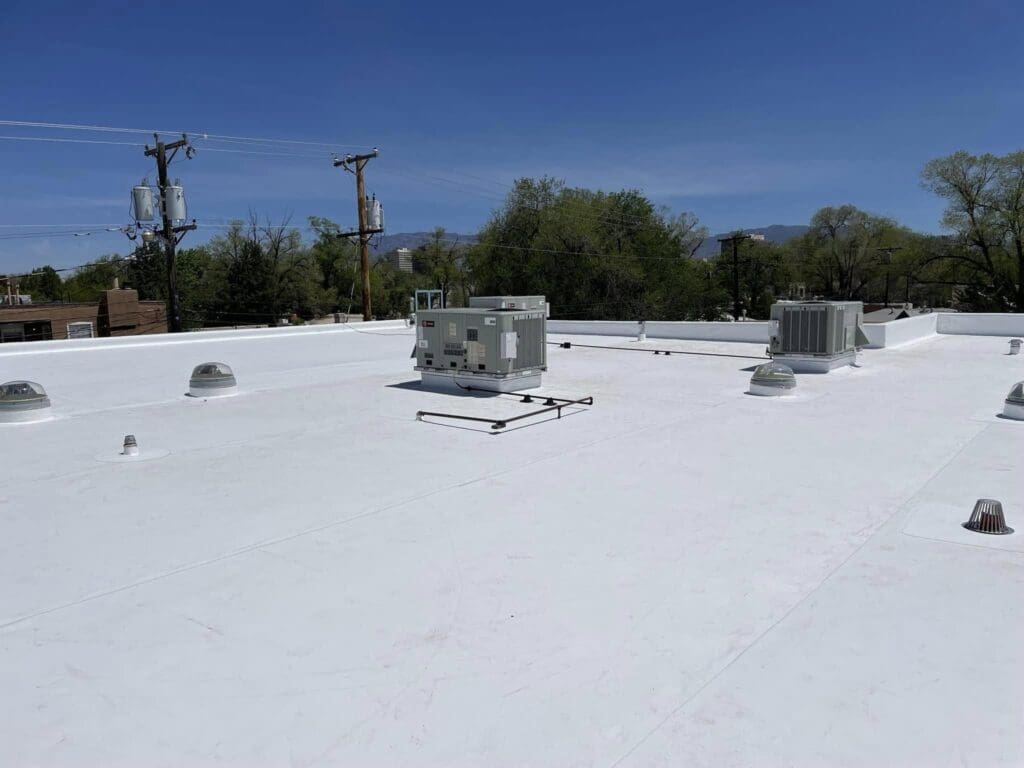
TPO, or thermoplastic polyolefin, is a single-ply roofing membrane commonly used on flat and low-slope roofs. It can be a good option for many New Mexico commercial buildings and some homes because reflective TPO surfaces and heat-welded seams suit many applications. However, proper installation, drainage, insulation, flashing, maintenance, and the condition of the building all play important roles in how well a TPO roof performs.
For property owners in Albuquerque, Santa Fe, and other parts of New Mexico, choosing a roofing system involves more than comparing materials. Intense sunlight, high elevation, hail, strong winds, monsoon storms, large temperature swings, and freeze-thaw conditions can all affect a roof over time.
Rocky Mountain Roofing Services installs and services TPO and other flat roofing systems for residential and commercial properties throughout Central and Northern New Mexico. Understanding what TPO is—and what it is not—can help property owners decide whether it deserves consideration for their building.
What Is a TPO Roof?
A TPO roof is a roofing system that uses a flexible thermoplastic membrane to create a weather-resistant surface over a flat or low-slope roof.
Unlike built-up roofing systems that use multiple layers of asphalt and reinforcing materials, TPO is classified as a single-ply roofing membrane. Large sheets of membrane cover the roof, with adjoining sections joined together to form the finished roofing surface.
One of the most important features of TPO is the way the seams are joined. Rather than simply overlapping the sheets and relying exclusively on adhesives, properly installed TPO membrane seams are typically heat-welded together.
Specialized equipment heats the adjoining membrane surfaces so they fuse together. Once properly welded, the seam becomes an integral part of the roofing system.
TPO roofing is especially common on:
- Warehouses
- Retail buildings
- Office buildings
- Churches
- Multifamily properties
- Industrial facilities
- Schools and institutional buildings
- Other structures with flat or low-slope roofs
TPO can also be appropriate for certain residential applications, particularly New Mexico homes incorporating flat or low-slope sections into Southwestern architectural designs.
However, TPO should not automatically be considered the best material for every flat roof. The existing roof, deck, insulation, drainage system, roof configuration, building use, rooftop equipment, and environmental exposure should all be evaluated before selecting a roofing system.
What Does TPO Stand For?
TPO stands for thermoplastic polyolefin.
The name refers to the type of thermoplastic membrane used to create the roofing surface.
TPO roofing membranes are manufactured specifically for roofing applications and are available in different products, thicknesses, reinforcement configurations, and system designs.
Property owners should therefore avoid assuming that every TPO roof is identical. The membrane is only one part of the complete roofing assembly.
The manufacturer, product specifications, installation method, insulation system, attachment, flashing details, roof deck, drainage, and quality of workmanship can all influence long-term performance.
How Is a TPO Roof Constructed?
A properly designed TPO roof is more than a white membrane stretched across a building.
A typical system may include several components:
Roof deck or substrate:
The structural surface supporting the roofing assembly.
Insulation:
Roof insulation can improve the building’s thermal performance and may also contribute to the overall design of the roofing assembly.
Cover board:
Depending on the roof design, a cover board may be installed above the insulation to provide a more stable surface and additional protection beneath the membrane.
TPO membrane:
The single-ply membrane creates the primary weather-resistant roofing surface.
Attachment system:
Depending on the roofing design, TPO may be mechanically attached, adhered, or installed using another manufacturer-approved system.
Heat-welded seams:
Adjacent sheets of TPO membrane are joined to create continuous seams.
Flashing:
Special detailing is required around walls, parapets, drains, curbs, vents, pipes, HVAC equipment, skylights, and other roof penetrations.
Drainage system:
Drains, scuppers, gutters, downspouts, roof slope, and other drainage components help move water away from the roof.
Each part matters.
A high-quality membrane cannot compensate indefinitely for poor drainage, improperly installed flashing, inadequate attachment, damaged insulation, or installation errors.
TPO Roofing at a Glance
| Feature | What Property Owners Should Know |
| Roofing type | Single-ply thermoplastic membrane |
| Typical roof | Flat and low-slope roofs |
| Common applications | Commercial buildings and some residential low-slope roofs |
| Seam construction | Heat-welded |
| Common appearance | Often white or another reflective color |
| Insulation | Can be incorporated into the roofing assembly |
| Repairs | Localized compatible repairs may be possible depending on roof condition |
| Drainage | Proper drainage remains essential |
| Maintenance | Regular inspections and preventative maintenance are recommended |
| New Mexico suitability | Can be a strong option when properly designed for the building and local conditions |
Why Is TPO Common on Commercial Buildings?
Walk through a commercial district in Albuquerque or Santa Fe and many of the large, light-colored flat roofs you see may use a single-ply roofing system such as TPO.
There are practical reasons for its popularity.
Commercial buildings often have large roof areas with relatively low slopes. TPO membrane can cover these areas efficiently while providing a continuous weather-resistant surface.
Its light-colored and reflective surface options are also attractive in sunny climates.
Commercial roofs frequently contain substantial mechanical equipment, however. HVAC units, vents, pipes, electrical equipment, drains, and other penetrations can create numerous areas requiring careful flashing.
Technicians may also need regular roof access to service rooftop equipment.
For this reason, a commercial TPO roof should be viewed as an entire roofing system—not simply as the membrane itself.
Roof layout, penetrations, drainage, attachment, insulation, flashing, walk pads, and future maintenance access all deserve consideration during the design and installation process.
Can TPO Be Used on New Mexico Homes?
Yes. TPO can be used on some residential properties, particularly homes with flat or low-slope roof sections.
This is especially relevant in New Mexico because Southwestern and Pueblo-inspired architecture commonly incorporates lower roof slopes than are typical in many other parts of the country.
A residential property might have:
- An entirely low-slope roof
- A flat addition
- A low-slope patio or porch roof
- A garage with a low-slope roof
- A combination of pitched and flat roof sections
TPO may be considered for some of these applications.
That does not mean TPO should replace shingles, tile, or metal roofing on every home.
Traditional asphalt shingles, tile, and many metal roofing systems are generally associated with pitched roof applications. TPO is primarily designed for appropriate flat and low-slope applications.
The correct material should therefore be chosen according to the roof configuration rather than simply because one material appears attractive on paper.
What Are the Advantages of TPO Roofing?
TPO has several characteristics that make it worth considering for New Mexico properties.
1. Reflective Surface Options
White and other reflective TPO membranes can reflect a portion of incoming solar energy rather than absorbing as much heat at the roof surface.
That can be particularly relevant in Albuquerque and other sunny areas of New Mexico.
A reflective roofing surface can help reduce solar heat absorption at the roof level. However, property owners should be cautious about claims promising a particular reduction in energy bills.
Actual building energy performance depends on many factors, including:
- Roof insulation
- Building design
- HVAC efficiency
- Windows
- Air leakage
- Occupancy
- Roof orientation
- Local weather
- Overall building envelope
Reflectivity is therefore an advantage, but it should be considered as one component of the entire building.
2. Heat-Welded Seams
Seams are critical areas on any membrane roofing system.
TPO allows adjoining membrane sheets to be heat-welded together. When performed correctly, this creates a strong continuous connection between sheets.
Proper seam preparation and workmanship remain essential. A TPO roof is only as dependable as the installation and detailing supporting it.
3. Compatibility With Insulated Roof Assemblies
TPO can be incorporated into roofing assemblies containing insulation and, when appropriate, cover boards.
That gives roofing professionals flexibility when designing a system around a building’s existing conditions and performance objectives.
4. Relatively Lightweight Construction
Single-ply membrane roofing does not require the multiple heavy asphalt layers associated with some traditional built-up roofing assemblies.
Structural requirements still need to be evaluated for the individual property, but TPO’s relatively lightweight membrane is one reason it is widely considered for commercial low-slope roofs.
5. Repairability
Damage does not automatically mean an entire TPO roof must be replaced.
When the membrane and overall roofing system remain serviceable, localized compatible repairs may sometimes address punctures, flashing problems, seam issues, or other isolated damage.
The deciding factor should be the condition of the entire roofing assembly rather than the presence of one leak.
What Are the Disadvantages of TPO Roofing?
TPO also has limitations that property owners should understand.
| TPO Advantage | Corresponding Consideration |
| Reflective surface | Energy performance depends on the entire building |
| Heat-welded seams | Seam quality depends heavily on proper installation |
| Lightweight membrane | Membrane can still be punctured or damaged |
| Large-sheet installation | Penetrations and roof transitions still require careful flashing |
| Repairable in many situations | Not every aging or extensively damaged roof is a good repair candidate |
| Suitable for many flat roofs | Does not correct underlying drainage or structural problems |
| Widely used commercially | Product specifications and warranties vary by manufacturer and system |
One of the biggest misconceptions is that installing a new membrane automatically eliminates every weakness of a flat roof.
It does not.
If the roof has inadequate slope, clogged drainage, deteriorated decking, wet insulation, poorly designed penetrations, or other underlying problems, those conditions must be addressed as part of the roofing project.
Is TPO Good for New Mexico Sun and Heat?
TPO can be a good roofing option in New Mexico’s sunny climate, but the answer requires more than looking at membrane color.
New Mexico receives intense solar exposure, and elevation can increase the amount of ultraviolet radiation roofing materials experience.
A light-colored reflective TPO membrane can help limit solar heat absorption at the roof surface compared with darker roofing surfaces.
However, New Mexico roofs must deal with more than heat.
They experience:
- Intense UV exposure
- Hot summer temperatures
- Large temperature changes between day and night
- High winds
- Hailstorms
- Monsoon rainfall
- Snow in some areas
- Freeze-thaw conditions
- Dry atmospheric conditions
These stresses make material selection, installation quality, flashing, attachment, drainage, and preventative maintenance especially important.
A roofing system should be selected for the complete environment rather than one weather characteristic.
How Does TPO Handle Hail and High Winds?
No responsible roofing contractor should describe a TPO roof as hail-proof or wind-proof.
Hail performance depends on the entire roof assembly.
The size and velocity of the hail, membrane characteristics, substrate, cover board, insulation, age and condition of the roof can all influence how a roofing system responds to a storm.
The same principle applies to wind.
Wind performance involves more than the membrane. Proper attachment, perimeter and corner detailing, roof deck conditions, flashing, installation methods, and the specific roofing assembly all matter.
New Mexico’s high winds make these details particularly important.
After a significant hailstorm or high-wind event, property owners should consider having the roof inspected even when an obvious interior leak has not developed.
Damage caught early may be much easier to address than water intrusion discovered months later.
What Happens When Water Ponds on a TPO Roof?
Installing TPO does not make drainage problems disappear.
Water should be directed toward properly functioning drains, scuppers, gutters, or other drainage components.
Ponding can develop because of:
- Inadequate roof slope
- Clogged drains
- Blocked scuppers
- Compressed insulation
- Roof deck deflection
- Debris
- Poor drainage design
- Changes to the roof caused by equipment or previous repairs
When water repeatedly remains in the same areas, roofing professionals should determine why it is happening rather than simply treating the visible surface.
Covering an underlying drainage problem with another layer of roofing material may leave the real problem unresolved.
Good flat roofing begins with good water management.
What Areas of a TPO Roof Are Most Vulnerable to Leaks?
A roof leak does not necessarily mean that the TPO membrane has failed in the middle of the roof.
Many leaks develop around transitions and penetrations.
Areas requiring particular attention include:
- HVAC curbs
- Roof drains
- Scuppers
- Plumbing vents
- Pipes
- Skylights
- Parapet walls
- Roof edges
- Expansion joints
- Flashing transitions
- Electrical penetrations
- Previous repair locations
Commercial buildings can be especially challenging because rooftop HVAC systems require periodic service.
Technicians, tools, replacement parts, panels, and foot traffic can expose membrane roofs to punctures and other localized damage.
Where frequent access is expected, designated walk pads or other appropriate protective measures can help reduce unnecessary membrane traffic.
Can You Walk on a TPO Roof?
TPO roofs can accommodate necessary service access when the roofing system is designed and maintained appropriately, but they should not be treated like patios or general-purpose walking surfaces.
Unnecessary traffic increases the chance of:
- Punctures
- Cuts
- Abrasion
- Dropped-tool damage
- Damage around penetrations
- Stress near mechanical equipment
Commercial roofs containing HVAC equipment naturally require more service traffic than many residential roofs.
Strategically placed walk pads can help create designated routes to frequently serviced equipment.
Property owners should also communicate with contractors working on rooftop mechanical, electrical, or communications equipment so roof damage can be avoided and any accidental damage can be identified quickly.
How Is a TPO Roof Maintained?
TPO is not maintenance-free.
Preventative maintenance is one of the most important steps property owners can take to protect any commercial or residential flat roofing system.
A sensible maintenance program can include:
- Annual professional roof inspections
- Inspections after major hail or wind events
- Removing roof debris
- Keeping drains and scuppers clear
- Checking seams and flashing
- Inspecting roof penetrations
- Monitoring areas around HVAC equipment
- Checking previous repairs
- Looking for membrane punctures or physical damage
- Addressing localized problems promptly
New Mexico’s weather makes post-storm inspections especially valuable.
A roof may sustain damage without immediately leaking into the building. Identifying the problem before the next monsoon storm, snow event, or freeze-thaw cycle may help prevent more extensive water intrusion.
How Long Does a TPO Roof Last in New Mexico?
There is no responsible single lifespan that applies to every TPO roof.
Long-term performance depends on variables such as:
- Membrane and system specifications
- Installation quality
- Roof drainage
- Insulation
- Roof deck condition
- Flashing
- Building use
- Rooftop traffic
- Storm exposure
- Maintenance
- Timely repairs
New Mexico adds another layer of environmental stress because roofs experience strong UV exposure, heat, wind, hail, monsoon storms, and significant temperature changes.
Property owners who want a more detailed explanation should review Rocky Mountain Roofing Services’ guide to TPO roof lifespan in New Mexico.
Can a TPO Roof Be Repaired?
Yes, many TPO roofs can be repaired when the damage is localized and the surrounding roofing system remains in serviceable condition.
Possible repair situations may include localized membrane damage, punctures, flashing problems, or certain seam-related issues.
However, repeated leaks across multiple locations may indicate a broader problem.
Wet insulation, extensive deterioration, widespread installation defects, chronic drainage problems, or an aging roof nearing the end of its useful service life can change the repair-versus-replacement calculation.
That is why the better question is not simply, “Can TPO be patched?”
It is:
Does repairing this TPO roof make sense given the condition of the complete roofing system?
A professional roof inspection can help answer that question.
TPO vs. PVC: Which Is Better?
TPO and PVC are both single-ply membrane roofing systems commonly associated with commercial and low-slope roofing.
Neither should automatically be declared better for every building.
The right choice can depend on:
- Building use
- Environmental exposure
- Roof configuration
- Chemical or grease exposure
- Existing roofing system
- Drainage
- Insulation
- Project objectives
- Manufacturer requirements
- Long-term maintenance plans
Property owners comparing the two materials should evaluate the entire roof assembly and intended application rather than choosing solely by price or membrane name.
For a detailed comparison, see Rocky Mountain Roofing Services’ guide to TPO vs. PVC roofing.
Is TPO Better Than Spray Foam, Modified Bitumen, or Built-Up Roofing?
Not necessarily.
TPO is one of several roofing systems available for New Mexico flat roofs.
Rocky Mountain Roofing Services works with commercial and flat roofing systems including:
- TPO
- PVC
- Spray polyurethane foam
- Modified bitumen
- Built-up roofing
- Roof coatings
- Metal roofing systems
Each has characteristics that can make it better suited to certain buildings. It only installs TPO, PVC and metal roofing systems.
For example, the condition of an existing roof, number of penetrations, drainage configuration, insulation requirements, rooftop traffic, building use, project objectives, and existing substrate can all influence which roofing system deserves consideration.
Instead of asking, “What is the best roofing material?” without context, property owners should ask:
What roofing system makes the most sense for this particular building?
That distinction can prevent expensive decisions based on generalized recommendations.
Is TPO Better for Commercial Buildings or Homes?
TPO is most closely associated with commercial roofing, but that does not mean it is exclusively commercial.
Commercial TPO Roofing
TPO can be particularly well suited to large, low-slope commercial roof areas such as those found on warehouses, offices, retail properties, churches, multifamily buildings, and industrial facilities.
Commercial projects also frequently benefit from the ability to integrate insulation and specialized drainage, flashing, and rooftop equipment details into the roofing assembly.
Residential TPO Roofing
Residential TPO is more application-specific.
A New Mexico home with a true flat or low-slope roof may be a legitimate candidate. TPO may also be considered for low-slope additions, garages, or other appropriate roof sections.
However, a conventional pitched roof may be better suited to another material such as shingles, tile, or metal.
The architecture and slope should guide material selection.
How Do You Know Whether TPO Is Right for Your Property?
Start with the roof—not the roofing product.
Before recommending TPO, an experienced roofing professional should evaluate factors such as:
- Roof slope and drainage — Does water move effectively toward drains or scuppers?
- Existing roofing system — What material is currently installed and what condition is it in?
- Roof deck or substrate — Is it structurally sound?
- Moisture — Is water trapped within the existing roofing assembly?
- Insulation — What is installed and what condition is it in?
- Penetrations — How many HVAC units, vents, pipes, skylights, and other penetrations are present?
- Rooftop traffic — Will technicians regularly access mechanical equipment?
- Exposure — How much sun, wind, hail, snow, and storm exposure does the property receive?
- Building use — Residential, retail, industrial, office, multifamily, and other buildings can have different roofing demands.
- Long-term goals — Is the owner planning to keep the property long-term, improve the roofing assembly, address chronic leaks, or replace an aging system?
Only after evaluating those factors does it make sense to compare TPO with other flat roofing systems.
Frequently Asked Questions About TPO Roofing in New Mexico
Is TPO roofing good for Albuquerque?
TPO can be a strong option for many Albuquerque flat and low-slope roofs. Reflective membrane options can be advantageous under intense sunshine, while heat-welded seams provide a continuous roofing surface. Proper installation, drainage, attachment, flashing, and maintenance remain critical because Albuquerque roofs also face UV exposure, wind, hail, monsoon storms, and large temperature swings.
Is TPO roofing good for Santa Fe?
TPO may also work well for appropriate Santa Fe properties, but local conditions need to be considered. In addition to strong UV exposure and temperature changes, Santa Fe and higher-elevation areas can experience colder winter temperatures, snow, and freeze-thaw cycles. The complete roof assembly should be designed for the property and location.
Is TPO only for commercial buildings?
No. TPO is strongly associated with commercial flat roofing, but it can also be used on certain residential flat and low-slope roofs.
What is a TPO roof made of?
The visible roofing surface is a thermoplastic polyolefin membrane designed for roofing applications. The complete roofing assembly may also contain insulation, cover board, attachment components, flashing, drainage components, and the underlying roof deck.
Are TPO seams glued together?
TPO is known for heat-welded seams. Specialized equipment heats adjoining membrane surfaces so they can be fused together.
Does white TPO keep a building cooler?
A reflective white roof surface can reduce solar heat absorption at the roof surface. The effect on indoor temperatures or utility costs depends on insulation, HVAC performance, building design, occupancy, and other factors.
Is TPO hail-proof?
No roofing system should be considered hail-proof. Hail performance depends on the membrane, substrate or cover board, insulation, age, installation, storm severity, and complete roofing assembly.
Can high winds damage TPO?
Strong winds can damage roofing systems when attachment, perimeter details, flashing, deck conditions, or other components are compromised. Wind performance should be considered as part of the complete roofing assembly.
Does ponding water mean a TPO roof has failed?
Not necessarily. Ponding can result from inadequate slope, clogged drainage, compressed insulation, structural deflection, or other conditions. The cause should be diagnosed rather than assuming the membrane itself is responsible.
Does TPO require insulation underneath it?
TPO roofing is commonly installed as part of an assembly that includes insulation, but the exact design depends on the building, existing roof, code requirements, manufacturer specifications, and project objectives.
Can a TPO roof be repaired instead of replaced?
Often, yes. Localized damage may be repairable when the surrounding roofing system remains in acceptable condition. Widespread deterioration, trapped moisture, recurring failures, or other major problems can make replacement a better long-term solution.
How often should a TPO roof be inspected?
Rocky Mountain Roofing Services recommends annual roof inspections along with inspections following significant storms. Drains, flashing, penetrations, seams, membrane condition, rooftop equipment areas, and previous repairs should receive particular attention.
Is TPO the best flat roof for New Mexico?
It can be an excellent option for some properties, but there is no single flat roofing material that is automatically best for every New Mexico building. TPO, PVC, spray foam, modified bitumen, built-up roofing, coatings, and other systems should be evaluated according to the property.
Should You Install a TPO Roof on Your New Mexico Property?
TPO deserves serious consideration for many flat and low-slope roofs in New Mexico.
Its reflective surface options, heat-welded seams, relatively lightweight membrane, compatibility with insulated roofing assemblies, and widespread commercial use make it an important option for property owners to understand.
But the roofing material is only part of the equation.
New Mexico roofs face an unusually demanding combination of intense UV exposure, high elevation, strong winds, hail, monsoon storms, large daily temperature changes, and—in Santa Fe and other higher-elevation areas—snow and freeze-thaw conditions.
A TPO roof therefore performs best when the entire roofing system is properly evaluated, designed, installed, drained, flashed, protected, and maintained.
For commercial buildings, TPO can be an excellent candidate for large low-slope roof areas. For homes, it can make sense when the architecture includes an appropriate flat or low-slope roof.
The decision should ultimately come from the property—not from a one-size-fits-all recommendation.
Get a Professional TPO Roof Evaluation in Albuquerque or Santa Fe
If you are considering TPO roofing for a home or commercial building in Albuquerque, Santa Fe, or surrounding New Mexico communities, Rocky Mountain Roofing Services can evaluate your existing roofing system and help determine whether TPO is the right choice.
The evaluation should consider the roof deck or substrate, insulation, moisture, drainage, flashing, penetrations, rooftop equipment, existing roofing materials, environmental exposure, and your long-term goals.
With more than 35 years of combined roofing experience, Rocky Mountain Roofing Services provides residential and commercial roofing, TPO roofing, flat roofing, roof repair, roof replacement, inspections, leak detection, and preventative maintenance throughout Central and Northern New Mexico.
Call Rocky Mountain Roofing Services at (505) 717-1925 to request a free roof inspection or free roofing quote.