What Are the Layers on a TPO Roof?
What Are the Layers on a TPO Roof?
A TPO roof is made up of more than the white membrane you see from the outside. A typical TPO roofing system may include a structural roof deck, an air or vapor-control layer when required, roof insulation, tapered insulation where needed for drainage, a cover board, an attachment or adhesive system, and the TPO membrane itself.
Not every TPO roof contains every one of these layers. The exact roof assembly depends on the building, roof deck, insulation requirements, drainage, attachment method, existing roofing materials, manufacturer specifications, and project design.
Understanding those differences is important because a TPO roof can look perfectly normal from the surface while moisture or deterioration is developing underneath the membrane.
Rocky Mountain Roofing Services installs, inspects, repairs, and maintains TPO roofing systems throughout Albuquerque, Santa Fe, and surrounding New Mexico communities. One of the most important parts of evaluating a TPO roof is determining the condition of the entire assembly—not simply looking at the white membrane on top.
What Is a TPO Roofing System?
TPO stands for thermoplastic polyolefin. It is a single-ply roofing membrane commonly used on commercial buildings and other structures with flat or low-slope roofs.
The TPO membrane creates the primary weather-resistant surface of the roof. Sections of membrane are joined together, typically using heat-welded seams, to create a continuous roofing surface.
But the membrane is only one component.
Think of a TPO roof as a layered system. Each component has a different job. The roof deck provides structural support. Insulation improves thermal performance. Tapered insulation can help establish drainage. A cover board may provide additional protection and a stable substrate. Fasteners, plates, or adhesives secure the roofing materials. Finally, the TPO membrane protects the assembly from rain, snow, sunlight, hail, and other weather.
This distinction becomes particularly important when diagnosing a leak.
A puncture may be visible in the membrane, for example, but the real question is whether water has traveled through that opening and reached the insulation or roof deck below.
What Are the Layers of a TPO Roof?
Although assemblies vary, a TPO roofing system can generally be understood from the bottom upward.
| TPO Roof Layer | Primary Purpose | Typical Material or Component | Why It Matters |
| Structural roof deck | Supports the roof assembly | Steel, wood, concrete, or other approved deck | Provides the structural foundation |
| Air/vapor-control layer | Controls air or vapor movement when required | System-specific material | Helps manage moisture in certain assemblies |
| Roof insulation | Provides thermal resistance | Polyiso or another approved insulation | Improves thermal performance |
| Tapered insulation | Establishes or improves drainage slope | Tapered insulation panels | Directs water toward drains and other outlets |
| Cover board | Protects insulation and creates a stable substrate | System-specific cover board | Adds protection beneath the membrane |
| Attachment system | Secures roofing components | Fasteners, plates, or adhesive | Helps hold the roofing system in place |
| TPO membrane | Provides the primary weather surface | Thermoplastic polyolefin | Protects the roof assembly from weather |
Some roofs will have additional components, and some may not require every layer listed here.
1. The Structural Roof Deck
At the bottom of the assembly is the roof deck.
The deck is the structural surface that supports the roofing system. Depending on the building, it may consist of steel, wood, concrete, or another approved material.
Everything above it ultimately depends on the deck being capable of supporting the roofing assembly.
The condition of the roof deck therefore matters when evaluating an older TPO roof. If water has been entering the system for an extended period, moisture may travel through insulation and eventually affect susceptible decking or other building components.
That is one reason a roof leak should not always be judged by the size of an interior ceiling stain.
The visible symptom inside the building may represent only a portion of the moisture problem above it.
2. Air and Vapor-Control Layers
Some TPO assemblies incorporate an air barrier, vapor retarder, or other moisture-control component.
Whether one is appropriate depends on the roof design, building use, climate, deck construction, insulation configuration, and project specifications.
Its purpose is different from the TPO membrane.
The TPO membrane primarily protects the roof from exterior weather. An air or vapor-control layer is intended to help manage the movement of air or water vapor within a particular roof and building assembly.
This is an example of why property owners should avoid assuming that every TPO roof is built exactly the same way.
The appropriate assembly should be determined for the individual building.
3. Roof Insulation
Above the structural components is commonly a layer—or multiple layers—of roof insulation.
Insulation plays an important role in the building’s thermal performance.
The type, thickness, and arrangement of insulation can vary according to the roofing system and project requirements. Polyisocyanurate, commonly called polyiso, is one insulation material that may be used in commercial roofing assemblies, although other approved insulation materials may be specified.
Insulation also becomes important when a TPO roof develops a leak.
Water entering through a puncture, failed seam, flashing defect, or penetration may migrate beneath the membrane and into the insulation.
Once that happens, the visible opening in the membrane is no longer the only concern.
A professional roof inspection may need to determine:
- Where the water entered
- How far the moisture traveled
- Whether insulation has become wet
- Whether the moisture is localized
- Whether the roof deck has been affected
- Whether surrounding roofing materials remain suitable for repair
The membrane can sometimes look relatively normal even when moisture is present underneath it.
4. Tapered Insulation and Roof Drainage
Flat roofs are not supposed to function like perfectly level surfaces.
Water needs a path toward the roof’s designed drainage system.
On some TPO roofs, tapered insulation is used to help create or improve that slope. Instead of maintaining one thickness throughout the roof, tapered insulation changes thickness across an area to help direct water toward drains, scuppers, canales, or other drainage outlets.
This can be particularly important on New Mexico flat roofs.
During the dry season, a minor drainage problem may be easy to overlook. Then a summer monsoon can place a large amount of water on the roof in a short period.
When water cannot drain correctly, ponding water may develop.
Ponding can result from several conditions, including blocked drainage, inadequate slope, settled insulation, structural movement, or other changes within the roof assembly.
Adding another patch or coating over a low area does not necessarily correct the underlying drainage problem.
The cause needs to be identified first.
5. The Cover Board
Depending on the roofing system, a cover board may be installed above the insulation and beneath the TPO membrane.
A cover board can create a more durable and stable surface beneath the membrane and provide additional protection for the insulation.
This layer can be especially valuable on roofs exposed to service traffic or other conditions that place additional stress on the roofing assembly.
Commercial roofs frequently contain HVAC units, vents, electrical equipment, solar components, and other rooftop systems. Service technicians may need to access these areas throughout the year.
Dropped tools, sharp objects, equipment panels, fasteners, or repeated foot traffic can potentially damage a roof.
A cover board does not make a TPO roof immune to damage, but when included in the specified system, it becomes another protective component within the assembly.
Not every TPO roof has the same type of cover board—or a cover board at all. Its use depends on the particular roof design and system requirements.
6. The Attachment System
The different components of a TPO roof must be properly secured.
Depending on the system, TPO roofing may use mechanical attachment, adhesive, or another approved system-specific method.
With a mechanically attached system, approved fasteners and plates are used as part of the attachment process.
With a fully adhered system, compatible adhesive is used to bond the membrane to the prepared substrate.
The attachment method affects more than installation. It is part of how the roof assembly responds to wind and movement.
That matters in New Mexico, where high winds can place considerable stress on roof edges, corners, flashings, and membrane systems.
A roofing contractor evaluating an existing TPO roof should therefore look beyond the surface and consider how the roofing system was constructed and attached.
7. The TPO Membrane
At the top of the assembly is the component most people recognize: the TPO membrane.
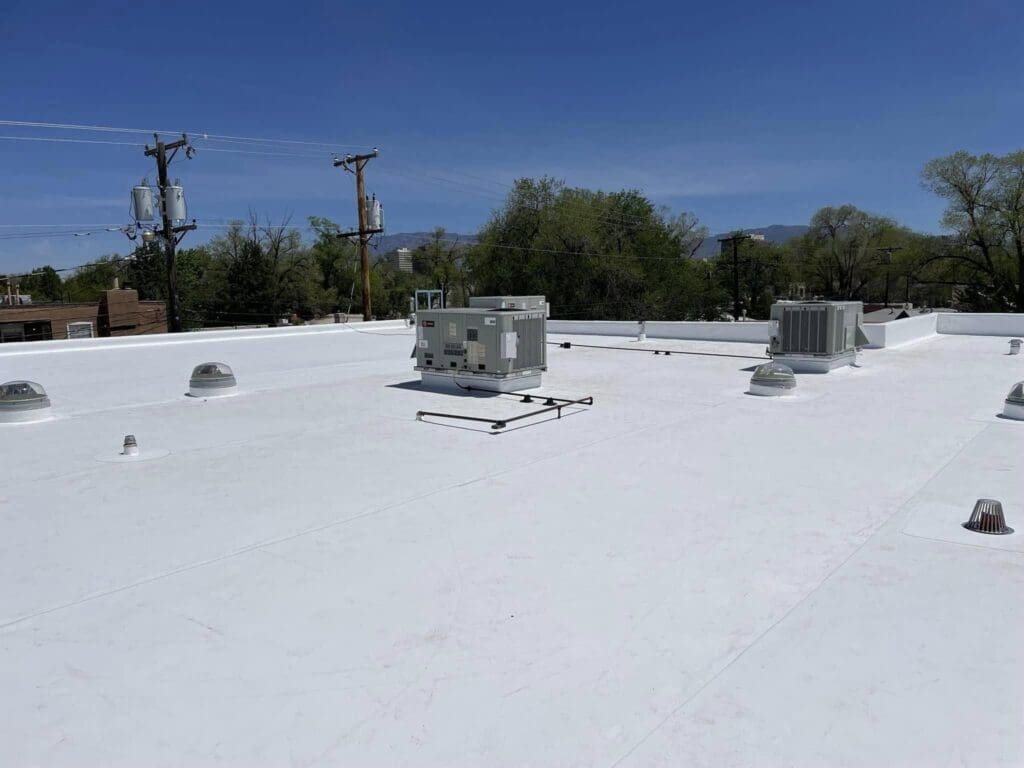
This is the white or light-colored roofing surface commonly seen on commercial flat roofs.
The membrane provides the primary waterproofing and weather surface for the roof assembly.
TPO membrane sheets are joined together to create a continuous surface, with seams typically heat welded. Properly constructed seams are therefore an important part of the roof’s weather protection.
The membrane also has to integrate correctly with:
- Parapet walls
- Roof edges
- Drains
- Scuppers
- Canales
- Pipes
- Vents
- HVAC curbs
- Skylights
- Other roof penetrations
These transitions deserve particular attention during inspections because roofing problems frequently develop where materials meet, change direction, or surround rooftop equipment.
Why TPO Roof Layers Matter in New Mexico
New Mexico’s climate places unusual demands on flat and low-slope roofing systems.
Albuquerque and Santa Fe roofs may experience intense ultraviolet exposure, high roof-surface temperatures, dramatic temperature changes, high winds, hailstorms, monsoon rainfall, and—in higher elevations—snow and freeze-thaw cycles.
The roofing assembly has to perform as a system through all of those conditions.
For example, repeated heating and cooling can cause roofing components to expand and contract. Hail can damage the membrane or other exposed components. Wind can stress roof edges and attachment details. Monsoon rainfall can reveal drainage problems that were not noticeable during months of dry weather.
This is why the condition of the visible TPO surface tells only part of the story.
What Happens If Water Gets Under a TPO Roof?
Water can enter a TPO roofing system through a puncture, open seam, damaged flashing, failed penetration detail, or another defect.
Once beneath the membrane, moisture may move laterally through or around roofing components before becoming visible inside the building.
That means the ceiling stain in an office may not be directly below the original roof opening.
Moisture may also affect insulation before there is an obvious interior leak.
When significant water intrusion is suspected, the objective of a professional inspection is not simply to locate a hole and cover it. The roofing professional should determine what failed and evaluate how much of the surrounding assembly may have been affected.
Depending on the condition and project, this may include evaluating the membrane, seams, flashings, insulation, drainage, penetrations, and roof deck.
Does Wet Insulation Mean the Entire TPO Roof Has to Be Replaced?
Not necessarily.
Localized damage does not automatically mean an entire TPO roofing system needs replacement.
If the source of the leak can be identified, the affected area is limited, surrounding insulation remains dry, and the roof deck and remaining roofing system are stable, a localized repair may sometimes be practical.
The damaged membrane may be opened in a controlled manner, affected materials evaluated, unsuitable insulation replaced as necessary, and the membrane repaired using compatible materials and appropriate procedures.
The situation changes when moisture is widespread.
If large portions of insulation are wet, the deck has deteriorated, multiple leaks are occurring, seams or flashings are failing throughout the roof, or previous repairs repeatedly fail, a broader restoration or replacement strategy may provide better long-term value.
Roof age alone should not make that decision.
The condition of the complete roofing assembly is more important.
Can TPO Be Installed Over an Existing Roof?
In some situations, a TPO roofing system may be installed as part of a recover project over an existing roofing assembly, but this is not automatically appropriate for every building.
The existing roof must first be evaluated.
Important considerations can include the condition of existing materials, trapped moisture, the roof deck, drainage, the number and type of existing roof layers, attachment requirements, project specifications, and applicable codes.
Installing a new membrane over an unstable or moisture-damaged assembly does not correct the underlying problem.
A proper evaluation should come first.
Are All TPO Roof Assemblies the Same?
No.
Two neighboring commercial buildings can both have white TPO roofs and have substantially different assemblies underneath.
Differences may include:
- Roof deck material
- Insulation type
- Insulation thickness
- Number of insulation layers
- Drainage design
- Tapered insulation
- Cover board
- Attachment method
- Existing roofing materials
- Penetration details
- Flashing design
- Manufacturer requirements
This is why identifying the membrane as “TPO” does not tell you everything about the roof.
A professional roofing evaluation considers the entire system.
How Can You Tell What Is Under an Existing TPO Roof?
Some information may be available from original construction documents, previous roofing records, specifications, warranties, or installation records.
A professional inspection can also provide information about visible roof details and the apparent construction of the system.
When more information is needed, additional evaluation may be appropriate depending on the project and roof condition.
The goal should be to understand enough of the assembly to make an informed decision—particularly before a major repair, roof recover, restoration, or complete replacement.
Property owners should not cut into a TPO membrane themselves to find out what is underneath it. Opening a functioning membrane can create a new water-entry point, and roofing work also involves significant fall, heat, wind, and electrical hazards.
How Often Should a TPO Roof Be Inspected?
Rocky Mountain Roofing Services recommends regular roof inspections as part of preventative maintenance.
Annual inspections can help identify small problems before they affect additional roofing layers.
Additional inspections may also be appropriate after:
- Significant hailstorms
- High-wind events
- Heavy monsoon rainfall
- Snow or freezing weather
- HVAC service
- Solar installation
- Plumbing or electrical work involving roof penetrations
- Any unexplained interior water stain or active leak
Commercial roofs that receive frequent service traffic may require additional attention because punctures and mechanical damage can occur during work around rooftop equipment.
Frequently Asked Questions About TPO Roof Layers
What are the main layers of a TPO roof?
A TPO roofing assembly may include the structural roof deck, an air or vapor-control layer when required, insulation, tapered insulation where needed, a cover board, an attachment system, and the TPO membrane. The exact construction varies by building and roof design.
What is directly underneath TPO roofing?
Depending on the roof assembly, the TPO membrane may be installed over a cover board, approved insulation, or another system-specific substrate. There is no single assembly used for every TPO roof.
Does a TPO roof need insulation?
Insulation is commonly part of TPO roofing assemblies, particularly on commercial buildings. The type and amount depend on the building, roof design, applicable requirements, and project specifications.
Does every TPO roof need a cover board?
No. Cover-board requirements vary by roofing assembly and project. When included, a cover board can provide a more stable substrate and additional protection beneath the membrane.
Does tapered insulation help a TPO roof drain?
Yes. Tapered insulation can be used to create or improve slope and help direct water toward roof drains and other designed drainage outlets.
How is a TPO membrane attached?
Depending on the roofing system, TPO may be mechanically attached, fully adhered, or installed using another approved system-specific method.
What happens when water gets underneath TPO?
Water can migrate into insulation or other components of the roofing assembly. Moisture may travel away from the original opening, so the location of an interior stain does not always identify the exact location of the roof defect.
Can wet insulation under TPO be repaired?
Localized wet insulation may sometimes be removed and replaced when the surrounding roof remains stable. Widespread moisture can require a more extensive repair or replacement strategy.
Can the TPO membrane be replaced without replacing all the insulation?
Potentially. If existing insulation is dry, stable, compatible with the planned roofing system, and otherwise suitable for reuse, some projects may not require removal of all insulation. The existing assembly should be evaluated before making that determination.
Schedule a TPO Roof Inspection in Albuquerque or Santa Fe
The white TPO membrane on your building is only the top layer of a larger roofing system.
Underneath it may be insulation, tapered drainage components, a cover board, attachment materials, moisture-control components, and the structural roof deck. When a TPO roof develops a leak or other problem, understanding the condition of those underlying layers can be just as important as finding the visible membrane damage.
Rocky Mountain Roofing Services provides TPO roof inspections, repairs, maintenance, and replacement for residential and commercial properties throughout Albuquerque, Santa Fe, and Central and Northern New Mexico.
With more than 35 years of combined roofing experience, the company evaluates each roofing system individually and recommends repairs, maintenance, restoration, or replacement based on the roof’s actual condition and long-term performance needs.
Rocky Mountain Roofing Services
100 Mountain Park Place, Suite A
Albuquerque, New Mexico 87114
Santa Fe Office
150 Washington Avenue, Suite 201
Santa Fe, New Mexico 87501
Phone: 505-717-1925
Contact Rocky Mountain Roofing Services to schedule a free TPO roof inspection or request a free roofing quote.
A thorough inspection can help determine what is happening not only on top of your TPO roof—but within the complete roofing system protecting your building.