Is a Metal Roof a Good Choice for New Mexico Homes and Buildings?
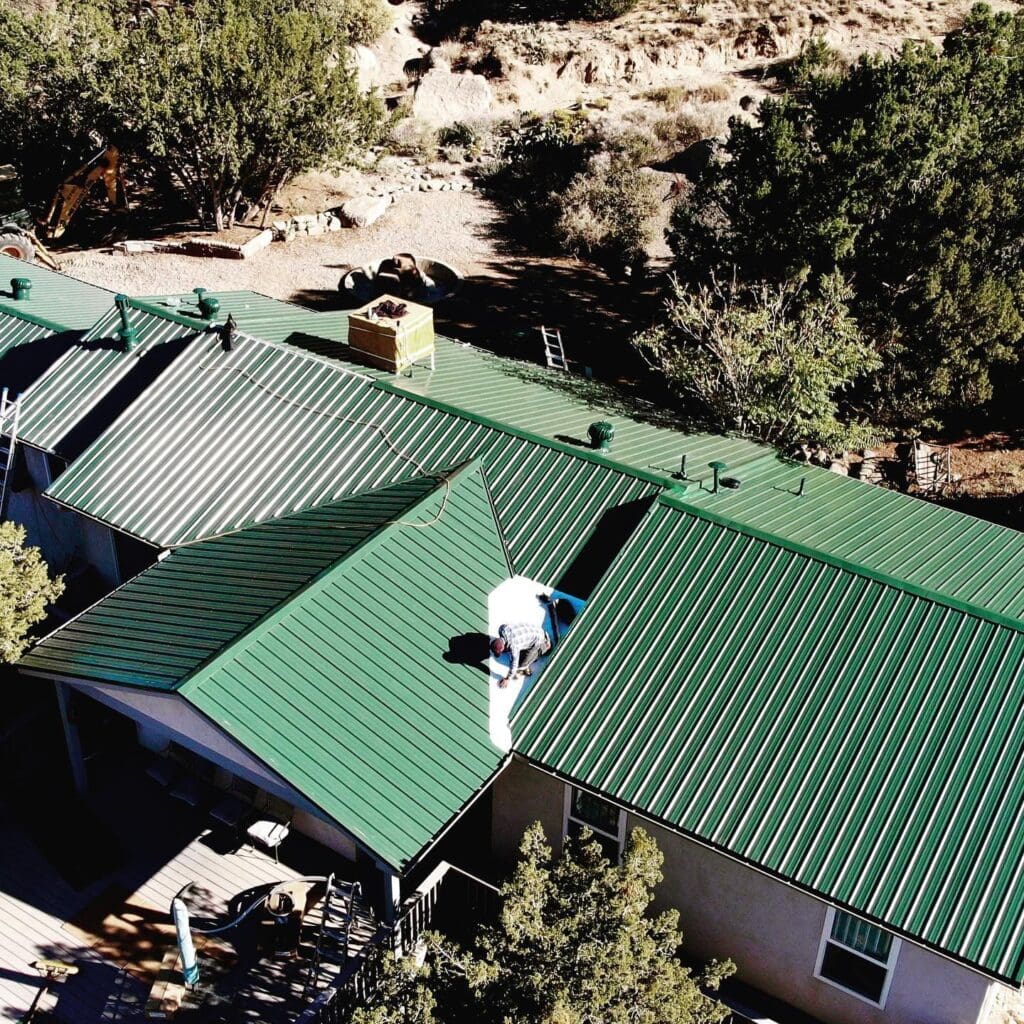
Yes, a metal roof can be an excellent choice for homes and commercial buildings in New Mexico, particularly when the roofing system is selected and installed to handle the property’s roof slope, weather exposure, drainage requirements, and long-term maintenance needs.
Metal roofing offers several advantages in Albuquerque and Santa Fe, including resistance to everyday weather exposure, a wide selection of finishes, and the potential for long service life. Certain reflective metal roof finishes may also help reduce solar heat absorption during New Mexico’s hot summer months.
However, metal roofing is not the best choice for every building. Higher initial installation costs, hail denting, rain noise, thermal expansion, and the roof’s existing design all deserve consideration.
The most important distinction is that a metal roof is more than its visible panels. The panel profile, attachment method, underlayment, insulation, flashing, and installation quality all influence how well the roofing system performs.
Is Metal Roofing a Good Fit for New Mexico’s Climate?
New Mexico presents a demanding environment for residential and commercial roofing systems.
In Albuquerque, roofs face intense sunlight, summer heat, high winds, and seasonal monsoon storms. Santa Fe properties experience many of the same conditions, along with colder winters, snowfall, and freeze-thaw cycles.
Metal roofing can perform well in these conditions, but its suitability depends on the type of metal roof and how it is installed.
A properly designed metal roofing system can shed rain and snow effectively, resist many forms of weather-related deterioration, and provide reliable protection over an extended period.
Yet no roofing material is immune to damage. Hail can dent metal panels, wind can expose weaknesses in attachment systems, and poorly installed flashing can allow water to enter a building.
The question is not simply whether metal roofing is durable. It is whether the specific metal roofing system is appropriate for the building and its location.
What Are the Benefits of Metal Roofing in Albuquerque and Santa Fe?
Metal Roofing Can Handle Intense Sun and Heat
One reason property owners consider metal roofing is its potential to reduce solar heat absorption.
New Mexico receives substantial sunshine throughout the year. During summer, roof surfaces can become much hotter than the surrounding air.
Certain metal roofing products use reflective finishes designed to reflect more sunlight and release absorbed heat.
These properties can help reduce roof surface temperatures under appropriate conditions.
However, not every metal roof provides the same energy performance.
A dark metal roof with a low-reflectance finish may absorb considerably more solar energy than a light-colored roof with a reflective coating.
The building’s insulation, ventilation, attic configuration, and air-conditioning system also affect indoor temperatures.
Homeowners should evaluate the specific roofing product rather than assume that installing metal panels automatically lowers cooling bills.
Metal Roofing Offers Long-Term Durability
Metal roofing is often selected because of its potential for long-term service.
Unlike asphalt shingles, metal panels do not depend on a surface layer of mineral granules for protection against sunlight.
Properly selected and maintained metal roofing systems can provide many years of weather protection.
Actual service life varies with the metal type, coating system, installation quality, environmental exposure, and maintenance.
Protective finishes may deteriorate before the underlying panels reach the end of their useful life. Fasteners, sealants, flashing, and other components may also require attention over time.
For that reason, property owners should compare the expected performance of the complete roofing assembly rather than rely on a manufacturer’s general lifespan claim.
Metal Roofs Can Shed Rain and Snow Efficiently
On appropriately sloped roofs, metal panels can provide an effective path for rainwater and melting snow to move toward gutters or other drainage systems.
This can be especially useful during New Mexico’s summer monsoon season.
In Santa Fe and higher-elevation communities, snow accumulation and snow sliding are additional considerations.
Because smooth metal surfaces may allow accumulated snow to slide suddenly, roof design may need to account for entrances, walkways, landscaping, and equipment below the roof edge.
Snow-retention devices may be appropriate for some buildings, but their selection and installation require project-specific evaluation.
Good drainage does not eliminate the need for properly designed flashing, roof edges, gutters, and roof penetrations such as hot water heater vent pipes.
What Are the Disadvantages of Metal Roofing?
Metal roofing has genuine drawbacks that should be considered before committing to a new installation.
Higher Initial Installation Costs
Metal roofing often has a higher upfront cost than conventional asphalt shingle roofing.
The difference depends on the panel material, roof design, labor requirements, removal of existing roofing, and installation details.
A simple roof with long, uninterrupted slopes may be easier to install than one with numerous dormers, skylights, valleys, and penetrations.
Standing seam systems may also involve different material and installation costs from exposed-fastener metal panels.
For a fair comparison, property owners should obtain estimates that account for the entire project, including underlayment, flashing, ventilation, insulation requirements, and removal or disposal costs.
The lowest initial price does not necessarily represent the lowest long-term cost. At the same time, a higher-priced roof is not automatically the better investment.
Hail Can Dent Metal Roofing
Hail is an important consideration in Albuquerque, Santa Fe, Rio Rancho, and other New Mexico communities.
Metal roofing may develop visible dents when struck by hailstones.
The amount of deformation depends on several factors, including panel thickness, metal type, profile, support beneath the panels, and storm conditions.
A dent does not automatically mean the roof has lost its ability to protect the building.
Some dents primarily affect appearance. Others may involve damaged coatings, seams, fasteners, or panel connections.
Cosmetic hail damage and functional hail damage are not necessarily the same.
Property owners should ask about the selected product’s tested impact resistance and how the manufacturer defines damage for warranty purposes.
After a significant storm, a professional roof inspection can help identify damage even when there is no visible leak.
Metal Roofs Can Be Noisy During Rain
Rain striking metal panels can produce noticeable sound, especially on buildings with limited insulation or exposed roof construction.
However, the familiar image of a metal roof creating constant loud noise during every storm is misleading.
Noise levels depend on the complete roof assembly.
A metal roof installed over a solid deck with appropriate underlayment, insulation, and finished interior ceilings may sound very different from metal panels installed over open framing.
For homeowners concerned about monsoon rain noise, the important question is how the proposed roof will be constructed, not simply whether the outer material is metal.
Metal Expands and Contracts with Temperature Changes
Metal changes dimensions as temperatures rise and fall.
This is particularly relevant in New Mexico, where roof surfaces may experience strong daytime heating followed by cooler nighttime temperatures.
Metal roofing systems must accommodate this movement.
Depending on the product, that may involve specialized clips, panel connections, expansion details, or other manufacturer-approved installation methods.
If movement is restricted or incorrectly addressed, stress may develop around fasteners, seams, or flashing.
Proper installation matters as much as the material itself.
Standing Seam vs. Exposed-Fastener Metal Roofing: What’s the Difference?
Not all metal roofing systems are installed the same way.
Two common approaches are standing seam metal roofing and exposed-fastener metal panels. Both can be appropriate for certain residential and commercial applications, but they differ in construction, appearance, and maintenance requirements.
Standing Seam Metal Roofing
Standing seam roofing uses raised panel seams, with fasteners generally concealed beneath the roofing surface.
Many standing seam systems use clips or other attachment methods designed to accommodate thermal movement.
This can reduce the number of exposed fastener penetrations through the main roof surface.
Standing seam roofing is often considered for residential properties, commercial buildings, and architectural projects where appearance and long-term performance are priorities.
However, standing seam systems are not all identical. Panel connections, attachment methods, and minimum slope requirements vary by manufacturer.
Exposed-Fastener Metal Roofing
Exposed-fastener roofing uses screws or other fasteners that pass through the metal panels into the supporting structure.
These fasteners commonly include sealing washers intended to limit water intrusion.
Exposed-fastener systems may offer a more economical installation option, depending on the roof design and product selected.
Their long-term performance depends partly on the condition of the fasteners and seals.
As the roof ages, some fasteners or washers may require inspection, maintenance, or replacement.
Which Metal Roofing System Is Better?
| Feature | Standing seam | Exposed-fastener panels |
| Fastener placement | Generally concealed | Visible through panels |
| Appearance | Raised seams and a streamlined profile | Often ribbed or corrugated |
| Thermal movement | Some systems use sliding clips | Movement accommodation depends on design |
| Maintenance | Inspect seams, flashing, finishes, and attachments | Inspect those areas plus exposed fasteners and washers |
| Initial cost | Often higher | Often lower |
| Best application | Depends on roof design and product | Depends on roof design and product |
Standing seam is not automatically the best choice for every property. A properly specified exposed-fastener system may be suitable for some buildings, while a standing seam system may be preferable where concealed attachments or particular architectural details are important.
The manufacturer’s installation requirements should guide the decision.
What Should Be Checked Before Installing a Metal Roof?
Choosing the right panel is only part of the process. Several building-specific conditions can determine whether metal roofing is a practical option.
Roof Slope and Drainage
A steep residential roof and a low-slope commercial roof have different drainage requirements.
Some metal roofing products are designed for steeper roof slopes. Other systems may be approved for lower slopes when installed with the required seams, sealants, and other details.
Not every metal panel is suitable for every roof pitch.
This is particularly important for flat and low-slope buildings in Albuquerque and Santa Fe.
For buildings with minimal slope, other systems may deserve consideration. The article What Is the Best Roofing Material for a Flat Roof in New Mexico? explains why material selection depends on the building’s conditions.
Roof Deck and Existing Structure
Before installing a new metal roof, the condition of the existing roof deck and supporting structure should be evaluated.
Deteriorated decking, inadequate attachment surfaces, or existing moisture problems may need to be corrected.
The roofing contractor should also determine whether the proposed system is compatible with the building’s structural design and applicable requirements.
Flashing Around Roof Penetrations
Skylights, plumbing vents, chimneys, HVAC equipment, and other penetrations interrupt the roof surface.
These areas require carefully designed flashing.
A metal roof with high-quality panels can still leak if water enters around poorly detailed penetrations.
Buildings with numerous rooftop openings may require more complex installation work and future maintenance.
Insulation, Ventilation, and Condensation
Metal roofing’s performance depends partly on what is installed beneath it.
Insulation helps control heat transfer. Ventilation, where appropriate, can help manage attic conditions.
Moisture control is also important because condensation can form when warm, moist air contacts sufficiently cold surfaces.
The appropriate design depends on whether the building has a ventilated attic, an insulated roof assembly, or another construction arrangement.
These decisions should be made as part of the complete roofing design rather than treated as optional accessories.
Is Metal Roofing Better Than Shingles, Tile, or TPO?
There is no single roofing material that performs best on every New Mexico building.
Asphalt shingles may offer a lower initial installation cost and a familiar appearance for residential properties.
Clay and concrete tile can complement Southwestern architecture, but their weight, underlayment requirements, and susceptibility to breakage must be considered.
Metal roofing may appeal to property owners seeking a particular architectural appearance, long-term durability, or reflective finishes.
For commercial and low-slope buildings, TPO and other membrane roofing systems may be more appropriate when the roof geometry or drainage conditions do not suit the proposed metal panel system.
A property owner comparing these options should evaluate the full roof assembly, not simply the visible roofing material.
For additional information about low-slope alternatives, see What Is a TPO Roof? Is It Good for New Mexico Buildings?.
How Do You Decide Whether Metal Roofing Is Right for Your Property?
Consider two different New Mexico buildings.
An Albuquerque home has a relatively steep roof with simple rooflines and few penetrations. Its owner wants a durable roofing system with a modern appearance.
Metal roofing may be a strong option for that property, provided the selected system meets the building’s structural, wind, drainage, and installation requirements.
Now consider a Santa Fe commercial building with a low-slope roof, multiple HVAC units, and numerous plumbing and electrical penetrations.
Metal roofing might still be possible, but the slope, flashing complexity, equipment access, and maintenance requirements deserve closer evaluation. A membrane roofing system may offer a more practical solution.
Neither decision should be made from appearance alone.
Before requesting a metal roofing estimate, ask the contractor:
- Is the proposed metal roofing system approved for my roof’s slope?
- What metal type, panel profile, and protective finish are included?
- How will the installation accommodate thermal expansion and contraction?
- What are the product’s documented wind and impact-resistance ratings?
- How will flashing, drainage, insulation, and condensation be addressed?
- What maintenance will the fasteners, seams, coatings, and other components require?
- What do the manufacturer and workmanship warranties actually cover?
- How does the total installation and long-term maintenance cost compare with other suitable roofing systems?
These questions help homeowners and commercial property owners compare proposals on more than price.
If your existing roof is approaching the end of its useful life, professional roof replacement services in Albuquerque or Santa Fe can help you evaluate available materials.
Frequently Asked Questions About Metal Roofing in New Mexico
Will a Metal Roof Make My House Hotter?
Not necessarily. Some reflective metal roofing finishes can reduce solar heat absorption compared with less-reflective surfaces. Indoor temperatures also depend on insulation, ventilation, roof construction, and other building conditions. A metal roof does not guarantee lower cooling costs.
Can Metal Roofing Rust?
Some metal roofing materials can corrode if protective finishes deteriorate or if the materials are exposed to incompatible metals or environmental conditions. Corrosion resistance varies by metal type, coating, and installation details. No metal roofing system should be assumed to be completely maintenance-free.
Can Metal Roofing Be Installed on a Flat Roof?
Certain metal roofing systems may be suitable for low-slope applications, but every product has specific minimum slope and installation requirements. A conventional exposed-fastener panel intended for a steep roof should not be assumed suitable for a nearly flat roof. A qualified roofing professional should evaluate the roof design and available systems.
Can Solar Panels Be Installed on a Metal Roof?
Yes, solar panels can be installed on many metal roofing systems using compatible mounting methods. Some standing seam systems allow attachments that clamp to approved seams without penetrating the panels. However, attachment compatibility, structural capacity, wind loads, electrical requirements, and manufacturer instructions must be evaluated for the specific project.
Does a Metal Roof Require Regular Maintenance?
Yes. Metal roofs should be inspected periodically and after significant storms. Maintenance may include checking flashing, seams, fasteners, sealants, protective finishes, and drainage components. The appropriate schedule depends on the roofing system, building conditions, and manufacturer recommendations.
Get Professional Metal Roofing Advice in Albuquerque or Santa Fe
A metal roof can be a worthwhile investment for many New Mexico homes and commercial buildings, but choosing the right system requires more than selecting a panel color or comparing material prices.
Roof slope, weather exposure, installation details, insulation, drainage, and long-term maintenance all influence performance.
Rocky Mountain Roofing Services provides residential and commercial roofing services throughout Albuquerque, Santa Fe, Rio Rancho, and surrounding New Mexico communities.
With more than 35 years of combined roofing experience, the company offers roof inspections, repairs, replacement, and metal roofing services tailored to the property’s needs.
If you’re considering metal roofing for a new building or an existing roof replacement, a professional evaluation can help determine whether it is the right option.
Call Rocky Mountain Roofing Services at 505-717-1925 or request a roofing estimate online.
Metal Roofing Disclaimer
The information in this article is provided for general educational purposes. Metal roofing performance varies by material, manufacturer, roof design, installation, and local conditions. Product ratings, minimum roof slopes, warranties, building-code requirements, and energy performance are system-specific. Consult a qualified roofing professional and the applicable manufacturer’s current technical documentation before selecting or installing a metal roofing system.