
What Happens When a Swamp Cooler Constantly Leaks on a Roof?
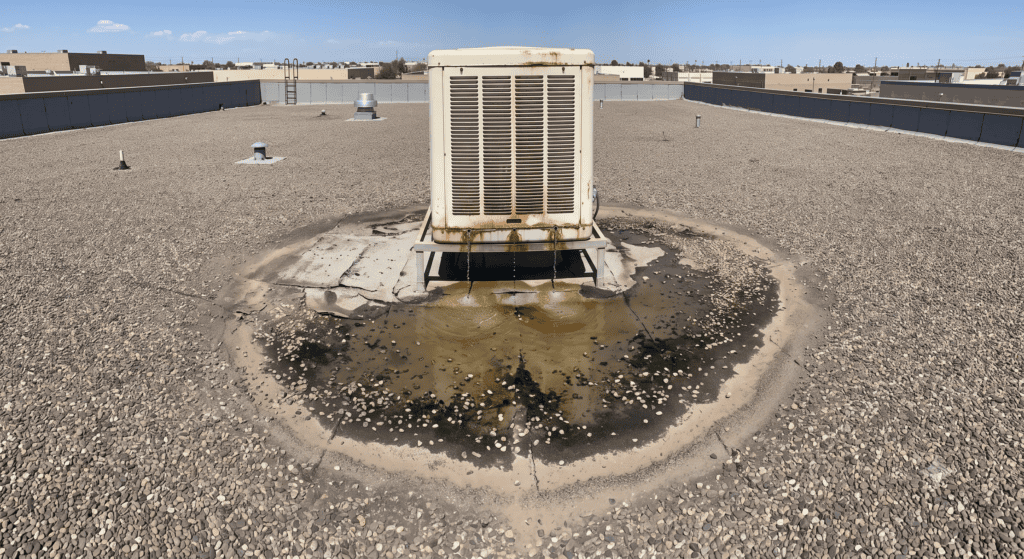
A swamp cooler that leaks constantly can cause much more roof damage than an ordinary rainstorm. Rain normally stops, drains away, and gives the roof time to dry. A leaking evaporative cooler may release water onto the same small area day and night, leaving shingles, membranes, flashings, insulation, and roof decking continuously wet.
Over time, constant moisture may loosen shingle granules, expose asphalt, weaken roof seams, erode protective coatings, damage spray foam, saturate insulation, rot wood decking, corrode metal components, and create recurring interior leaks.
The exact damage depends on:
- How long the cooler has been leaking
- How much water is escaping
- Where the water is flowing
- The roofing material beneath the cooler
- The condition of the equipment curb and flashing
- Whether moisture has entered the insulation
- Whether the roof drains correctly
- The age and condition of the existing roof
A constantly wet area does not automatically mean the entire roof must be replaced. Localized damage can often be repaired when the problem is identified early and the surrounding roofing system remains dry and serviceable.
The first priority is correcting the swamp cooler’s mechanical leak. The roof should then be professionally inspected to determine how far the water has traveled and whether the damage is limited to the surface or extends into the insulation and roof deck.
Rocky Mountain Roofing Services provides roof inspections, leak detection, shingle repair, flat-roof repair, flashing reconstruction, drainage improvements, roof restoration, and replacement throughout Albuquerque, Santa Fe, and surrounding New Mexico communities. With more than 35 years of combined roofing experience, the company evaluates the complete roofing assembly instead of simply covering the visible area with another layer of sealant.
Why Is Constant Swamp-Cooler Water More Damaging Than Rain?
Roofs are designed to handle intermittent weather.
During a typical rainstorm:
- Water reaches the roof.
- The roofing surface directs it toward gutters, drains, scuppers, or canales.
- The storm ends.
- The roof begins drying.
A faulty swamp cooler creates a different situation. Water may continue flowing for hours, days, or even weeks. The same roof area remains exposed without a normal drying period.
Continuous leakage can be especially damaging because:
- Water is concentrated around one equipment curb.
- Small cracks remain continuously exposed.
- Wet insulation may not dry.
- Sediment and mineral residue collect in the drainage path.
- Surface heat may dry the top while moisture remains trapped underneath.
- Repeated wetting can weaken underlayment and decking.
- Water may migrate farther from the original leak source.
- Existing repairs may lose adhesion.
- Ponding water may remain even during otherwise dry weather.
In Albuquerque and Santa Fe, this constant moisture is combined with intense UV exposure, high roof-surface temperatures, strong winds, dust, hail, and large temperature swings. Those conditions can accelerate deterioration around an already vulnerable area.
What Causes a Swamp Cooler to Leak Onto the Roof?
A rooftop evaporative cooler can leak for several reasons.
Faulty Float Valve
The float valve controls how much water enters the cooler pan. If it sticks, becomes misadjusted, or fails to close, water can rise too high and overflow onto the roof.
Water Level Set Too High
Even a functioning float may be adjusted incorrectly. If the water level sits too close to the top of the reservoir, movement, wind, or normal operation may cause repeated overflow.
Cracked or Rusted Reservoir Pan
Older metal pans may corrode and develop pinholes or larger openings. Plastic components may crack from age, heat, impact, or freeze damage.
Loose or Split Water-Supply Line
A small leak in the water line or fitting may run continuously whenever the supply valve is open.
Failed Drain Connection
Drain fittings, overflow tubes, winterization plugs, and connections can loosen, crack, or deteriorate.
Cooler Is Not Level
If the unit sits unevenly, water may collect along one side and overflow even when the overall water level appears normal.
Deteriorated Housing
Rust, cracked panels, damaged seams, or worn components can allow water to escape from the unit.
Failed Equipment-Curb Flashing
Sometimes the cooler itself is not leaking. Water may be entering where the equipment curb meets the roofing system.
Improper Drainage or Discharge Routing
Bleed-off water or overflow may be discharged directly onto a vulnerable portion of the roof instead of being routed to an appropriate drainage point.
An HVAC technician may need to repair the float valve, pan, supply line, drain, or cooler housing. Roofing work should not be considered complete while water continues escaping from the equipment.
How Does a Constant Swamp-Cooler Leak Damage Asphalt Shingles?
Asphalt shingles are designed to shed water downhill. They are not intended to sit beneath a constant stream or pool of water.
Continuous cooler leakage can cause several types of shingle damage.
Granule Loss
The mineral granules on asphalt shingles protect the asphalt layer from sunlight and physical wear.
Water flowing across the same area can move dirt and debris over the surface and contribute to granule loss. Foot traffic around the cooler may accelerate that wear, particularly when shingles are hot or softened.
Once granules are lost, the exposed asphalt receives more direct UV radiation. New Mexico’s strong sunlight can then age the shingle more rapidly.
Softened or Deteriorated Edges
Repeated saturation may affect already aged or damaged shingle edges. They may begin to curl, lift, crack, or lose their ability to lie flat.
Water Entry Through Nail Holes
Shingle roofs depend on overlapping courses and properly placed fasteners. Water that flows in an unusual direction or remains in one area may find a path through exposed nail holes, damaged tabs, or flashing defects.
Underlayment Saturation
Once water reaches beneath the shingles, it may soak the underlayment. The roof surface can appear dry while materials underneath remain damp.
Rusted Fasteners
Constant moisture can corrode exposed or vulnerable metal fasteners, reducing their holding strength.
Damage From Foot Traffic
Swamp coolers require regular maintenance. Technicians walking repeatedly across wet, hot, or deteriorated shingles may loosen granules or crack weakened areas.
A few damaged shingles may be replaceable. However, the roofer should inspect the underlayment, flashing, and decking before assuming the problem is limited to the visible surface.
Can a Swamp Cooler Cause Roof Decking to Rot?
Yes, repeated or prolonged moisture can damage wood roof decking if water reaches beneath the roofing system.
Common residential decking materials include plywood and oriented strand board. These materials can tolerate limited construction exposure, but repeated saturation may weaken them.
Possible consequences include:
- Soft or spongy decking
- Swelling or delamination
- Reduced fastener holding strength
- Sagging around the cooler curb
- Deterioration extending beyond the visible opening
- Interior ceiling or wall damage
Soft decking may also create a safety concern for anyone walking near the cooler.
Not every swamp-cooler leak causes structural damage. If the problem is found early, only a small section of decking may need replacement. A professional inspection is needed to determine whether the surrounding deck remains dry and sound.
On commercial buildings with metal roof decking, prolonged moisture may contribute to rust or corrosion. The extent depends on the metal, coatings, duration of exposure, and whether water remains trapped against the deck.
What Happens to TPO and PVC Roofing?
TPO and PVC are single-ply roofing membranes commonly used on commercial and residential low-slope roofs. The membrane itself is designed to resist water, but failures can still develop at seams, punctures, drains, and flashings.
Constant water around a swamp cooler may reveal or worsen:
- Weak or open heat-welded seams
- Punctures caused by maintenance traffic
- Failed equipment-curb flashing
- Cuts from sharp metal
- Damage around pipes or supply lines
- Poor drainage near the cooler
- Wet insulation beneath the membrane
- Loose or deteriorated previous repairs
Water does not necessarily chemically destroy an intact TPO or PVC membrane simply because it remains wet. The greater concern is that constant water repeatedly tests every nearby seam, flashing, penetration, and repair.
Sediment may also settle around the cooler and conceal small openings.
How Are TPO or PVC Roofs Repaired?
A professional repair may involve:
- Probing nearby seams
- Identifying punctures or cuts
- Cleaning the membrane
- Removing unstable material
- Replacing localized wet insulation
- Installing compatible membrane patches
- Heat welding the repair
- Rebuilding the equipment-curb flashing
- Correcting drainage around the cooler
A generic roof cement or sealant should not be assumed to work on a single-ply membrane. The repair material must be compatible with the existing roof.
What Happens to Modified-Bitumen Roofing?
Modified bitumen is an asphalt-based flat-roof system installed in sheets or rolls.
Constant moisture may expose weaknesses involving:
- Open laps
- Cracks
- Splits
- Failed patches
- Deteriorated flashing
- Blisters
- Punctures
- Wet insulation
- Damage around equipment curbs
As modified bitumen ages, UV exposure and temperature movement may reduce flexibility. Continuous water can then enter through openings that might remain unnoticed during short rainstorms.
Localized damage may be repaired by removing failed material, replacing wet insulation, installing compatible reinforced repair materials, and rebuilding the cooler flashing.
What Happens to Built-Up or Tar-and-Gravel Roofing?
Built-up roofing contains multiple reinforced asphalt layers and is often covered with gravel.
The gravel helps protect the asphalt from sunlight and minor impact, but it can also conceal damage.
A constantly leaking swamp cooler may contribute to:
- Gravel displacement
- Exposed asphalt
- Cracks and splits
- Failed previous patches
- Blisters
- Open flashing transitions
- Moisture trapped between plies
- Saturated insulation
- Drainage problems around the cooler
The visible puddle may not show the full extent of the damage because water can move beneath the gravel and through the roofing layers.
A roofer may need to move aggregate, inspect the underlying membrane, replace wet materials, install reinforced repair plies, and restore the protective surfacing.
What Happens to Spray Polyurethane Foam Roofing?
Spray polyurethane foam roofing is protected by a coating that shields the foam from sunlight and weather.
A swamp-cooler leak can damage the system when:
- The coating is thin or deteriorated.
- Foam has become exposed.
- Maintenance traffic creates punctures.
- Water collects around the cooler curb.
- Hail, birds, or tools have damaged the surface.
- A new penetration was poorly repaired.
- The protective coating has lost adhesion.
Intact coated foam may tolerate water exposure, but exposed or damaged foam can deteriorate when moisture and sunlight reach it.
How Is Foam Roofing Repaired?
Localized foam damage may be repaired by:
- Removing loose or deteriorated foam
- Inspecting for trapped moisture
- Drying and preparing the area
- Rebuilding the foam profile
- Shaping the repair to encourage drainage
- Applying a compatible protective coating
- Reconstructing the equipment-curb flashing
The surrounding roof should also be examined. One exposed area may indicate that the coating is becoming thin across a larger section.
What Happens to Silicone, Acrylic, and Elastomeric Roof Coatings?
Roof coatings are used over several types of roofing systems, including spray foam, built-up roofing, modified bitumen, and other compatible surfaces.
Continuous swamp-cooler water may contribute to:
- Peeling
- Cracking
- Blistering
- Thin coating
- Loss of adhesion
- Sediment accumulation
- Separation around the cooler curb
- Exposed substrate or foam
- Failure at previous repairs
Silicone coatings generally tolerate standing water better than many acrylic coatings. However, even a silicone-coated roof still requires proper drainage, sound insulation, stable roofing underneath, and secure flashings.
A coating does not repair:
- A faulty float valve
- A cracked cooler pan
- A leaking supply line
- Saturated insulation
- Rotten decking
- A structurally unstable roof
- A failed curb assembly
Before recoating, the roof must be inspected, cleaned, repaired, dried, and tested for adhesion where appropriate.
How Does Constant Moisture Affect Roof Insulation?
Wet insulation is one of the most important hidden concerns after a long-term cooler leak.
Depending on the roofing system and insulation type, moisture may:
- Reduce thermal performance
- Spread beyond the visible puddle
- Add weight to the roof assembly
- Contribute to blistering
- Affect membrane or coating adhesion
- Promote corrosion of metal components
- Cause recurring leaks
- Damage ceilings and walls
- Remain trapped after the roof surface dries
The cooler may be repaired and the visible water may disappear, but saturated insulation can remain beneath the membrane.
How Do Roofers Find Wet Insulation?
Depending on the roof, a professional evaluation may include:
- Visual roof inspection
- Interior inspection
- Infrared scanning when conditions are appropriate
- Electronic moisture testing
- Core samples
- Carefully placed test cuts
No single test is appropriate for every roof. The contractor should choose methods based on the roofing system, building construction, weather, and suspected damage.
Why Is the Ceiling Stain Sometimes Away From the Swamp Cooler?
Water does not always travel straight down from the point where it enters.
It may move:
- Across the roof deck
- Through insulation
- Along framing
- Around ducts or pipes
- Through wall cavities
- Along the equipment curb
- From a higher roof area to a lower interior point
A ceiling stain several feet away from the cooler may still be connected to the rooftop leak.
This is why patching directly above an interior stain often fails. The visible stain identifies where the water appeared—not necessarily where it entered.
A proper leak investigation compares the interior evidence with the cooler location, roof slope, flashing details, drainage path, penetrations, and roofing condition.
Do Mineral Deposits From Swamp-Cooler Water Damage the Roof?
Evaporative-cooler water can leave mineral residue as it evaporates.
Deposits may:
- Build up around the cooler
- Follow the drainage path
- Collect around seams and flashings
- Hold dirt and debris
- Conceal small roof defects
- Interfere with repair or coating adhesion
- Make the area more difficult to clean and inspect
Mineral deposits alone do not necessarily destroy a roofing membrane. However, they indicate where water has been flowing and must be removed during proper surface preparation.
How Does New Mexico Weather Make the Damage Worse?
A leaking swamp cooler is particularly hard on a New Mexico roof because the moisture is combined with demanding weather conditions.
Intense UV Exposure
Albuquerque and Santa Fe receive strong sunlight at high elevation. Once shingle granules, roof coating, or protective surfacing is lost, exposed material may deteriorate more rapidly.
High Roof-Surface Temperatures
A roof can become far hotter than the surrounding air. The surface may appear dry while water remains trapped in insulation below.
Rapid Temperature Changes
Hot afternoons and cooler nights cause repeated expansion and contraction. Cracked coatings, weak seams, and failed flashings may worsen under this movement.
Monsoon Storms
A cooler leak may already have saturated the area before a heavy storm arrives. Rain can then expand the leak or spread moisture farther through the roofing system.
High Winds and Hail
Wind may drive water into weak flashing details. Hail may damage coatings, foam, membranes, metal components, or the cooler itself.
Freeze-Thaw Cycles
Santa Fe and higher-elevation communities experience freezing temperatures. Water inside a crack or failed seam may freeze, expand, and enlarge the opening.
What Warning Signs Should Property Owners Watch For?
Possible signs of swamp-cooler roof damage include:
- Water continuously overflowing from the cooler
- A wet area around the unit during dry weather
- Mineral staining or residue
- Shingle granules collecting below the cooler
- Bare or shiny asphalt on shingles
- Curled, lifted, or softened shingles
- Cracked roofing cement
- Open membrane seams
- Loose cooler flashing
- Peeling roof coating
- Exposed spray foam
- Blisters
- Soft roof areas
- Rust around the curb or metal deck
- Ceiling stains
- Bubbling interior paint
- Musty odors
- Water appearing whenever the cooler operates
- Repeated repairs around the same area
Water flowing constantly from a rooftop unit should not be treated as normal operation.
Can Swamp-Cooler Roof Damage Be Repaired Locally?
Often, yes.
Localized repair may be practical when:
- The mechanical cooler leak has been corrected.
- The roofing damage is limited to one area.
- Most insulation remains dry.
- The roof deck is sound.
- The surrounding shingles or membrane remain serviceable.
- Flashing failure is localized.
- Compatible repair materials are available.
- Drainage can be corrected.
Possible repairs include:
- Replacing damaged shingles
- Replacing localized underlayment
- Replacing a small section of decking
- Rebuilding cooler-curb flashing
- Repairing TPO or PVC seams
- Patching membrane punctures
- Removing wet insulation
- Rebuilding spray foam
- Repairing modified-bitumen roofing
- Restoring a compatible coating system
- Improving drainage around the unit
The repair must extend to dry, stable materials. Covering wet insulation or damaged decking with a surface patch may lead to another failure.
When Is Partial Roof Replacement Needed?
Partial replacement may be appropriate when the damage is too extensive for a small repair but remains limited to the section around the cooler.
Examples include:
- Saturated insulation in one drainage area
- Rotten decking around the equipment curb
- Widespread shingle damage beneath the cooler
- A failed flat-roof section around the unit
- Removal of the cooler during conversion to refrigerated air
- Installation of a new equipment curb
- Multiple old patches concentrated in one area
The transition between the new roofing section and the existing system must be designed carefully. A poorly constructed connection may create a new leak.
When Might the Entire Roof Need Replacement?
Complete replacement may provide better long-term value when:
- Moisture has spread through a large portion of the roof.
- The roof has several active leaks.
- Decking is deteriorated across broad areas.
- The membrane or shingles are already near the end of their serviceable life.
- Flashings are failing throughout the roof.
- Coating adhesion is failing broadly.
- Repeated cooler-related repairs have not lasted.
- Several incompatible repair materials have been used.
- The roof has major drainage problems.
- Repair costs are approaching replacement cost.
- The building owner is completing a major HVAC conversion or renovation.
Roof age alone should not determine the recommendation. The inspection should consider moisture, material condition, repair history, deck condition, drainage, and the owner’s plans for the property.
Swamp-Cooler Leak Damage by Roofing System
| Roofing system | Possible damage | Warning signs | Typical professional response |
| Asphalt shingles | Granule loss, damaged edges, wet underlayment or deck | Bare asphalt, curling, soft decking, stains | Replace damaged shingles, underlayment, decking, and flashing |
| TPO or PVC | Open seams, punctures, curb-flashing failure | Loose seam, cuts, water around curb | Heat-weld compatible repairs and replace wet materials |
| Modified bitumen | Cracks, open laps, blistering | Splits, loose laps, soft areas | Install reinforced repair plies and replace wet insulation |
| Built-up roofing | Hidden cracks, flashing failure, saturated insulation | Displaced gravel, exposed asphalt, recurring leaks | Move gravel, repair membrane, replace wet materials, restore surfacing |
| Spray foam | Coating loss, exposed or damaged foam | Bare foam, soft areas, peeling coating | Remove damaged foam, rebuild the profile, and recoat |
| Roof coating | Peeling, blistering, adhesion loss | Cracks, thin coating, exposed substrate | Repair the substrate, reinforce, prime, and recoat |
| Roof insulation | Saturation and reduced performance | Soft areas, recurring leaks, higher energy use | Locate wet boundaries and replace damaged insulation |
| Wood or metal deck | Rot, fastener failure, or corrosion | Soft decking, rust, sagging | Repair or replace affected deck sections |
What Does a Professional Inspection and Repair Process Involve?
A professional response may include the following steps.
1. Confirm Whether the Cooler Is Still Leaking
The roof repair cannot be expected to last while the float valve, pan, fitting, supply line, or drain continues releasing water.
2. Inspect the Interior
Ceiling stains, wall damage, framing, ductwork, and visible deck conditions may provide clues about the water path.
3. Identify the Roofing System
The repair method must match asphalt shingles, TPO, PVC, modified bitumen, built-up roofing, foam, or the existing coating.
4. Inspect the Cooler and Equipment Curb
The roofer evaluates the curb flashing, roof transitions, water path, drainage, supply-line penetrations, and surrounding repairs.
5. Check for Hidden Moisture
Moisture testing may be used when the extent of damage is uncertain.
6. Determine the Repair Scope
The contractor explains whether localized repair, restoration, partial replacement, or complete replacement is appropriate.
7. Remove Damaged Materials
Wet insulation, deteriorated roofing, damaged decking, and failed flashing are removed as needed.
8. Install Compatible Roofing Materials
The repair is tied into dry, stable sections of the existing system.
9. Improve Drainage
Water should be directed away from the cooler and toward the designed drainage system.
10. Complete a Final Inspection
The repaired area, equipment curb, seams, flashings, and drainage path are reviewed.
How Can Future Swamp-Cooler Roof Damage Be Prevented?
Preventative steps include:
- Schedule seasonal evaporative-cooler maintenance.
- Inspect and adjust the float valve.
- Check the reservoir pan for rust or cracks.
- Inspect supply and drain lines.
- Confirm that the cooler sits level.
- Watch for overflow during startup.
- Inspect the equipment-curb flashing.
- Keep nearby drains, scuppers, and canales clear.
- Check the roof after spring startup.
- Inspect after shutdown and winterization.
- Avoid directing discharge across vulnerable roof areas.
- Repair roofing damage promptly.
- Inspect the roof after cooler replacement or removal.
- Keep photographs and maintenance records.
Because roofs involve fall hazards, electrical equipment, high temperatures, and potentially soft decking, property owners should avoid unsafe rooftop inspections.
Frequently Asked Questions
Can a leaking swamp cooler damage a roof?
Yes. Continuous water can damage shingles, seams, flashings, coatings, insulation, and decking when the affected area remains wet.
Why is constant swamp-cooler water worse than rain?
Rain is temporary and normally drains away. A cooler leak may expose the same roof area continuously without allowing it to dry.
What causes a swamp cooler to overflow?
Common causes include a faulty or misadjusted float valve, a cracked pan, a loose water line, a blocked drain, an unlevel unit, or deteriorated components.
Can a leaking float valve damage shingles?
Yes. Repeated water flow may contribute to granule loss, damaged shingle edges, wet underlayment, and decking deterioration.
Can a swamp cooler rot roof decking?
Prolonged moisture can weaken wood decking if water enters beneath the roofing system. The extent depends on duration and how far the moisture spreads.
What happens when water collects around a TPO roof curb?
Constant water may expose weak seams, punctures, and flashing defects. Moisture may then enter the insulation beneath the membrane.
Can a swamp cooler damage a spray foam roof?
Yes. Water can worsen punctures, coating loss, exposed foam, or failed flashing around the cooler.
Can roof coatings withstand standing water?
Performance varies by coating type and condition. Silicone generally tolerates standing water better than many acrylic coatings, but no coating corrects a leaking cooler, wet insulation, or failed roof assembly.
Why is my ceiling stained when it has not rained?
The swamp cooler, water-supply line, drain, pan, or flashing may be leaking. Water may travel through the roof assembly before appearing indoors.
Can the roof around a swamp cooler be repaired locally?
Often, yes, when the cooler leak has been corrected and the damage remains limited to one area.
Does the entire roof need replacement after a cooler leak?
Not necessarily. Replacement is more likely when moisture, deck damage, membrane deterioration, or repeated leaks affect large areas.
Should the cooler be repaired before the roof?
Yes. The source of continuous water should be corrected before the roofing repair is considered complete.
Schedule a Swamp-Cooler Roof Inspection in Albuquerque or Santa Fe
A swamp cooler that leaks day and night can damage far more than the equipment itself.
Constant water may loosen shingle granules, expose asphalt, weaken membrane seams, damage roof coatings, saturate insulation, deteriorate decking, corrode metal components, and create recurring interior leaks.
The float valve, reservoir pan, water line, drain, or other mechanical problem should be corrected promptly. The roof around the cooler should then be inspected to determine whether water has entered beneath the visible surface.
Rocky Mountain Roofing Services provides professional roof inspections, leak detection, shingle repair, flat-roof repair, flashing reconstruction, drainage improvements, roof restoration, and roof replacement throughout Albuquerque, Santa Fe, and surrounding New Mexico communities.
With more than 35 years of combined roofing experience, the company evaluates each roof individually and recommends the least extensive solution that can reasonably restore dependable long-term performance.
Rocky Mountain Roofing Services
100 Mountain Park Place, Suite A
Albuquerque, New Mexico 87114
Santa Fe Office
150 Washington Avenue, Suite 201
Santa Fe, New Mexico 87501
Phone: 505-717-1925
Schedule a professional roof inspection before a small swamp-cooler leak spreads into insulation, decking, walls, or interior finishes.
Conclusion
A constantly leaking swamp cooler can cause serious roofing problems even when the weather is completely dry.
Unlike rain, which normally drains away and allows the roof to dry, a faulty evaporative cooler may keep the same section of roofing wet continuously. That ongoing exposure can damage asphalt shingles, TPO and PVC seams, modified-bitumen laps, built-up roofing, spray foam, roof coatings, insulation, flashings, fasteners, and decking.
The cooler’s mechanical problem must be repaired first. Otherwise, any roofing repair will remain exposed to the same continuous source of water.
Localized damage can often be repaired when the surrounding roof remains dry and serviceable. Damaged shingles may be replaced. Cooler flashing can be rebuilt. TPO seams can be repaired with compatible membrane. Foam can be reconstructed and recoated. Wet insulation and damaged decking may be removed from a defined area.
More extensive work may be needed when moisture has spread through a large portion of the roof, decking has deteriorated, coating adhesion is failing broadly, or repeated repairs no longer provide dependable performance.
The most reliable answer comes from a complete inspection.
An experienced New Mexico roofing contractor can identify the roofing system, inspect the cooler curb and water path, evaluate hidden moisture, and determine whether localized repair, restoration, partial replacement, or complete replacement is the appropriate solution.