
Why Is My Roof Leaking Around a Skylight?
Rocky Mountain Roofing Services
Albuquerque • Santa Fe • Central and Northern New Mexico | 505-717-1925
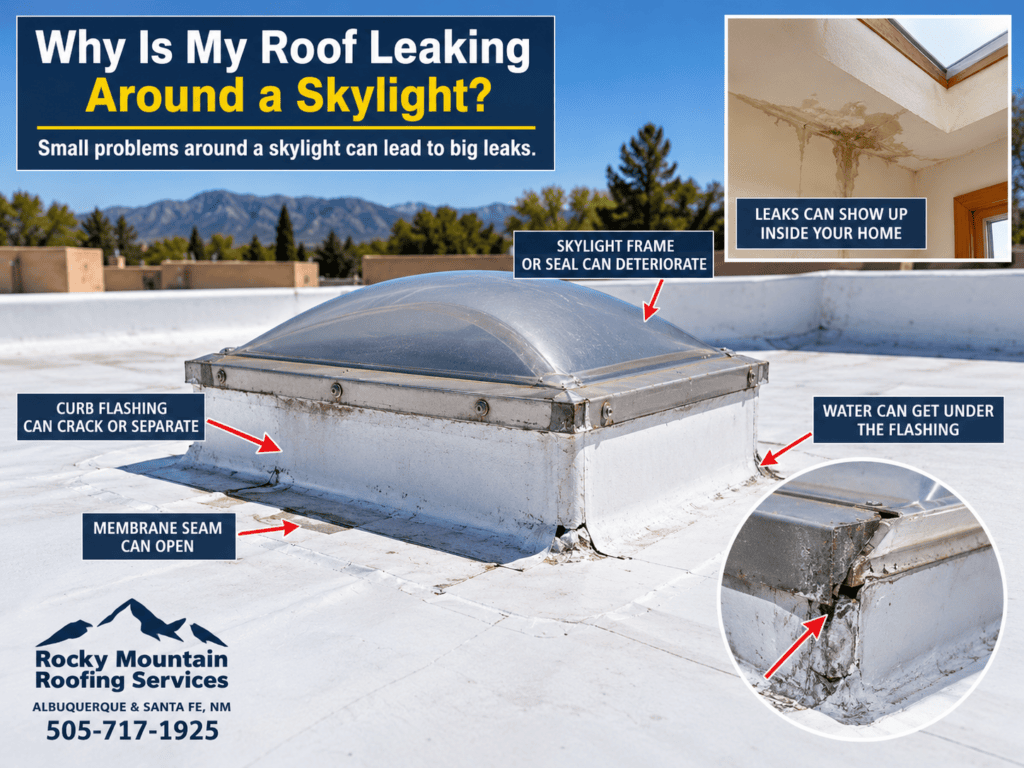
| Direct Answer: Water around a skylight often comes from the weatherproofing around the opening – flashing, underlayment, a curb or the surrounding roofing – but the skylight frame or glazing can also leak, and interior condensation can imitate a roof leak. The right repair starts by determining whether the water is entering through the roof, through the skylight assembly, or forming inside the building. |
A skylight creates an opening through a roofing system, so several components have to work together to move rainwater around that opening. When one of those details deteriorates, separates or was not integrated correctly, water may show up on the skylight frame, drywall, ceiling or wall below. The visible wet spot tells you where the water became noticeable – not necessarily where it entered the roof.
That distinction matters in New Mexico. A skylight on a pitched shingle or tile roof is not flashed the same way as a curb-mounted skylight on a flat or low-slope roof. Albuquerque monsoon rain, high winds and strong sun can expose vulnerable details, while Santa Fe and higher-elevation areas add snow and freeze-thaw cycles. Those conditions can influence where an inspection should focus, but they do not prove the cause of a particular leak.
A Skylight Leak Is Not Always the Skylight Itself
When water appears around a skylight, there are three broad places to investigate. The first is the roof-side weatherproofing: flashing, underlayment, shingles, tile, membrane, coating or curb transition. The second is the skylight assembly itself, including the frame, glazing, gasket or joints. The third is interior moisture, especially condensation on a cold skylight surface.
This is why automatically covering the perimeter with more sealant can be a poor diagnostic shortcut. A surface bead may hide the symptom temporarily without restoring the layered drainage path that the roof and skylight flashing were designed to provide. It can also make the original entry point harder to see later.
How a Skylight Is Supposed to Keep Water Out
A properly integrated skylight does more than rely on caulk. The roofing, underlayment and metal flashing are arranged so water moving down the roof is directed around the opening and back onto the roof surface. VELUX, for example, describes different engineered flashing systems for shingles, tile, metal roofing and curb-mounted applications. The details vary because water behaves differently on different roof coverings and slopes.
Deck-mounted skylights on steep-slope roofs
On many pitched roofs, a deck-mounted skylight sits directly on the roof deck. Flashing pieces are integrated with the roof covering. With shingles, step flashing along the sides works with head and sill details to route water around the unit. Underlayment provides another layer of water protection around the opening. Tile and metal roofs require different flashing profiles and integration details.
Curb-mounted skylights and low-slope roofs
A curb-mounted skylight sits on a raised curb rather than directly on the roof deck. This configuration is common on low-slope applications and commercial buildings. The roof membrane or other roofing system has to be properly tied into the curb, and the skylight itself has to seal to the top of that curb. A defect at either interface can produce water around the same interior opening.
Rocky Mountain Roofing Services works with flat and low-slope systems throughout New Mexico. For broader context on penetrations, flashing, ponding and membrane problems, see What Are the Most Common Flat Roof Problems in New Mexico?.
The Most Likely Places Water Can Enter Around a Skylight
Failed or poorly integrated flashing
Flashing is one of the first areas to evaluate because it is the transition between the skylight and the roofing system. Side flashing can separate, head flashing can stop directing water correctly, metal can become damaged, or a previous repair can interfere with the intended drainage path. On a low-slope roof, the membrane-to-curb transition can also open, crack or deteriorate.
Underlayment problems around the opening
The visible metal flashing is not the only water-control layer. Underlayment around a skylight helps protect the roof deck when water gets beneath the outer roof covering. If that layer is missing, damaged, aged or poorly integrated, water can reach the opening even when the visible flashing does not look obviously broken from the ground.
Damage to the surrounding roofing
The entry point can be outside the skylight assembly. A lifted shingle, cracked tile, membrane puncture, failed seam, deteriorated coating or other defect upslope can admit water. Once inside the roof assembly, that water can move along decking, insulation or framing and appear beside the skylight because the opening provides a convenient place for it to emerge.
A problem with the skylight frame, gasket or glazing
Sometimes the roof-side flashing is doing its job and the skylight assembly needs attention. Depending on the product, age and design, the frame, glazing seal, gasket, joints or operating components may need to be evaluated. That is a different repair question from rebuilding roof flashing, and it may require coordination with a skylight specialist or manufacturer-qualified service provider.
Could It Be Condensation Instead of a Roof Leak?
Yes. Condensation is one of the easiest skylight problems to misread. Warm, moisture-laden indoor air can contact a colder skylight surface and form droplets. Those droplets may run down the glass or frame and drip onto drywall, making the area look like it is leaking from outside.
Weather timing is useful here. If water appears when it has not rained or snowed, especially during cold weather or periods of high indoor humidity, condensation deserves consideration. VELUX specifically notes in its service guidance that condensation can make a skylight appear to leak even when it is not raining. That does not rule out a roof problem; it simply changes the diagnostic path.
Safe interior observations can help. Note whether droplets are forming directly on the glass, whether the moisture follows cold mornings, and whether bathroom, kitchen or other indoor humidity is unusually high. Do not climb onto a wet, steep or unfamiliar roof to investigate the exterior yourself.
Use Weather and Timing to Narrow Down the Source
The pattern of the leak can provide useful clues, but no single clue proves the cause. A professional inspection should connect the timing with the roof type, skylight design and condition of the surrounding materials.
| Symptom or Timing | Possible Direction | What to Inspect |
| Leaks during ordinary rain | Flashing, underlayment, curb/membrane transition, nearby roofing or skylight assembly | Inspect the complete skylight perimeter and surrounding roof, not just the wet interior corner. |
| Leaks mainly during wind-driven rain | Side/head flashing, exposed joints, frame or an upslope/sidewall entry path | Look for details that become vulnerable when rain is pushed horizontally or uphill. |
| Water after snow or thawing | Roof/flashing defect, curb transition, drainage issue or another upslope source | Trace meltwater paths and inspect cold-weather-sensitive transitions. |
| Drips when there has been no precipitation | Condensation, interior humidity or a non-roof moisture source | Check for droplets on glass/frame and compare with indoor humidity and temperature. |
| Stain below skylight but no obvious exterior defect | Water may be traveling from another roof entry point | Expand the inspection upslope and around nearby penetrations, seams and transitions. |
Why the Ceiling Stain May Not Be Directly Below the Leak
Roof water does not always travel straight down. After entering at a flashing edge, membrane defect or nearby roof opening, it can follow the roof deck, framing, insulation or another building component before gravity finally pulls it into the room. The result can be a stain beside or below the skylight even though the exterior opening is several feet away.
This is one reason a documented professional roof inspection is more useful than treating the visible ceiling stain as a map of the roof entry point. The roof covering, flashing, penetrations, drainage and interior evidence need to be considered together.
What Should a Professional Skylight-Leak Inspection Include?
The inspection should match the roof system rather than assume a standard shingle-roof detail. On a pitched roof, that may mean examining the head, side and sill flashing, surrounding shingles or tile, underlayment clues, previous patches and the roof area upslope. On a flat roof, the curb, membrane or coating transition, seams, drainage and nearby rooftop penetrations become especially important.
From inside, staining patterns, damp framing, insulation and the location of active moisture can help narrow the path. The skylight frame, glass, gasket and operating parts should also be evaluated when the roof-side details do not explain the symptom. The goal is not simply to prove that water is present. It is to identify which assembly failed and how far the moisture has traveled.
RMRS provides roof leak repair in Albuquerque and leak diagnostics across multiple roof systems, including flat, tile, shingle, metal and foam roofs. Its current inspection materials specifically include flashings around skylights and other roof penetrations.
Can a Skylight Leak Be Repaired Without Replacing the Skylight or Roof?
Often, a localized leak does not automatically require replacement of either the entire skylight or the entire roof. If the problem is isolated to a repairable flashing detail, surrounding roofing, membrane transition or localized damage, a targeted roof repair may be appropriate when the rest of the system remains sound.
The decision changes if the skylight frame, glazing, gasket or other product component has failed, or if the surrounding roof is broadly deteriorated. A skylight can need replacement while the roof remains serviceable. The opposite can also be true: the skylight may be sound while the roofing or curb flashing around it needs repair.
That repair-first diagnostic approach is consistent with RMRS’s broader Albuquerque roof repair service, which evaluates the roof condition before deciding whether repair or replacement is the more appropriate path.
Why New Mexico Conditions Matter
New Mexico roofs experience strong ultraviolet exposure, large temperature swings, wind, hail and sudden monsoon rainfall. In Santa Fe and higher-elevation communities, snow and freeze-thaw cycles add another form of stress. These conditions can age exposed sealants, move metal flashing, stress roofing transitions and reveal small defects during a severe weather event.
The roof design matters just as much as the climate. A skylight on a tile roof has different surrounding details from one on asphalt shingles. A curb-mounted skylight on a Pueblo-style flat roof depends on the integrity of the curb and low-slope roofing transition. For that reason, the same visible ceiling stain can lead to different inspection priorities on two New Mexico buildings.
What Should You Do If Water Is Appearing Around a Skylight?
Start with safe observations. Record when the moisture appears, whether it follows light rain, heavy rain, wind-driven rain, snowmelt or dry weather, and whether droplets are visible on the interior glass. Photograph the stain or drip pattern if you can do so safely. Move belongings away from active water and address significant interior water or electrical hazards promptly with the appropriate qualified professional.
Avoid walking onto the roof to apply caulk around the skylight. Roof work involves fall hazards, and a quick surface patch can cover evidence that helps identify the real water path. The more useful next step is an inspection of the skylight, flashing, surrounding roof and interior evidence.
Frequently Asked Questions
Can a skylight leak even if the glass is not cracked?
Yes. Water can enter around flashing, underlayment, a curb, surrounding roofing, the skylight frame or another nearby roof defect even when the glass is intact.
How can I tell condensation from a skylight roof leak?
Condensation becomes more plausible when droplets form on the inside glass or frame during cold or humid conditions and there has been no precipitation. A true exterior leak is more likely to follow rain or snowmelt, but timing alone is not enough to confirm the source.
Why does my skylight leak only when the wind blows rain against it?
Wind-driven rain can push water toward side, head or frame details that do not receive the same exposure during calm rainfall. The inspection should include the surrounding and upslope roof because the entry point may not be the skylight itself.
Can water enter above the skylight and travel to the opening?
Yes. Water can move along decking, framing, insulation or other components before becoming visible. An interior stain near the skylight does not prove the exterior opening is directly above it.
Does a leaking skylight always need to be replaced?
No. If the skylight itself is sound and the failure is limited to flashing or surrounding roofing, a localized repair may be possible. Replacement becomes more relevant when the skylight assembly itself is damaged, deteriorated or otherwise unsuitable to keep in service.
Should a roofer or skylight contractor inspect the problem?
If the suspected problem involves roof flashing, underlayment, a curb, membrane or surrounding roofing, a roofing professional is a logical starting point. If the roof-side details are sound but the frame, glazing, gasket or operating mechanism is defective, skylight-specific service may also be needed.
Schedule a Roof Leak Inspection in Albuquerque or Santa Fe
A wet skylight does not tell you whether you need flashing repair, surrounding roof repair, skylight service or a larger roofing project. Accurate leak detection comes first.
Rocky Mountain Roofing Services provides residential and commercial roof inspections, leak detection, roof repair, flashing repair and preventative maintenance throughout Albuquerque, Santa Fe and surrounding New Mexico communities. The company has more than 35 years of combined roofing experience and works with flat, TPO, foam, metal, shingle and tile roofing systems.
If water is appearing around a skylight, call Rocky Mountain Roofing Services at 505-717-1925 or request a roof inspection or roofing quote. The goal is to identify the source first, then determine the repair that fits the actual condition of the roof and skylight.
External Sources Used & Why They Matter
VELUX Professional – Skylight Flashing Systems: Used to verify that skylight flashing systems differ by roof material and mounting method, including step flashing, tile/metal flashing and curb-mounted applications.
VELUX – Residential Skylight Brochure / Flashing Systems: Used to verify the layered role of flashing and underlayment and the distinction between deck-mounted and curb-mounted systems.
Rocky Mountain Roofing Services – Roof Inspection Albuquerque: Used to verify RMRS’s current inspection scope, including skylight flashing and roof penetrations, and the company’s leak-detection positioning.