What Is the Best Roofing Material for a Flat Roof in New Mexico?
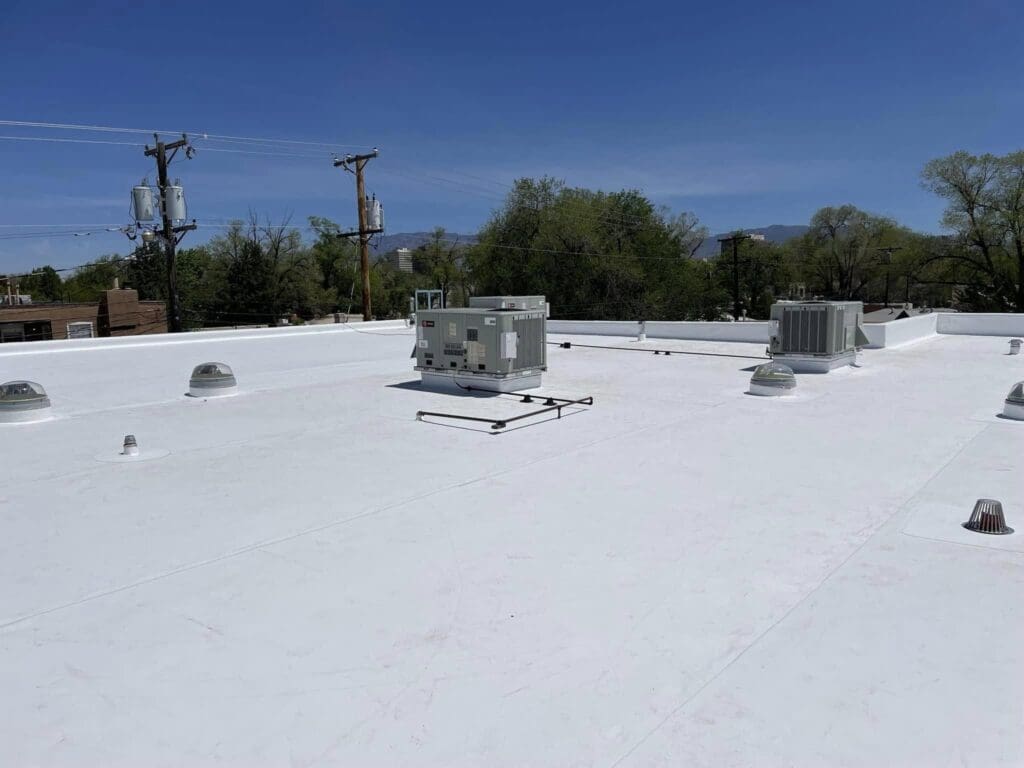
There is no single best roofing material for every flat roof in New Mexico. TPO, PVC, spray foa, modified bitumen, built-up roofing, and roof coatings each have advantages. The best choice depends on the building, existing roof, drainage, UV and storm exposure, insulation needs, rooftop traffic, chemical exposure, maintenance goals, and budget.
Choosing a flat roofing system in New Mexico is different from choosing one in a milder climate.
A roof in Albuquerque or Santa Fe may face intense sunshine and ultraviolet exposure, large temperature swings, strong winds, hail, heavy monsoon rainfall, and, particularly in northern New Mexico, snow and freeze-thaw conditions.
Those environmental stresses matter.
So does the building itself.
A large commercial warehouse may have very different roofing needs from a restaurant, church, apartment building, retail property, office, or Southwestern-style home with a low-slope roof.
That is why asking, “What is the best roofing material for a flat roof?” does not have a one-size-fits-all answer.
The better question is:
Which flat roofing system is best suited to this particular New Mexico building?
TPO may be an excellent choice for one property. PVC may make more sense for another. Spray polyurethane foam can provide important advantages when insulation is a priority. Modified bitumen and built-up roofing remain useful asphalt-based systems. And when an existing roof is still in suitable condition, a roof coating may extend its service life without requiring complete replacement.
Understanding the differences can help property owners make a better long-term roofing decision.
What Are the Main Flat Roofing Materials Used in New Mexico?
Flat and low-slope roofs can be constructed using several different roofing systems.
Among the important options are:
- TPO roofing
- PVC roofing
- Spray polyurethane foam, or SPF
- Modified bitumen
- Built-up roofing, commonly called BUR or tar-and-gravel
- Roof coating and restoration systems
Each approaches weather protection differently.
Some use flexible single-ply membranes. Some use multiple asphalt-based layers. Spray foam combines roofing and insulation characteristics. Coatings are liquid-applied materials generally used to restore and protect suitable existing roofing systems.
Here is a practical overview.
| Flat Roofing System | Important Characteristics | May Be Well Suited For | Important Considerations |
| TPO | Single-ply membrane, reflective surface, heat-welded seams | Many commercial and low-slope applications | Installation quality, seams, penetrations, drainage, rooftop traffic |
| PVC | Single-ply membrane, heat-welded seams, useful chemical-resistance characteristics | Restaurants and some commercial/industrial environments | Product compatibility, installation, building exposure |
| Spray Foam (SPF) | Seamless sprayed system with insulation value | Buildings where insulation and seamless application are priorities | Proper installation, coating protection, periodic maintenance |
| Modified Bitumen | Reinforced asphalt-based membrane | Many traditional low-slope applications | UV exposure, surface condition, installation method, maintenance |
| BUR / Tar-and-Gravel | Multiple asphalt and reinforcing layers, often protected by aggregate | Existing commercial and older flat-roof applications | Weight, gravel movement, leak diagnosis, maintenance |
| Roof Coatings | Liquid-applied protective/restoration membrane | Suitable existing roofs that do not require complete replacement | Existing roof condition, moisture, drainage, compatibility |
The right choice should be made after considering the entire roofing assembly—not simply the material at the surface.
Is TPO the Best Flat Roofing Material for New Mexico?
TPO is one of the most important options to consider for commercial and low-slope roofing in New Mexico.
TPO stands for thermoplastic polyolefin. It is a flexible single-ply roofing membrane commonly installed in large sheets.
Adjacent membrane sheets are joined using heat-welded seams.
One reason TPO receives considerable attention in sunny climates is its availability in highly reflective surfaces. A reflective roof can absorb less solar heat than a dark roofing surface, which can be an important consideration in a climate with intense sunshine.
For Albuquerque properties exposed to long periods of strong sun, that can make TPO attractive.
What Are the Advantages of TPO Roofing?
Depending on the roof design and installation, advantages can include:
- Reflective surface options
- Heat-welded seams
- Relatively lightweight construction
- Broad commercial applicability
- Compatibility with different insulation assemblies
- Repairability when damage is localized
- Straightforward visual inspection of many membrane areas
- Suitability for many new and replacement roofing projects
TPO can work particularly well on large commercial roofs where a reflective membrane and dependable single-ply roofing system are priorities.
However, the material itself is only one part of roof performance.
Seams must be installed properly. Flashing around HVAC units, pipes, vents, drains, walls, and other penetrations requires careful detailing. The membrane also needs protection from punctures and unnecessary rooftop traffic.
And like every flat roofing system, TPO depends on effective drainage.
A premium membrane cannot correct a poorly designed roof slope or blocked drain.
When Might TPO Be a Strong Choice?
TPO deserves serious consideration when a property owner wants a reflective single-ply roofing system for a commercial or low-slope building and the roof can be properly designed, insulated, drained, and installed.
It should not automatically be selected simply because it is popular.
The existing roof assembly, deck, insulation, drainage, penetrations, rooftop equipment, and intended building use should all be evaluated first.
Is PVC Better Than TPO for a Flat Roof?
Sometimes—but not universally.
PVC, or polyvinyl chloride roofing, is another single-ply membrane system.
Like TPO, PVC roofing can use heat-welded seams to create a continuous roofing surface.
One important reason PVC may be considered for certain commercial buildings is its resistance to some types of grease, oils, and chemical exposure.
That can make the material particularly relevant when evaluating roofs over:
- Restaurants
- Commercial kitchens
- Food-processing areas
- Certain manufacturing operations
- Buildings with rooftop exhaust systems
Imagine a restaurant roof where exhaust fans regularly discharge grease-containing air.
That environment is very different from the roof of an office building.
The roofing system should reflect that difference.
Is PVC Always Better for Restaurants?
No roofing recommendation should be made from the building category alone.
The specific membrane product, rooftop discharge, chemical exposure, equipment configuration, drainage, and manufacturer requirements should all be evaluated.
But chemical and grease exposure is an important factor that can move PVC higher on the list of potential roofing materials.
TPO vs. PVC: Which Should You Choose?
Both can be excellent single-ply roofing systems when properly specified and installed.
TPO may be attractive for broad commercial applications where reflectivity, heat-welded seams, and general roof performance are priorities.
PVC may become particularly attractive where the roof encounters grease or certain chemical exposures.
The answer should come from the building conditions—not from assuming one membrane is universally superior.
Is Spray Foam Roofing Good for New Mexico?
Spray polyurethane foam can be particularly interesting in New Mexico because it combines roofing characteristics with insulation.
Spray polyurethane foam, or SPF, is applied as a liquid that expands and hardens in place.
Unlike a roofing system assembled primarily from large sheets or rolls, SPF creates a seamless surface when properly installed.
That characteristic can be valuable on roofs containing many penetrations, irregular shapes, equipment curbs, and transitions.
What Are the Advantages of Spray Foam Roofing?
Potential advantages include:
- Seamless application
- Insulating properties
- Ability to conform around penetrations
- Lightweight construction
- Potential to improve portions of roof drainage through properly designed application
- Restoration and recoating potential
- Suitability for various existing roof conditions when properly evaluated
For New Mexico property owners concerned about heat and building efficiency, the insulation component can be particularly relevant.
But spray foam is not simply installed and forgotten.
Does a Foam Roof Need a Protective Coating?
The foam roofing system depends on a protective coating to shield the foam from ultraviolet exposure and weather.
That is especially important in New Mexico.
The same intense sunshine that makes insulation and reflective roofing attractive also means the protective surface of a foam roof deserves regular attention.
Coating condition should be monitored as part of preventative maintenance.
If the protective surface deteriorates, maintenance or recoating may become necessary.
That does not make foam a poor choice.
It means the owner should understand the roofing system’s maintenance requirements before selecting it.
When Does Spray Foam Make Sense?
SPF can be particularly useful when:
- Insulation improvement is an important goal
- The roof contains many penetrations
- A seamless application is desirable
- The existing roof is suitable for the proposed system
- Drainage improvements can appropriately be incorporated into the design
- The owner is prepared to maintain the protective coating
Installation quality is critical.
Proper substrate preparation, weather conditions during application, foam thickness, coating application, flashing, and drainage details all influence performance.
Is Modified Bitumen Good for Flat Roofs?
Yes. Modified bitumen remains an important low-slope roofing option.
Modified bitumen is an asphalt-based roofing membrane reinforced to improve flexibility and durability.
For property owners familiar with traditional asphalt roofing, modified bitumen represents a more modern reinforced membrane approach to low-slope roofing.
Different modified bitumen products and installation methods are available, so the exact roof assembly matters.
What Are the Advantages of Modified Bitumen?
Depending on the system, important characteristics can include:
- Reinforced membrane construction
- Familiar asphalt-based technology
- Suitability for low-slope roofing
- Repairability
- Multiple installation options
- Compatibility with various commercial and residential flat-roof applications
Modified bitumen can be a practical option for roofs where an asphalt-based membrane system is appropriate.
New Mexico’s intense UV exposure and heat still need to be considered.
Surface protection, reflectivity, installation method, flashing, drainage, and maintenance can all influence long-term performance.
It should therefore be compared with TPO, PVC, SPF, and other options based on the actual building rather than simply the roofing material’s name.
Are Tar-and-Gravel Roofs Still a Good Option?
Built-up roofing has been used on commercial and flat-roof buildings for generations.
Built-up roofing, or BUR, consists of multiple layers of asphalt and reinforcing materials.
Many traditional BUR systems are protected by aggregate, creating what property owners commonly call a tar-and-gravel roof.
These roofs can provide substantial, multi-layer weather protection.
However, they have characteristics property owners should understand.
What Are the Advantages of Built-Up Roofing?
A properly designed BUR system can offer:
- Multiple roofing layers
- Long-established roofing technology
- A substantial roofing assembly
- Aggregate surface protection in applicable systems
- Familiarity among experienced commercial roofing professionals
But there are tradeoffs.
What Are the Disadvantages of Tar-and-Gravel Roofing?
Potential considerations include:
- Greater roof-system weight
- Loose or displaced aggregate
- More difficult visual inspection of the underlying membrane
- More complicated leak tracing
- Maintenance around penetrations and flashing
- Challenges identifying the exact location of membrane damage beneath gravel
A roof leak illustrates the issue.
On a smooth single-ply membrane, a roofing professional may be able to visually inspect seams, penetrations, punctures, and membrane conditions relatively directly.
On a gravel-surfaced built-up roof, aggregate can obscure the roofing layers below.
That does not mean the system has failed.
It means inspection and leak diagnosis can be different.
For an existing tar-and-gravel roof, the decision should often be whether continued repair, restoration, or replacement provides the best long-term value.
Can a Roof Coating Replace a New Flat Roof?
Sometimes a coating can help avoid premature replacement.
But a roof coating should not be treated as a substitute for a new roof in every situation.
That distinction is critical.
A roof coating is a liquid-applied protective membrane used to extend the service life of certain suitable roofing systems.
Rocky Mountain Roofing Services works with roof coatings and flat-roof restoration as part of its commercial roofing services.
Depending on the roof and proposed system, coatings may include materials such as silicone or acrylic products.
When Can a Roof Coating Make Sense?
A restoration coating may be worth evaluating when:
- The underlying roofing system remains serviceable
- Moisture problems are limited or appropriately addressed
- The substrate is suitable
- Drainage is functioning adequately or can be corrected
- Flashing and penetrations can be properly restored
- The proposed coating is compatible with the existing roof
- Complete tear-off and replacement are not yet necessary
This can create an additional option between repeated minor repairs and complete roof replacement.
When Is a Roof Coating Not Enough?
A coating should not be used to conceal a failing roof.
Potential warning conditions include:
- Widespread wet insulation
- Significant deck or substrate deterioration
- Major structural problems
- Extensive membrane failure
- Chronic drainage problems that remain unresolved
- Large areas of incompatible or deteriorated roofing
- Conditions that prevent proper coating adhesion
Applying a new surface over unresolved problems does not make those problems disappear.
A professional roof inspection should determine whether the roof is actually a restoration candidate.
Which Flat Roofing Material Handles New Mexico Sun Best?
New Mexico’s sunshine is one of the most important factors in material selection.
Albuquerque and Santa Fe roofs experience intense ultraviolet exposure, and elevation can make UV exposure particularly demanding.
Highly reflective roofing surfaces can help reduce solar heat absorption at the roof surface.
White or reflective TPO and PVC membranes are therefore often considered when solar reflectivity is important.
Reflective roof coatings can also provide a reflective surface on appropriate restoration projects.
Spray foam systems typically depend on their protective coating, making the coating’s condition important for UV protection.
Modified bitumen and built-up roofing can use different surfacing approaches depending on the specific assembly.
But color alone should not determine which roof is best.
Reflectivity is one performance characteristic among many.
A reflective roof with poor drainage, damaged flashing, inadequate attachment, wet insulation, or poorly installed seams is not a good roofing system simply because its surface is white.
Which Flat Roof Is Best for Hail?
This question requires caution because no roofing system should be assumed to be hail-proof.
Hail performance depends on much more than the top roofing membrane.
Factors can include:
- Hailstone size
- Wind speed
- Impact angle
- Membrane or coating condition
- Membrane thickness
- Insulation
- Cover board
- Substrate
- Roof age
- Complete roof assembly
This is why comparing roofing systems using a simple “good for hail” or “bad for hail” label can be misleading.
For properties in hail-prone areas of New Mexico, the roofing professional should consider the complete assembly and available impact-resistant system options.
After a significant hailstorm, a professional inspection can also identify damage that may not immediately produce an interior leak.
Which Flat Roof Is Best for High Winds?
Wind performance also depends on the entire roofing system.
New Mexico can experience powerful winds, and roof edges and perimeters can be particularly vulnerable.
Important factors include:
- Attachment method
- Roof deck
- Perimeter and corner detailing
- Flashing
- Parapets
- Membrane attachment
- Insulation attachment
- Roof penetrations
- Building height and exposure
- Installation quality
A property owner should therefore avoid selecting a material based solely on the assumption that one membrane automatically solves wind problems.
The roof must be designed and installed as a system.
What Is the Best Flat Roof for Ponding Water?
The first answer is not a roofing material.
It is proper drainage.
Flat roofs are not truly designed to function as completely level surfaces that intentionally hold water indefinitely.
They should move water toward drains, scuppers, gutters, or other appropriate drainage points.
Ponding can develop because of:
- Clogged drains
- Blocked scuppers
- Debris
- Compressed insulation
- Insufficient slope
- Structural deflection
- Poorly designed drainage
- Previous roof modifications
Changing roofing material without addressing the underlying drainage problem may simply place a new roof over an old problem.
In some situations, tapered insulation or properly designed SPF application may help improve drainage characteristics.
In others, drains, scuppers, structural conditions, or other components require correction.
The drainage problem should be diagnosed before the replacement system is selected.
Which Flat Roofing System Provides the Most Insulation?
Spray polyurethane foam deserves particular attention when insulation is a primary objective because insulation is an inherent part of the SPF roofing system.
However, that does not mean other roofing membranes cannot be part of highly insulated roofs.
TPO, PVC, modified bitumen, and BUR systems can be installed over insulation assemblies designed to meet the project’s requirements.
This highlights an important distinction:
The roofing membrane and the complete roofing assembly are not the same thing.
A property owner choosing a roof should consider:
- Membrane
- Insulation
- Cover board
- Vapor control where applicable
- Attachment
- Roof deck
- Drainage
- Flashing
- Penetrations
Looking only at the top membrane provides an incomplete picture of roof performance.
Which Flat Roofing Material Is Easiest to Repair?
Most major flat-roof systems can be repaired under appropriate conditions.
The type of repair differs.
TPO and PVC membranes can often receive compatible membrane repairs when damage is localized and the surrounding material remains suitable.
SPF roofs can be repaired and recoated when conditions allow.
Modified bitumen repairs use methods appropriate to the specific asphalt-based system.
Built-up roofing can also be repaired, although gravel or multiple layers may make diagnosis and access more involved.
Coated roofs can often receive localized coating repairs when the existing system remains compatible and serviceable.
Rather than asking which roof is easiest to repair in every circumstance, consider:
How easy will this particular roof be to inspect, maintain, diagnose, and repair over its service life?
That question includes rooftop access, equipment, penetrations, foot traffic, drainage, building operations, and the owner’s maintenance program.
Which Flat Roof Requires the Least Maintenance?
No commercial flat roof should be considered maintenance-free.
That expectation can lead to preventable problems.
Flat roofs contain numerous components that deserve periodic inspection:
- Drains
- Scuppers
- Flashing
- Seams
- Penetrations
- HVAC curbs
- Roof edges
- Coatings
- Membranes
- Equipment supports
Debris can block drainage.
HVAC contractors can accidentally puncture membranes.
Sealants and flashing can deteriorate.
Wind can move materials.
Hail can cause impact damage.
Coatings can weather.
The best roofing system is therefore not necessarily the one marketed as requiring the least attention.
A better goal is a system that can be reasonably inspected, maintained, and repaired throughout its useful life.
Annual professional inspections, post-storm inspections, drain cleaning, debris removal, flashing checks, and prompt minor repairs are practical components of flat-roof maintenance.
How Does Albuquerque’s Climate Affect Flat-Roof Selection?
Albuquerque presents several roofing challenges at the same time.
Intense Sun and UV Exposure
Long periods of sunshine place continual stress on exposed roofing materials.
Reflectivity and UV protection therefore deserve consideration.
Large Temperature Changes
Roof surfaces can become extremely hot during sunny periods and then cool considerably.
That repeated expansion and contraction affects membranes, flashing, seams, penetrations, and other roofing components.
Hailstorms
Hail can affect membranes, coatings, flashing, rooftop equipment, and other roof components.
High Winds
Strong winds place additional demands on perimeter detailing, flashing, attachment, and exposed roof components.
Monsoon Rain
Summer storms can deliver substantial rainfall over a short period.
Drainage that seems adequate during light rain may reveal weaknesses during a major monsoon storm.
For Albuquerque flat roofs, roofing material selection and drainage design should therefore be considered together.
What Is the Best Flat Roof for Santa Fe?
The same major systems can be considered in Santa Fe, but local conditions can place additional emphasis on cold-weather performance.
Santa Fe’s higher elevation can mean:
- Intense UV exposure
- Snow
- Freezing temperatures
- Freeze-thaw cycles
- High winds
- Significant temperature fluctuations
Water that does not drain properly becomes particularly important when freezing conditions are added to the equation.
Roof design, insulation, drainage, flashing, penetrations, and maintenance therefore matter just as much as the membrane itself.
The “best” Santa Fe flat roof should be selected for the individual building and its exposure rather than simply copying a roofing specification used on another property.
What Flat Roof Is Best for Different Types of Buildings?
Building use can significantly narrow the options.
| Building / Condition | Roofing Systems Worth Evaluating | Why |
| General commercial building | TPO, PVC, SPF, modified bitumen, BUR | Several systems may fit depending on assembly and goals |
| Restaurant / commercial kitchen | PVC and other compatible systems | Grease and chemical exposure require special consideration |
| Building with insulation concerns | SPF or insulated membrane assembly | Thermal performance becomes a major design factor |
| Roof with many penetrations | SPF, TPO, PVC or other properly detailed systems | Penetration detailing becomes especially important |
| Existing serviceable roof | Repair or coating/restoration may be possible | Full replacement may not yet be necessary |
| Older BUR/tar-and-gravel roof | Repair, restoration, or replacement evaluation | Existing assembly and moisture determine options |
| Heavy rooftop equipment/traffic | System with appropriate protection and detailing | Service traffic increases potential for roof damage |
| Chronic ponding | Drainage correction plus appropriate roofing system | Material alone will not solve drainage defects |
This table is not a substitute for inspection.
It demonstrates why building conditions should lead the decision.
Should You Repair, Restore, or Replace Your Existing Flat Roof?
Before choosing a new roofing material, determine whether you actually need a new roof.
This can prevent unnecessary replacement.
Repair May Make Sense When:
- Damage is localized
- The majority of the roof remains serviceable
- Wet insulation is limited
- Flashing problems can be corrected
- A puncture or seam failure is isolated
- Drainage problems are minor and correctable
Restoration May Make Sense When:
- The existing roof remains a suitable substrate
- Moisture problems are limited or can be addressed
- The roof can accept a compatible coating system
- Flashing and penetrations can be restored
- The owner wants to extend the service life of an otherwise viable roofing system
Replacement May Be More Practical When:
- Deterioration is widespread
- Wet insulation affects substantial areas
- The deck or substrate has significant problems
- Repairs have become frequent
- The existing system is no longer a suitable restoration candidate
- Major drainage or roof-assembly corrections are required
Condition—not simply age—should help drive that decision.
How Should You Choose the Best Flat Roof for Your New Mexico Property?
A professional evaluation should answer several questions before a roofing system is selected.
1. What Roof Is There Now?
The existing assembly can influence whether a new system can be installed over portions of it, whether restoration is possible, or whether removal is necessary.
2. Is the Roof Wet?
Hidden moisture can completely change the project.
Wet insulation should be identified and appropriately addressed rather than trapped beneath a new roofing system.
3. Does the Roof Drain Properly?
A roofing material should not be expected to solve an unresolved drainage problem by itself.
4. What Is Under the Membrane?
The condition of insulation, cover boards, substrate, and roof deck matters.
5. How Is the Building Used?
An office, restaurant, warehouse, manufacturing facility, church, apartment building, and residence can have very different roofing requirements.
6. How Much Rooftop Equipment Is Present?
HVAC units, exhaust systems, solar equipment, pipes, vents, skylights, and other penetrations affect roofing design and maintenance.
7. How Much Foot Traffic Will the Roof Receive?
Frequent service activity increases the importance of membrane protection and designated walkways where appropriate.
8. What Are the Owner’s Long-Term Plans?
A property owner planning to hold a commercial building long term may evaluate roofing investments differently from someone planning a major redevelopment.
These factors allow the roofing contractor to move from a generic product recommendation to a roofing system designed around the actual property.
Frequently Asked Questions About Flat Roofing Materials in New Mexico
What is the best material for a flat roof in New Mexico?
There is no universal best material. TPO, PVC, SPF, modified bitumen, BUR, and coatings all have appropriate applications. The best choice depends on the existing roof, drainage, building use, climate exposure, insulation needs, rooftop traffic, chemical exposure, maintenance goals, and overall roof condition.
Is TPO the best flat roofing material?
TPO can be an excellent choice for many commercial flat roofs because it offers reflective surface options, heat-welded seams, and broad applicability. It is not automatically the best material for every building.
Is PVC better than TPO?
PVC may have advantages in environments involving grease, oils, or certain chemical exposures, while TPO is widely used for general commercial roofing. Product specifications and building conditions should determine the choice.
Is spray foam roofing good for New Mexico?
SPF can be well suited to New Mexico because it provides a seamless roofing surface and insulation. Its protective coating must be properly installed and maintained, particularly under intense UV exposure.
Is modified bitumen good for flat roofs?
Yes. Modified bitumen is a reinforced asphalt-based membrane designed for low-slope roofing and remains a viable option for many buildings.
Are tar-and-gravel roofs still used?
Yes. Built-up roofing remains an established commercial roofing system. Existing BUR roofs may be candidates for repair, restoration, or replacement depending on condition, moisture, drainage, and other factors.
Can a roof coating replace a new roof?
A coating may extend the service life of a suitable existing roof, but it is not a universal substitute for replacement. Extensive wet insulation, structural deterioration, major drainage problems, or widespread roof failure can make coating inappropriate.
Which flat roof is best for restaurants?
PVC deserves consideration because certain PVC roofing products can provide useful resistance to grease and chemical exposure. The exact membrane should be evaluated for compatibility with the restaurant’s rooftop conditions.
Which flat roof provides the most insulation?
SPF inherently provides insulation as part of the roofing system. Other roofing membranes can also be installed over substantial insulation assemblies, so complete system design matters.
What flat roof is best for ponding water?
No membrane should be selected as a substitute for proper drainage. The reason for ponding should first be identified and corrected where practical.
Which flat roofing system is easiest to repair?
TPO, PVC, SPF, modified bitumen, BUR, and coating systems can all be repaired under appropriate conditions. Repairability depends on the existing material, damage, moisture, accessibility, roof condition, and compatibility of repair materials.
Which flat roof lasts the longest?
Roof longevity depends on the complete system, installation quality, maintenance, drainage, climate exposure, storm damage, rooftop traffic, material selection, and other conditions. A universal lifespan comparison can therefore be misleading.
Which flat roof requires the least maintenance?
No flat roof should be treated as maintenance-free. Annual inspections, drain cleaning, flashing checks, debris removal, post-storm inspections, and prompt repairs can help protect the roofing investment.
Is a reflective roof better in Albuquerque?
Reflective roofing can reduce solar heat absorption at the roof surface, making reflectivity an important consideration in Albuquerque’s sunny climate. It should still be evaluated alongside drainage, insulation, attachment, durability, building use, and overall system design.
Is the best flat roof different in Santa Fe?
Potentially. Santa Fe’s elevation, UV exposure, snow, freezing temperatures, freeze-thaw cycles, and wind should be incorporated into the roofing design and material decision.
Should I replace an old flat roof just because of its age?
Not necessarily. Age is one factor. Membrane condition, moisture, drainage, flashing, repair history, substrate condition, and remaining serviceability should also be evaluated.
How do I know whether my flat roof should be repaired, restored, or replaced?
Start with a professional roof inspection. The roofing professional should evaluate the membrane, seams, coatings, flashing, penetrations, drainage, insulation, moisture, substrate, deck, previous repairs, and overall condition before recommending the appropriate approach.
So, What Is the Best Flat Roofing System for New Mexico?
The best flat roofing material is not necessarily the newest material, the most expensive material, or the material used on the building next door.
It is the system that fits your building.
For one Albuquerque commercial property, that may be a reflective TPO system.
For a restaurant exposed to rooftop grease, PVC may deserve stronger consideration.
For a property where insulation is a major objective, spray polyurethane foam may offer important advantages.
Another building may be well served by modified bitumen or a properly designed built-up roofing system.
And some existing roofs may not need replacement at all. If the underlying roofing system remains suitable, professional repair or a properly designed roof coating/restoration project may provide better long-term value.
That is why material selection should come after the roof is evaluated, not before.
Epilogue
Rocky Mountain Roofing Services provides flat roofing, TPO roofing, PVC roofing, spray foam roofing, modified bitumen, built-up roofing, roof coatings, flat-roof repair, restoration, replacement, leak diagnostics, inspections, drainage improvements, and preventative maintenance throughout Albuquerque, Santa Fe, and surrounding New Mexico communities.
With more than 35 years of combined roofing experience, the company’s approach is to evaluate the property individually and recommend a roofing solution based on its condition, building use, climate exposure, and long-term performance goals—not a one-size-fits-all recommendation.
If you are considering a new flat roof, repairing an existing system, or trying to decide whether restoration or replacement makes more sense, call Rocky Mountain Roofing Services at 505-717-1925 to request a free roof inspection or free roofing quote. A professional evaluation can help determine which flat roofing system makes the most sense for your New Mexico property.