What Causes Ponding Water on a Flat Roof in New Mexico?
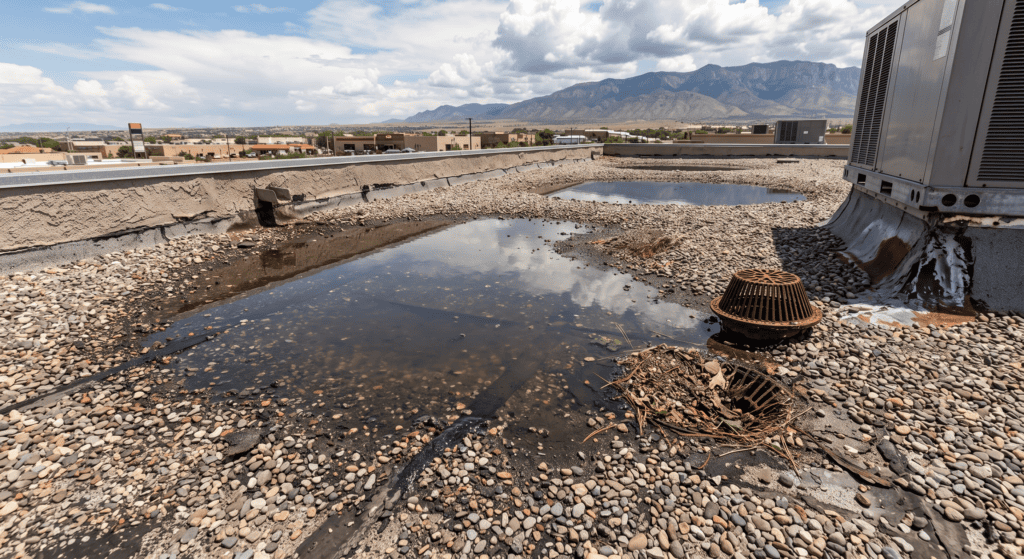
In New Mexico, if you’ve ever looked at your flat roof a day or two after a rainstorm and noticed puddles of water still sitting on the surface, you’re not alone. Ponding water is one of the most common concerns property owners have about flat roofing systems, especially in Albuquerque, Santa Fe, and throughout New Mexico, where seasonal monsoon storms can dump large amounts of rain in a short period of time.
Many homeowners assume a flat roof should drain just like a sloped roof. In reality, most flat roofs are actually low-slope roofing systems that are engineered to direct water toward drains, scuppers, gutters, or other drainage points. While it’s normal for a roof to remain damp immediately after a storm, water that continues to collect in the same areas can indicate that something isn’t functioning as intended.
Ponding water isn’t simply a cosmetic issue. Standing water adds weight to the roof, accelerates the aging of many roofing materials, stresses seams and flashings, and can eventually contribute to leaks, insulation damage, and costly repairs if the underlying drainage problem isn’t corrected. Left unaddressed, what begins as a shallow puddle can gradually shorten the service life of an otherwise sound roofing system.
New Mexico’s climate presents additional challenges. Intense ultraviolet (UV) exposure, dramatic daily temperature swings, seasonal hailstorms, strong winds, and heavy summer monsoon rains all place significant stress on residential and commercial roofing systems. Even a minor drainage problem can become much more serious after repeated storms or years of weather exposure.
At Rocky Mountain Roofing Services, one of the most common concerns encountered during flat roof inspections is standing water that has remained on the roof long after the weather has cleared. With more than 35 years of combined roofing experience serving Albuquerque, Santa Fe, and Central New Mexico, the company has inspected and repaired virtually every type of flat roofing system, including TPO, spray polyurethane foam (SPF), modified bitumen, built-up roofing (BUR), PVC, and roof coating systems. Every inspection focuses on identifying the underlying cause of the drainage problem rather than simply treating the visible symptoms.
In this article, you’ll learn what ponding water actually is, why it develops, how long water should remain on a flat roof, the damage prolonged standing water can cause, and when it’s time to schedule a professional roof inspection.
What Is Ponding Water on a Flat Roof?
Ponding water refers to water that remains on a flat or low-slope roof for an extended period after precipitation has ended instead of draining away through the roof’s drainage system.
Despite the name, a flat roof is rarely perfectly level. Most commercial and residential flat roofs are constructed with a slight slope designed to encourage water to flow toward:
- Roof drains
- Scuppers
- Gutters
- Downspouts
- Interior drainage systems
- Tapered insulation systems
When everything is functioning properly, rainwater gradually moves off the roof without remaining in one location.
Ponding occurs when that drainage process is interrupted.
Instead of flowing away, water collects in depressions or low areas and forms shallow pools that may range from only a few feet across to large sections of the roof.
These low spots can develop because of:
- Minor construction irregularities
- Roof settlement
- Aging roofing materials
- Structural movement
- Deteriorated insulation
- Blocked drainage systems
- Improper roof design
It’s important to understand that ponding water itself is not the root problem. Rather, it is usually a symptom that something within the roofing system or drainage design deserves further evaluation.
One isolated puddle following an unusually heavy rainstorm does not automatically mean a roof is failing. However, if water repeatedly collects in several of the same locations after multiple storms, it should be professionally inspected to determine why drainage has changed.
How Long Is Water Allowed to Remain on a Flat Roof?
One of the most common questions property owners ask is:
“How long should water stay on my flat roof after it rains?”
In general, a properly functioning flat roof should drain within a reasonable period after rainfall ends. Many roofing professionals consider standing water that remains for more than approximately 48 hours after precipitation has stopped to be ponding water that warrants further evaluation.
The 48-hour guideline is commonly referenced throughout the roofing industry because it helps distinguish temporary surface moisture from a recurring drainage issue. However, several factors influence how quickly a roof dries, including:
- The amount of rainfall received
- Roof size
- Drainage design
- Roof slope
- Air temperature
- Humidity
- Wind
- Sun exposure
- Roof surface material
For example, following one of Albuquerque’s summer monsoon storms, a roof may naturally retain some water overnight. If that same water is still present two or three days later under sunny, dry conditions, the drainage system may not be performing as intended.
It’s also worth noting that small amounts of temporary standing water do not automatically require roof replacement. Many roofs continue to perform well for years after localized drainage issues are corrected. The important step is identifying why water is remaining instead of simply assuming the puddle is harmless.
A professional roof inspection can determine whether the cause is as simple as clogged drains or whether more extensive repairs—such as correcting roof slope, replacing deteriorated insulation, repairing flashings, or restoring sections of the roof membrane—may be necessary.
Why Flat Roofs Are More Vulnerable to Ponding Water
Flat roofs provide many advantages. They maximize usable building space, simplify rooftop equipment installation, reduce construction costs for many commercial buildings, and are well suited for many architectural styles found throughout New Mexico.
However, their relatively shallow slope also means they rely on engineered drainage systems rather than gravity alone.
Unlike a steep asphalt shingle roof, where rainwater rapidly runs toward the gutters, flat roofs depend on carefully designed drainage paths. Even relatively minor changes in elevation can affect how efficiently water leaves the roof.
Several characteristics make flat roofs more susceptible to ponding water than steeper roofing systems.
Minimal Roof Slope
Flat roofs typically have only a slight pitch. While sufficient for drainage when properly constructed, that minimal slope leaves less margin for settlement, construction tolerances, or structural movement over time.
Large Roof Surfaces
Commercial buildings often have expansive roof areas capable of collecting significant amounts of water during New Mexico’s heavy summer storms. Larger roof surfaces increase the importance of properly functioning drains, scuppers, and drainage design.
Rooftop Equipment
HVAC systems, evaporative coolers, skylights, vents, solar equipment, and other rooftop penetrations can interrupt natural drainage patterns if water becomes trapped around equipment curbs or flashing details.
Aging Roofing Systems
As roofs age, insulation may compress, decking may settle slightly, and roofing materials can gradually lose their original shape. These subtle changes may create low spots where water repeatedly collects after rain.
Debris Accumulation
Leaves, dirt, roofing granules, wind-blown debris, and even nesting materials can clog roof drains and scuppers. Although Albuquerque and Santa Fe are not heavily forested compared to many regions, seasonal winds frequently carry dust, branches, pine needles, cottonwood debris, and other materials onto rooftops that can interfere with drainage.
Flat roofs are designed to handle water—but only when the entire drainage system is functioning properly. Regular inspections and preventative maintenance help identify small drainage issues before they develop into significant roof repairs or premature roof replacement.
What Are the Most Common Causes of Ponding Water on a Flat Roof?
Ponding water rarely develops because of a single issue. In most cases, it results from one or more drainage problems that gradually worsen over time. Understanding the underlying cause is essential because simply removing the standing water does not solve the problem. Unless the source of the drainage issue is corrected, the same areas are likely to collect water after every significant rainstorm.
During roof inspections throughout Albuquerque, Santa Fe, and surrounding New Mexico communities, Rocky Mountain Roofing Services commonly identifies several conditions that contribute to recurring ponding water. The exact cause varies depending on the roofing system, the age of the building, previous repairs, and local weather conditions.
Insufficient Roof Slope
One of the leading causes of ponding water is inadequate roof slope.
Although flat roofs appear level, they are actually designed with a slight pitch that allows water to flow toward drains or scuppers. If the roof was originally constructed with insufficient slope, water may naturally settle in low areas rather than draining completely.
This can occur because of:
- Design deficiencies
- Construction inaccuracies
- Improper installation
- Renovations that altered roof elevations
- Changes made during previous roof repairs
Even a small difference in elevation can affect drainage across a large roof surface.
Fortunately, inadequate slope does not always require replacing the entire roofing system. In some situations, localized drainage improvements or tapered insulation systems can successfully redirect water toward drainage points.
Structural Settlement
Buildings naturally move over time.
As foundations settle and structural components age, portions of the roof deck may gradually change elevation. While these movements are often small, they can create shallow depressions where water consistently collects.
Settlement may be caused by:
- Normal building movement
- Foundation settlement
- Aging structural framing
- Long-term loading
- Changes in rooftop equipment
- Previous construction modifications
Commercial buildings with large roof spans are especially susceptible because even slight deflection across long distances can create noticeable low spots.
Professional roof inspections help determine whether ponding results from roofing materials alone or whether structural evaluation should also be considered.
Compressed or Deteriorated Roof Insulation
Many modern flat roofs include insulation beneath the roofing membrane.
Over time, insulation can become compressed because of:
- Age
- Moisture intrusion
- Repeated foot traffic
- Heavy rooftop equipment
- Previous leaks
When insulation loses its original thickness, the roof surface above it may begin to sag slightly.
These depressions often become the exact locations where standing water repeatedly develops after storms.
If moisture has entered the insulation, simply repairing the membrane may not fully correct the drainage problem. Wet insulation frequently loses much of its insulating value and may require replacement before proper roof performance can be restored.
Blocked Roof Drains
Roof drains serve as the primary exit point for water on many commercial roofing systems.
When drains become partially or completely blocked, water has nowhere to go.
Common obstructions include:
- Leaves
- Dirt
- Gravel
- Roofing debris
- Pine needles
- Cottonwood seeds
- Bird nests
- Trash
- Wind-blown debris
Although Albuquerque receives relatively little annual rainfall compared to many parts of the country, powerful summer monsoon storms can wash significant amounts of debris across a roof in only a few minutes.
If roof drains are not cleaned regularly, even moderate rainfall may produce standing water.
Routine maintenance is one of the simplest ways to prevent unnecessary ponding.
Clogged Scuppers and Gutters
Many residential flat roofs throughout New Mexico use scuppers rather than interior roof drains.
Scuppers allow water to exit through openings built into parapet walls before flowing into downspouts or collection systems.
If a scupper becomes blocked by leaves, roofing materials, or accumulated debris, water backs up across the roof surface.
Likewise, clogged gutters can prevent water from leaving the roof efficiently, creating ponding near roof edges.
Because debris often accumulates gradually, many property owners don’t realize a drainage problem exists until they notice standing water or an interior roof leak.
Regular cleaning helps keep these drainage components functioning properly.
Poor Drainage Around Rooftop Equipment
Flat roofs often contain numerous penetrations and mechanical equipment, including:
- HVAC units
- Swamp coolers
- Exhaust fans
- Skylights
- Solar equipment
- Plumbing vents
- Electrical conduits
Each penetration interrupts the natural flow of water.
Improperly designed equipment curbs, deteriorated flashing, or poorly planned drainage pathways can allow water to become trapped around these rooftop features.
This is especially common around older evaporative coolers where repeated maintenance, repairs, or equipment replacement has altered the surrounding roofing system.
Instead of flowing freely toward drains, water may collect around the equipment after every storm.
Previous Roofing Repairs That Changed Drainage
Not every roof has been repaired correctly.
Over many years, multiple contractors may have installed patches, coatings, overlays, or localized repairs that unintentionally changed how water moves across the roof.
Examples include:
- Uneven roofing patches
- Excessive roofing cement
- Multiple overlapping membranes
- Improper flashing repairs
- Added roof coatings without correcting drainage
- Incompatible repair materials
While these repairs may temporarily stop a leak, they can also create new low areas where water begins collecting.
An experienced roofing contractor evaluates not only the current leak but also how previous repairs have altered the overall drainage pattern.
Aging Roofing Materials
Roofing materials naturally change as they age.
Over years of exposure to:
- Intense New Mexico sunshine
- High UV radiation
- Temperature fluctuations
- Wind
- Hail
- Snow
- Freeze-thaw cycles
roof membranes gradually expand, contract, and weather.
These changes can contribute to:
- Minor surface irregularities
- Seam movement
- Membrane wrinkling
- Localized depressions
- Reduced drainage performance
Older roofing systems are therefore more likely to develop ponding water than newer installations.
Age alone does not necessarily mean replacement is required, but it does increase the importance of regular inspections.
Why New Mexico’s Climate Makes Ponding Water Worse
New Mexico’s weather creates a unique combination of stresses for flat roofing systems.
Unlike regions with frequent light rainfall, Albuquerque and Santa Fe often experience long dry periods followed by sudden, intense storms.
Heavy monsoon rainfall can place large volumes of water on a roof in a short amount of time.
Afterward, the region’s intense sunshine rapidly heats roofing materials, causing repeated expansion and contraction.
Additional weather factors include:
- High ultraviolet exposure
- Strong seasonal winds
- Wind-driven debris
- Hailstorms
- Snow accumulation
- Freeze-thaw cycles in higher elevations
- Large daily temperature swings
These conditions gradually accelerate the wear of roofing materials while increasing the importance of proper drainage.
A drainage issue that appears minor today can become much more significant after several years of seasonal weather exposure.
For this reason, Rocky Mountain Roofing Services recommends regular roof inspections to identify developing drainage problems before they lead to roof leaks, insulation damage, or more extensive repairs.
What Damage Can Ponding Water Cause?
While a shallow puddle on a flat roof may not seem alarming, standing water should never be ignored. Ponding water often signals an underlying drainage issue, and if it remains on the roof after repeated storms, it can gradually accelerate the deterioration of the roofing system.
The longer water sits in one location, the more opportunity it has to affect roofing materials, seams, flashings, insulation, and even the structural components beneath the roof. In New Mexico, where roofs are subjected to intense ultraviolet (UV) exposure, dramatic temperature swings, monsoon rains, hail, and high winds, ponding water can magnify the effects of normal weathering over time.
Understanding the potential consequences of standing water helps property owners recognize why routine inspections and timely repairs are so important.
Accelerated Roof Membrane Deterioration
Most modern flat roofing systems are designed to withstand years of exposure to the elements. However, they are intended to shed water—not hold it indefinitely.
When water remains in the same area after every storm, roofing materials are exposed to prolonged moisture that can gradually accelerate aging.
Depending on the roofing system, prolonged ponding may contribute to:
- Premature membrane wear
- Loss of protective coatings
- Surface cracking
- Seam deterioration
- Membrane shrinkage
- Increased weathering
- Faster UV degradation around ponding areas
Although roofing materials are manufactured to resist moisture, repeated long-term exposure can reduce their service life compared to roofs that drain properly.
Increased Risk of Roof Leaks
One of the biggest concerns with recurring ponding water is the increased likelihood of leaks.
Standing water places continuous pressure on roofing seams, flashing details, penetrations, and other areas that normally experience only temporary exposure during rain.
Over time, even a small weakness may allow water to enter the roofing assembly.
Common leak locations include:
- HVAC equipment curbs
- Swamp cooler curbs
- Pipe flashings
- Skylights
- Roof drains
- Scuppers
- Expansion joints
- Roof-to-wall transitions
- Membrane seams
Water rarely enters directly beneath the visible puddle. Once inside the roofing system, moisture can travel considerable distances before becoming visible inside the building.
This often makes professional leak detection necessary to identify the true point of entry.
Wet Roof Insulation
Perhaps one of the most expensive consequences of prolonged ponding water is saturated roof insulation.
Once water enters beneath the roofing membrane, insulation may begin absorbing moisture.
Wet insulation can:
- Lose much of its insulating value
- Increase heating and cooling costs
- Add unnecessary weight to the roof
- Delay drying after storms
- Contribute to additional roof deterioration
- Require replacement during repairs
Because insulation is hidden beneath the roofing membrane, property owners may have no indication that moisture is accumulating until leaks appear inside the building.
Professional moisture testing and infrared roof inspections can often help determine whether insulation has been affected.
Interior Water Damage
Roof leaks caused by ponding water may eventually damage the interior of a building.
Depending on where the leak develops, water intrusion may affect:
- Ceiling drywall
- Ceiling tiles
- Paint
- Insulation
- Interior framing
- Flooring
- Electrical fixtures
- Office equipment
- Furniture
- Inventory
- Personal belongings
Commercial property owners may also experience business interruptions if leaks affect occupied workspaces.
Addressing drainage problems before leaks develop is almost always less expensive than repairing both the roof and the building interior.
Mold and Moisture Problems
Persistent roof leaks create favorable conditions for mold growth when building materials remain damp for extended periods.
As discussed in Rocky Mountain Roofing Services’ companion article, “How Quickly Can Mold Start Growing Inside a Ceiling After a Swamp Cooler Leak?”, moisture should be addressed promptly because prolonged dampness increases the likelihood of mold developing on suitable building materials.
Mold concerns are often related to:
- Wet drywall
- Ceiling insulation
- Wood framing
- Ceiling cavities
- Dust and organic debris
The roofing contractor’s role is to identify and repair the source of water intrusion. Water mitigation and mold remediation, when necessary, should be performed by appropriately qualified professionals.
Added Weight on the Roof Structure
Water is surprisingly heavy.
One inch of water weighs approximately 5.2 pounds per square foot.
While properly designed roofs account for temporary rain loads, large areas of standing water increase the amount of weight the roof must continuously support.
For example:
| Ponding Area | Approximate Additional Water Weight |
| 100 square feet | About 520 pounds per inch of water |
| 500 square feet | About 2,600 pounds per inch of water |
| 1,000 square feet | About 5,200 pounds per inch of water |
If water repeatedly accumulates in the same low area, that additional weight may contribute to further structural deflection, creating an even deeper depression that collects more water during future storms.
This cycle is one reason ponding water should be evaluated rather than ignored.
Damage to Roof Flashings
Flashing protects many of the roof’s most vulnerable transitions.
Examples include:
- Parapet walls
- Chimneys
- Roof penetrations
- Equipment curbs
- Expansion joints
- Skylights
Standing water may expose these flashing details to prolonged moisture, increasing the opportunity for deterioration if the flashing has already begun aging.
Routine inspections help identify loose flashing, failed sealants, and minor defects before they become active roof leaks.
Faster Deterioration Around Rooftop Equipment
Commercial roofs frequently contain mechanical equipment that interrupts normal drainage patterns.
Examples include:
- HVAC systems
- Swamp coolers
- Exhaust fans
- Solar equipment
- Satellite equipment
- Vent pipes
Water that repeatedly collects around these components can increase wear on surrounding roofing materials and flashing details.
Because these areas are already among the most common locations for roof leaks, proper drainage is especially important.
Can Ponding Water Void a Roofing Warranty?
This is a question many property owners ask after discovering standing water.
The answer depends on the specific roofing system and the warranty provided by the manufacturer or installer.
Some commercial roofing warranties contain provisions regarding excessive ponding water, while others may continue providing coverage under certain conditions.
Warranty language varies considerably based on:
- Manufacturer
- Roofing material
- Installation method
- Commercial or residential application
- Maintenance history
- Cause of the drainage issue
Rather than assuming coverage exists—or doesn’t—property owners should review their warranty documentation and have the roof inspected if recurring ponding develops.
An inspection can help determine whether the drainage problem requires maintenance, localized repairs, or more extensive corrective work.
When Should You Schedule a Professional Roof Inspection?
Not every puddle requires emergency repairs.
However, professional evaluation is recommended when:
- Water remains on the roof more than approximately 48 hours after rainfall.
- Ponding occurs after nearly every storm.
- Interior water stains appear.
- Roof drains frequently clog.
- The ponding area continues growing larger.
- Sagging roof areas become visible.
- Roof coatings begin cracking or peeling.
- Membrane seams show signs of separation.
- Flashing appears loose or damaged.
- The roof is approaching the later years of its expected service life.
A comprehensive roof inspection identifies not only where water is collecting, but why.
Rocky Mountain Roofing Services evaluates the entire roofing system—including drainage components, flashing details, roof penetrations, insulation conditions when appropriate, and overall roof performance—to recommend the most practical long-term solution rather than simply addressing the visible symptom.
By identifying drainage problems early, many property owners can avoid more extensive repairs and help extend the useful life of their flat roofing system.
How Is Ponding Water on a Flat Roof Repaired?
The best solution for ponding water depends entirely on why the water is collecting in the first place. A roof that develops standing water because of a clogged drain requires a very different repair than one with structural settlement or deteriorated insulation.
That’s why experienced roofing contractors begin with a comprehensive inspection instead of immediately recommending a repair or replacement.
At Rocky Mountain Roofing Services, every flat roof inspection focuses on identifying the root cause of the drainage issue. Once the cause has been determined, the appropriate repair strategy can be developed to improve drainage, protect the roofing system, and help extend its service life.
Cleaning Roof Drains, Scuppers, and Gutters
Sometimes the simplest solution is the correct one.
Leaves, dirt, roofing granules, wind-blown debris, and nesting materials can partially or completely block drainage components, preventing water from leaving the roof.
Routine maintenance often includes:
- Cleaning roof drains
- Removing debris from scuppers
- Clearing gutters and downspouts
- Inspecting drain strainers
- Checking for damaged drainage components
- Verifying proper water flow
Because New Mexico experiences seasonal high winds and summer monsoon storms, roof drains should be inspected regularly, especially on commercial buildings with large flat roof surfaces.
Repairing Damaged Roofing Membranes
If ponding water has contributed to leaks or membrane deterioration, localized roof repairs may restore the waterproof integrity of the roofing system.
Depending on the roof type, repairs may involve:
- Repairing membrane seams
- Replacing damaged flashing
- Installing compatible membrane patches
- Resealing penetrations
- Repairing roof coatings
- Correcting punctures or tears
Each roofing material has its own repair procedures.
For example:
- TPO roofing uses heat-welded membrane repairs.
- Spray polyurethane foam (SPF) roofs often require recoating or foam restoration.
- Modified bitumen systems may require membrane patches or flashing repairs.
- Built-up roofing (BUR) repairs depend on the age and condition of the roofing layers.
Using repair materials compatible with the existing roofing system is essential for long-term performance.
Correcting Low Areas with Tapered Insulation
If ponding results from shallow depressions rather than structural movement, tapered insulation may provide an effective solution.
Unlike standard insulation, tapered insulation gradually changes thickness across the roof, creating a subtle slope that encourages water to flow toward drains or scuppers.
Benefits include:
- Improved drainage
- Reduced standing water
- Better roof performance
- Increased energy efficiency
- Extended roof life
Tapered insulation is commonly incorporated during roof replacement projects but may also be appropriate during certain roof restoration projects.
Improving Roof Drainage Design
Occasionally, the original drainage system simply does not move water efficiently.
Depending on the roof’s configuration, improvements may include:
- Adding roof drains
- Installing additional scuppers
- Modifying drainage pathways
- Improving gutter capacity
- Redirecting water around rooftop equipment
- Correcting drainage obstructions
Commercial buildings often benefit from drainage improvements because even modest design changes can significantly reduce recurring ponding.
Replacing Wet Insulation
If water has penetrated beneath the roofing membrane, the insulation below may require replacement.
Wet insulation rarely dries completely once saturated beneath a roofing system.
Replacing damaged insulation helps restore:
- Proper roof slope
- Thermal performance
- Energy efficiency
- Structural integrity of the roofing assembly
Moisture testing during a professional roof inspection helps determine whether insulation replacement is necessary or whether repairs can remain localized.
Roof Coating Restoration
Many commercial flat roofs throughout New Mexico utilize elastomeric, acrylic, or silicone roof coating systems.
When appropriate, restoring these coatings may:
- Improve weather resistance
- Increase UV protection
- Seal minor surface imperfections
- Extend roof service life
However, roof coatings should not be viewed as a solution for major drainage problems.
Applying a new coating over a roof with significant ponding water without correcting the underlying drainage issue is unlikely to provide lasting results.
The drainage problem should always be addressed first.
When Is Roof Replacement the Better Option?
Not every roof with ponding water needs replacement.
However, replacement may become the most practical long-term investment when multiple conditions exist simultaneously.
These may include:
- Extensive membrane deterioration
- Repeated roof leaks
- Widespread wet insulation
- Significant structural settlement
- Numerous previous repairs
- Advanced roof age
- Chronic drainage failures
- Roof nearing the end of its expected service life
Rather than repeatedly investing in temporary repairs, replacing the roofing system may provide lower long-term ownership costs while improving drainage, energy efficiency, and reliability.
An experienced roofing contractor can explain whether repairs remain practical or whether replacement offers greater long-term value.
Repair vs. Replacement Comparison
| Condition | Repair May Be Appropriate | Replacement May Be Appropriate |
| Clogged drains or scuppers | ✓ | |
| Minor membrane damage | ✓ | |
| Localized flashing failure | ✓ | |
| Small isolated ponding areas | ✓ | |
| Localized insulation damage | ✓ | |
| Widespread wet insulation | ✓ | |
| Extensive membrane deterioration | ✓ | |
| Repeated leaks across multiple areas | ✓ | |
| Significant structural drainage issues | ✓ | |
| Roof at end of expected lifespan | ✓ |
Every roofing system is unique. A professional inspection provides the information needed to make an informed decision rather than relying on assumptions.
Frequently Asked Questions
Is ponding water normal on a flat roof?
Small amounts of water may remain temporarily after heavy rainfall, but water that repeatedly remains on the roof for approximately 48 hours or longer should be evaluated to determine whether a drainage problem exists.
Can ponding water cause my roof to leak?
Yes. Although standing water does not automatically cause leaks, it increases the amount of time roofing materials, seams, and flashing remain exposed to moisture. Existing weaknesses are more likely to allow water intrusion.
Does every low spot mean I need a new roof?
No. Many drainage problems can be corrected through maintenance or targeted repairs. A professional inspection helps determine the most appropriate solution.
How often should a flat roof be inspected?
Rocky Mountain Roofing Services generally recommends professional roof inspections at least once each year and after major hailstorms, windstorms, or severe monsoon events. Commercial buildings may benefit from more frequent preventative maintenance inspections.
Can I remove ponding water myself?
Removing standing water without identifying why it accumulated only addresses the symptom. Walking on a wet roof can also create safety risks. Property owners should avoid unnecessary rooftop access and have recurring ponding professionally evaluated.
Conclusion
Ponding water is more than a puddle left behind after a rainstorm. It is often an early indicator that a flat roofing system is not draining as efficiently as it should. Whether the cause is a blocked drain, deteriorated insulation, structural settlement, aging roofing materials, or an issue with the roof’s original design, addressing the problem early can help prevent more extensive damage in the future.
Throughout Albuquerque, Santa Fe, and Central New Mexico, flat roofs face demanding conditions that include intense UV exposure, monsoon rains, hail, high winds, and dramatic temperature swings. These environmental factors make routine inspections and preventative maintenance especially important for protecting both residential and commercial roofing systems.
At Rocky Mountain Roofing Services, every inspection begins with identifying the underlying cause of the drainage issue—not simply treating the visible symptoms. With more than 35 years of combined roofing experience, our team provides honest evaluations and practical recommendations designed to maximize the life of your roofing investment while helping you avoid unnecessary repairs or premature replacement.
If you’ve noticed standing water remaining on your flat roof after recent storms, don’t wait for it to become an expensive roof leak. A professional inspection can identify developing problems before they lead to significant damage.
Schedule Your Flat Roof Inspection Today
Whether you own a home, commercial building, office, retail center, warehouse, or multi-family property, Rocky Mountain Roofing Services is ready to help.
Our experienced roofing professionals provide:
- Flat roof inspections
- Roof leak detection
- TPO roofing repairs
- Spray foam roofing services
- Roof drainage improvements
- Commercial roof maintenance
- Residential roof repair
- Roof replacement consultations
- Preventative maintenance programs
Serving Albuquerque, Santa Fe, Rio Rancho, Corrales, Bernalillo, Placitas, Los Lunas, Belen, Edgewood, and communities throughout Central and Northern New Mexico, Rocky Mountain Roofing Services is committed to delivering honest recommendations, quality workmanship, and long-lasting roofing solutions built for New Mexico’s unique climate.
Contact Rocky Mountain Roofing Services today to schedule a professional roof inspection and protect your property from the long-term effects of ponding water.