
TPO vs. PVC Roofing: Which Is Better?
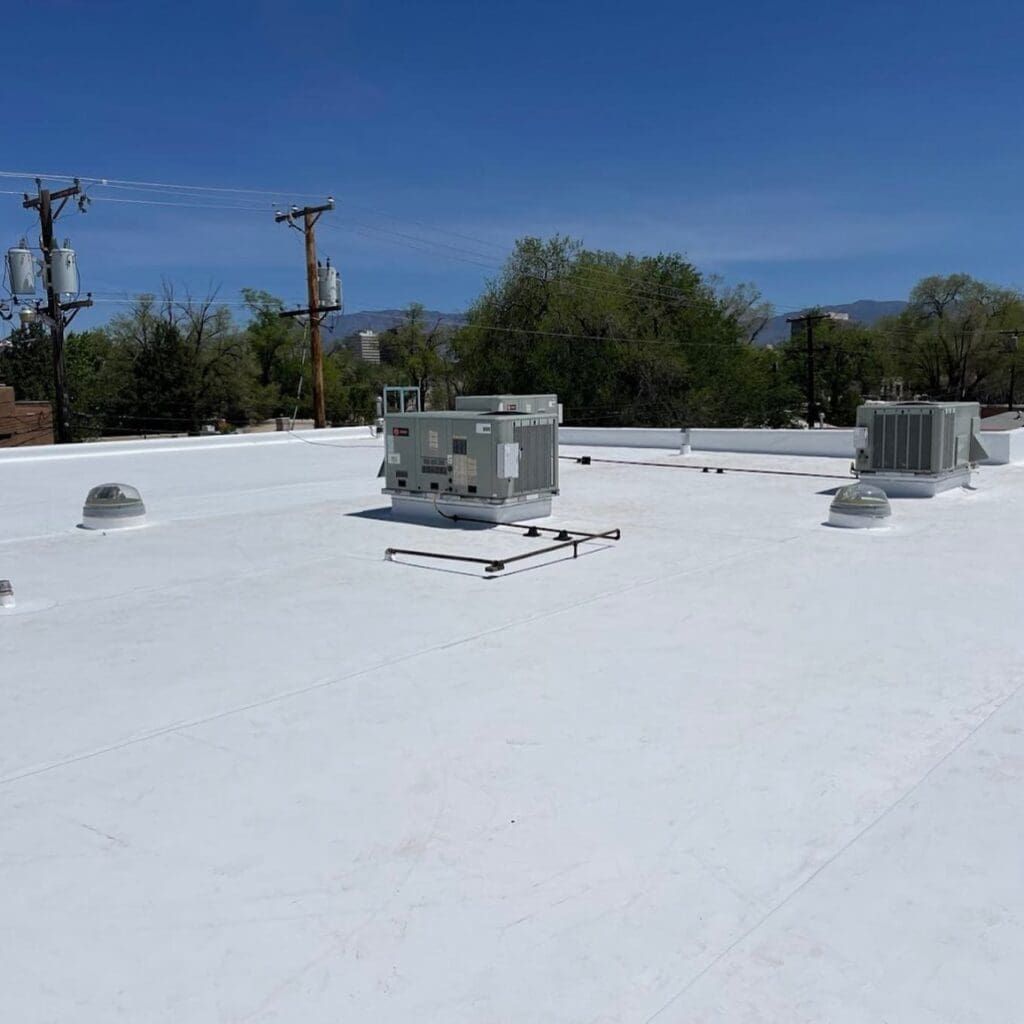
Neither TPO nor PVC is universally better. Both are reflective, heat-welded single-ply membranes commonly used on flat and low-slope roofs. TPO is often attractive for broad commercial roofing applications and overall value, while PVC can be particularly useful where chemical, grease, or oil exposure is a concern. The better choice depends on the building, roof assembly, exposure, and long-term performance goals.
That distinction matters for commercial property owners in New Mexico.
From the ground, a white TPO roof and a white PVC roof may look almost identical. Both can provide reflective surfaces, both can be installed on commercial flat and low-slope roofs, and both use heat-welded seams.
But TPO and PVC are different materials with different characteristics.
Choosing between them should involve more than asking which membrane is “best.”
A restaurant with rooftop kitchen exhaust may have very different roofing requirements than an office building in Albuquerque. A warehouse with frequent rooftop mechanical work presents different concerns than a retail property in Santa Fe. Existing insulation, drainage, roof penetrations, budget, building use, weather exposure, and long-term maintenance plans can all influence the decision.
Understanding those differences is the starting point for choosing the right flat roofing system.
What Is the Main Difference Between TPO and PVC Roofing?
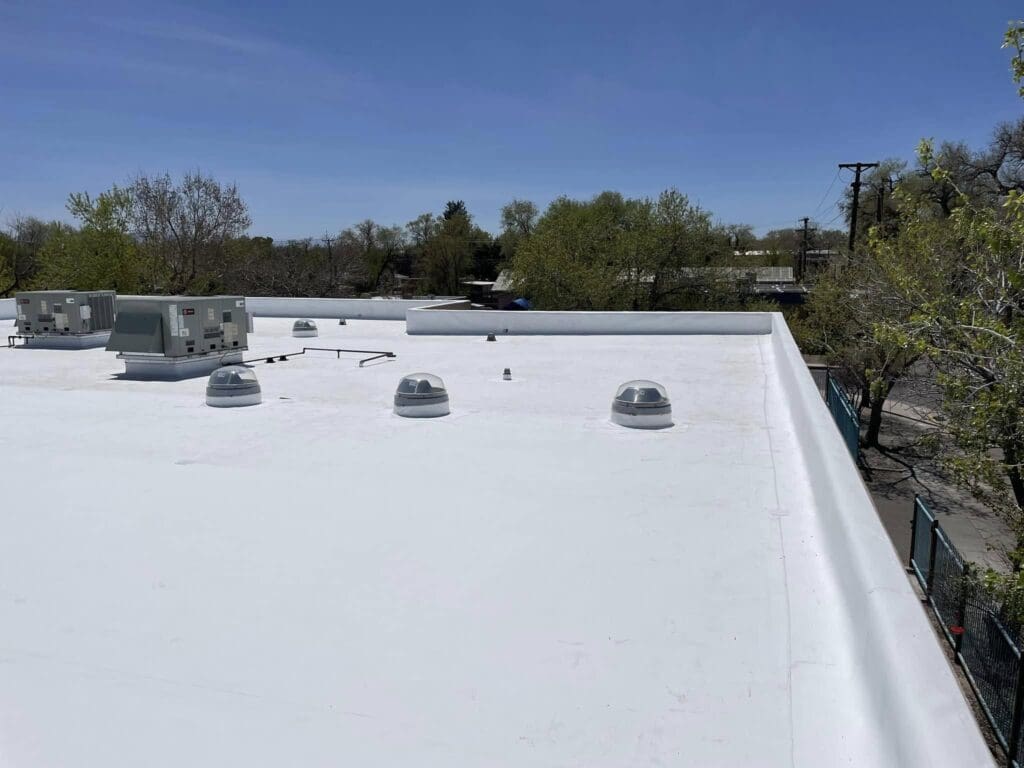
TPO and PVC are both thermoplastic single-ply roofing membranes, but they are made from different materials.
TPO stands for thermoplastic polyolefin.
PVC stands for polyvinyl chloride.
Both roofing systems are commonly supplied as flexible membrane sheets that are installed over an appropriate roof assembly. Adjacent sheets are joined using hot-air welding equipment.
The resulting welded seams are one of the major characteristics of thermoplastic roofing systems.
If you are unfamiliar with TPO itself, our guide explaining what is a TPO roof provides a more detailed introduction to the system and its suitability for New Mexico.
PVC has a longer history in commercial roofing and is particularly well known for resistance to many chemicals, oils, and greases.
TPO has become widely used for commercial roofing because it combines reflective properties, heat-welded seams, flexibility, and broad applicability across many types of buildings.
The key is not deciding that one material is always better.
It is determining which membrane better fits the conditions on a particular roof.
TPO vs. PVC Roofing: How Do They Compare?
Here is a practical overview.
| Roofing Factor | TPO Roofing | PVC Roofing |
| Membrane type | Thermoplastic single-ply | Thermoplastic single-ply |
| Common roof type | Flat and low-slope roofs | Flat and low-slope roofs |
| Seams | Heat welded | Heat welded |
| Reflective options | Yes | Yes |
| Commercial use | Very common | Very common |
| Chemical/grease resistance | Varies by product and exposure | Often a major strength of PVC |
| Restaurants/food-service roofs | May be appropriate depending on conditions | Often considered where grease exposure is significant |
| Installation quality | Critical | Critical |
| Drainage requirements | Proper drainage is important | Proper drainage is important |
| Maintenance | Regular inspections recommended | Regular inspections recommended |
| Repairability | Often repairable when conditions allow | Often repairable when conditions allow |
| New Mexico suitability | Can perform well when properly specified | Can perform well when properly specified |
| Best choice | Depends on building and roof conditions | Depends on building and roof conditions |
This comparison demonstrates why asking TPO or PVC? requires additional questions about the property.
What Is TPO Roofing?
TPO is a flexible single-ply membrane used extensively on commercial flat and low-slope roofs.
A typical TPO roofing assembly may include:
- Structural roof deck
- Insulation
- Cover board where specified
- TPO membrane
- Adhesive or mechanical attachment
- Heat-welded seams
- Flashing
- Roof drains or scuppers
- Perimeter and edge components
TPO is frequently manufactured in white and other reflective colors.
Its reflective surface can be particularly attractive in sunny environments such as Albuquerque and other parts of New Mexico because reducing solar heat absorption at the roof surface can be beneficial for many commercial buildings.
However, reflectivity should never be confused with immunity to New Mexico weather.
A TPO roof still has to contend with UV exposure, hail, high winds, temperature changes, monsoon rainfall, rooftop traffic, drainage conditions, and normal aging.
Installation and preventative maintenance therefore remain important throughout the roof’s service life.
What Is PVC Roofing?
PVC is another thermoplastic single-ply roofing membrane commonly used on commercial flat and low-slope roofs.
Like TPO, PVC sheets can be joined with heat-welded seams to create a continuous roofing surface.
PVC’s material formulation gives it characteristics that can be particularly useful for certain commercial and industrial buildings.
One of the most important is resistance to many chemicals, oils, fats, and greases.
That can make PVC worth considering for buildings such as:
- Restaurants
- Commercial kitchens
- Food-processing facilities
- Certain manufacturing facilities
- Buildings with grease-producing rooftop exhaust
- Certain industrial properties
This does not mean every restaurant automatically needs PVC.
Nor does it mean every PVC product can tolerate every chemical.
The exact membrane and manufacturer specifications should always be evaluated against the actual substances to which the roof may be exposed.
But building use can be an important factor when comparing PVC vs. TPO roofing.
Do TPO and PVC Both Have Heat-Welded Seams?
Yes.
This is one of the major similarities between the two roofing systems.
During installation, hot-air welding equipment is used to fuse overlapping membrane sections together.
When properly prepared and welded, these seams form strong, weather-resistant connections.
The quality of those seams matters.
Problems can occur when installation conditions, surface preparation, equipment settings, workmanship, contamination, or other factors interfere with proper welding.
This is why the name printed on the membrane does not determine roof performance by itself.
A high-quality roofing membrane installed poorly can develop problems.
A properly specified roofing system also needs careful attention around:
- Drains
- Scuppers
- Roof edges
- HVAC curbs
- Pipes
- Vents
- Skylights
- Exhaust equipment
- Other penetrations
In many real-world roof leak investigations, details such as flashing and penetrations deserve just as much attention as the membrane itself.
Which Is Better for New Mexico Sun and Heat?
Both TPO and PVC are available as reflective roofing membranes and can be appropriate for sunny climates.
That is valuable in New Mexico, where commercial roofs may experience prolonged exposure to intense sunshine.
White and other reflective roof surfaces can reflect a larger portion of incoming solar energy than many darker roof surfaces, helping reduce roof surface heat absorption.
But New Mexico creates a more complicated roofing environment than simply “hot and sunny.”
Commercial roofs in Albuquerque, Santa Fe, and surrounding communities can face:
- Intense ultraviolet exposure
- High elevation
- Large daytime-to-nighttime temperature swings
- High winds
- Hailstorms
- Monsoon rainfall
- Snow in colder and higher-elevation locations
- Freeze-thaw cycles
Neither TPO nor PVC should therefore be selected solely because it is white.
The entire roofing assembly has to perform under local conditions.
How Does High UV Exposure Affect TPO and PVC?
All exposed roofing materials experience weathering over time.
New Mexico’s intense sunshine and high elevation make UV exposure an especially important consideration.
Roof membranes, flashing, sealants, coatings, and other exposed components can gradually age as they remain exposed to sunlight and weather.
Both TPO and PVC systems should therefore be evaluated based on the specific membrane, manufacturer, thickness, roof assembly, installation requirements, and expected conditions.
Regular professional roof inspections can also help identify deterioration before it develops into a more serious roofing problem.
Reflectivity is helpful.
Maintenance is still necessary.
Which Roofing Membrane Handles Chemicals and Grease Better?
This is one area where PVC can have an important advantage.
PVC roofing is widely recognized for resistance to many chemicals, oils, fats, and greases.
That characteristic can make PVC particularly relevant on commercial buildings where rooftop contaminants are a regular concern.
Consider a restaurant.
Kitchen exhaust equipment may discharge grease-containing air near or onto portions of the roof. Over time, contaminants can accumulate around exhaust areas.
A roofing membrane that is poorly suited to that exposure could deteriorate prematurely.
For this reason, PVC is frequently considered for food-service buildings and certain industrial properties.
However, chemical resistance should never be generalized too broadly.
If a roof will be exposed to a particular chemical, oil, grease, or industrial substance, the roofing professional should verify the membrane manufacturer’s compatibility information for that specific exposure.
Is PVC Better for Restaurants?
PVC may be an especially strong candidate for restaurants and other buildings where grease exposure is expected.
But the correct answer depends on the actual building.
A restaurant roof should be evaluated for:
- Kitchen exhaust locations
- Grease exposure
- HVAC equipment
- Roof drainage
- Existing membrane
- Insulation
- Rooftop traffic
- Equipment service areas
- Roof slope
- Penetrations
- Overall roof design
The membrane is only one component.
If grease routinely collects around an exhaust fan, for example, the roof may also require appropriate maintenance practices and careful attention to the flashing surrounding that equipment.
Selecting a suitable membrane does not eliminate the need for roof maintenance.
Which Is More Resistant to Punctures: TPO or PVC?
There is no responsible universal answer that applies to every TPO and PVC product.
Puncture resistance can be affected by:
- Membrane formulation
- Membrane thickness
- Reinforcement
- Cover board
- Insulation
- Substrate
- Roof assembly
- Age
- Temperature
- Installation
- Type of impact
That means comparing two membranes based solely on the letters “TPO” and “PVC” can be misleading.
The underlying roof assembly can make a substantial difference.
This is particularly important on commercial roofs with frequent foot traffic.
HVAC technicians, electricians, maintenance personnel, telecommunications workers, and other contractors may repeatedly access rooftop equipment.
Tools, fasteners, equipment panels, and other sharp objects can potentially damage single-ply membranes.
Walkway systems or additional protection may therefore be appropriate around heavily traveled areas regardless of which membrane is selected.
Which Is Better for Hail?
Neither membrane should be assumed to be hail-proof.
Hail performance depends on much more than whether the roof is TPO or PVC.
Important factors can include:
- Hailstone size
- Wind speed
- Impact angle
- Membrane thickness
- Membrane condition
- Cover board
- Insulation
- Substrate
- Complete roof assembly
New Mexico hail can be severe enough to damage many types of roofing systems.
Following a significant hailstorm, the appropriate response is not to assume a TPO or PVC roof survived because no water immediately appeared inside the building.
Some damage may require a closer inspection to identify.
A post-storm commercial roof inspection can help identify punctures, impact damage, flashing problems, and other concerns before another storm exposes them.
Which Handles New Mexico Wind Better?
Both TPO and PVC systems can be designed for wind resistance when properly specified and installed.
The more important questions involve the roof assembly and attachment system.
Wind performance can depend on:
- Attachment method
- Fastener pattern
- Adhesive
- Roof deck
- Perimeter design
- Edge details
- Building height
- Roof geometry
- Local wind requirements
- Installation quality
Wind pressures can be particularly significant around roof perimeters and corners.
Strong New Mexico winds can also move debris across commercial roofs, damage rooftop equipment, or expose weaknesses in flashing and edge components.
Once again, membrane selection is only one part of long-term performance.
How Do Temperature Swings Affect TPO and PVC Roofing?
Albuquerque and Santa Fe can experience significant temperature differences between daytime and nighttime.
Roofing materials heat up and cool down as conditions change.
That causes components to expand and contract.
This repeated movement is commonly called thermal cycling.
Thermoplastic roofing systems are designed to accommodate movement, but repeated expansion and contraction can still place stress on:
- Seams
- Flashing
- Perimeters
- Penetrations
- Attachment points
- Roof edges
Proper installation becomes particularly important under these conditions.
A poorly detailed penetration or marginal seam may not leak immediately after installation.
Repeated weather exposure and movement can eventually reveal weaknesses.
Which Is Better for Ponding Water?
Neither TPO nor PVC should be viewed as a substitute for proper drainage.
Flat roofs should be designed so water moves toward drains, scuppers, or other drainage points.
When water remains on the roof long after rainfall, the underlying cause should be investigated.
Potential causes include:
- Clogged drains
- Blocked scuppers
- Inadequate slope
- Compressed insulation
- Structural deflection
- Poor drainage design
- Changes from previous roofing work
Persistent ponding water can also collect dirt and debris and increase stress on portions of the roofing assembly.
The solution is not simply choosing TPO instead of PVC—or PVC instead of TPO.
The drainage problem itself should be addressed.
Which Lasts Longer: TPO or PVC?
There is no single lifespan number that can reliably determine which system will last longer on every New Mexico building.
Roof service life depends on many variables, including:
- Product selection
- Membrane thickness
- Complete roof assembly
- Installation quality
- Welded seams
- Flashing
- Drainage
- UV exposure
- Weather
- Hail and wind damage
- Rooftop traffic
- Maintenance
- Repair history
PVC has a long history in commercial roofing, while modern TPO has become one of the widely used single-ply roofing choices.
But an expertly installed and maintained TPO roof may outperform a poorly installed PVC roof.
The reverse can also be true.
Property owners researching TPO roof lifespan should therefore resist treating expected service-life ranges as guarantees.
Condition matters more than a marketing number.
Is TPO Less Expensive Than PVC?
TPO is often considered when overall project value is an important factor, while PVC can involve different material and system costs.
However, there is no reliable universal price difference that applies to every project.
Commercial roofing costs depend on much more than the membrane.
Factors can include:
- Roof size
- Existing roofing system
- Tear-off requirements
- Insulation
- Cover board
- Membrane thickness
- Attachment method
- Roof access
- Drainage work
- Number of penetrations
- HVAC equipment
- Flashing complexity
- Labor requirements
- Manufacturer and system specifications
The lowest initial material cost does not necessarily produce the lowest long-term roofing cost.
If a building has substantial grease or chemical exposure, for example, selecting a membrane because it costs less initially could be a poor decision if that membrane is not appropriate for the exposure.
Rocky Mountain Roofing Services’ approach is to evaluate the roof and recommend a system based on long-term value rather than competing primarily on price.
Can TPO and PVC Roofs Be Repaired?
Yes, depending on the roof’s condition.
Both systems can often be repaired when damage is localized and the surrounding roofing materials remain serviceable.
Potential repair areas include:
- Punctures
- Tears
- Seams
- Flashing
- Roof edges
- Drains
- Penetrations
- HVAC curbs
- Storm-damaged sections
Before recommending commercial roof repair, however, the roofing professional should determine why the problem developed.
Repairing a puncture makes sense when the puncture is the problem.
Repairing the same leak repeatedly without addressing failed drainage, widespread wet insulation, or another underlying problem does not.
Accurate diagnosis should come before repair.
Can TPO Be Installed Over PVC or PVC Over TPO?
Possibly in some roofing assemblies, but this should not be treated as a universal installation rule.
Re-roofing over an existing membrane requires evaluating several factors, including:
- Existing membrane
- Roof condition
- Moisture
- Insulation
- Roof deck
- Attachment
- Compatibility
- Separator or cover-board requirements
- Drainage
- Building-code requirements
- Manufacturer specifications
Wet or badly deteriorated roofing materials should not simply be hidden beneath a new membrane without proper evaluation.
A professional inspection can help determine whether the existing roof is a suitable candidate for a recover system or whether removal and replacement are more appropriate.
How Important Is Installation Quality?
Extremely important.
The debate over TPO vs. PVC roofing sometimes places so much attention on membrane chemistry that installation quality gets overlooked.
A commercial roof is a system.
Performance depends on:
- Correct substrate preparation
- Proper insulation
- Appropriate attachment
- Correct membrane installation
- Properly welded seams
- Flashing details
- Roof edges
- Penetrations
- Drainage
- Manufacturer requirements
- Final inspection
A technically excellent membrane cannot compensate for poor workmanship.
That is particularly important in New Mexico, where UV exposure, temperature swings, high winds, hail, monsoon storms, snow, and freeze-thaw cycles can expose installation weaknesses over time.
How Often Should TPO and PVC Roofs Be Inspected?
Annual roof inspections are a practical baseline for commercial roofing maintenance.
Additional inspections are advisable after significant storms or when work has been performed on rooftop equipment.
Rocky Mountain Roofing Services recommends maintenance activities that can include:
- Annual inspections
- Post-storm inspections
- Roof drain cleaning
- Flashing inspections
- Debris removal
- Monitoring roof penetrations
- Prompt repair of minor leaks
- Preventative commercial roof maintenance
This approach applies whether the roof uses TPO, PVC, or another commercial roofing system.
A roof should not have to be actively leaking before someone looks at it.
The purpose of preventative roof maintenance is to find small problems before they develop into expensive ones.
Which Is Better for Albuquerque Commercial Buildings?
Both TPO and PVC can be appropriate for Albuquerque commercial properties.
A typical office, retail, warehouse, multi-family, church, or similar commercial property may find TPO an attractive option when the building needs a reflective single-ply system and there is no unusual chemical or grease exposure.
PVC may deserve stronger consideration when the building’s operations expose the roof to grease, oils, or certain chemicals.
But Albuquerque conditions also require attention to:
- Intense sunshine
- UV exposure
- Hot roof temperatures
- Large temperature swings
- Hail
- High winds
- Monsoon rainfall
- Rooftop HVAC equipment
The right Albuquerque roofing contractor should evaluate those conditions along with the existing roof assembly before recommending a membrane.
Which Is Better for Santa Fe Commercial Buildings?
The same basic decision process applies in Santa Fe, but elevation and winter weather deserve additional consideration.
Santa Fe commercial roofs can experience:
- Strong solar exposure
- Cold winter temperatures
- Snow
- Freeze-thaw cycles
- High winds
- Hail
- Large temperature changes
Both TPO and PVC can be considered for properly designed commercial roofing applications.
As in Albuquerque, building use matters.
A Santa Fe restaurant with rooftop kitchen exhaust may present a different membrane-selection decision than an office or retail building with no grease exposure.
The goal should be matching the roofing system to the building rather than choosing a membrane based solely on popularity.
When May TPO Be the Better Choice?
TPO may deserve strong consideration when:
- A reflective single-ply commercial roof is desired
- The building has no unusual chemical or grease exposure
- Overall project value is important
- The roof is appropriate for a TPO assembly
- Manufacturer and project specifications support the system
- Experienced TPO installation is available
TPO is used on a wide variety of commercial buildings and can provide a practical roofing solution when correctly specified, installed, and maintained.
When May PVC Be the Better Choice?
PVC may deserve stronger consideration when:
- The roof is exposed to grease
- Oils are a concern
- Certain chemical exposures are present
- The building contains commercial kitchen exhaust
- The facility’s use makes chemical resistance an important design consideration
- Project specifications favor an appropriate PVC system
Again, exact chemical compatibility should be verified for the specific membrane rather than assumed.
What Should You Ask Before Choosing TPO or PVC?
Instead of starting with “Which membrane is better?” ask five more useful questions.
1. How is the building used?
Restaurants, industrial facilities, warehouses, offices, retail properties, churches, and multi-family buildings can have very different roofing exposures.
2. What is already on the roof?
The existing membrane, insulation, deck, drainage, and moisture conditions can affect the replacement or recover strategy.
3. What happens on the roof?
Frequent HVAC maintenance or other rooftop traffic may require additional protection.
4. How does the roof drain?
Membrane choice does not correct poor drainage.
5. What are the long-term goals?
Initial cost, maintenance, expected building ownership, energy considerations, future rooftop equipment, warranty requirements, and long-term performance can all affect the decision.
Those questions provide far more useful information than simply comparing product names.
Frequently Asked Questions About TPO vs. PVC Roofing
What is the main difference between TPO and PVC roofing?
Both are thermoplastic single-ply roofing membranes with heat-welded seams, but they have different chemical compositions and performance characteristics. PVC is particularly recognized for resistance to many chemicals, oils, and greases, while TPO is widely used across general commercial roofing applications.
Is PVC roofing better than TPO?
Not universally. PVC may be preferable for certain grease or chemical exposures, while TPO can be an excellent choice for many other commercial buildings. Building conditions should determine the recommendation.
Is TPO roofing less expensive than PVC?
TPO is often considered for value-conscious commercial applications, but project costs vary widely. Roof size, insulation, tear-off, membrane specifications, drainage, flashing, access, labor, and other factors affect final pricing.
Which lasts longer, TPO or PVC?
Neither has one guaranteed lifespan that applies to every roof. Installation quality, product selection, weather, maintenance, drainage, rooftop traffic, storm damage, and the complete roof assembly influence actual service life.
Which is better for New Mexico sun and heat?
Both are available in reflective configurations and can be appropriate for New Mexico. Selection should consider the complete roofing assembly, product specifications, UV exposure, temperature swings, building use, and maintenance requirements.
Are both TPO and PVC considered cool roofs?
Both are available in light-colored, highly reflective configurations commonly used as cool-roof solutions. Actual reflectance and performance depend on the specific product.
Which membrane handles chemicals and grease better?
PVC is widely recognized for resistance to many chemicals, oils, fats, and greases. Exact compatibility should still be confirmed with the membrane manufacturer for the specific exposure.
Which is better for restaurants or buildings with kitchen exhaust?
PVC can be particularly valuable where grease from commercial kitchen exhaust may contact the roof. The complete building and roofing conditions should still be evaluated before choosing a membrane.
Which is more resistant to punctures?
That cannot be determined from the membrane name alone. Thickness, reinforcement, cover board, substrate, roof assembly, product formulation, age, and type of impact all influence puncture resistance.
Do TPO and PVC both use heat-welded seams?
Yes. Both thermoplastic systems commonly use hot-air welding to join membrane sheets.
Can TPO and PVC roofs be repaired?
Yes, when roof conditions permit. Localized punctures, seams, flashing, penetrations, and other damaged areas may often be repairable if the surrounding roofing system remains serviceable.
Can you install TPO over an existing PVC roof or PVC over TPO?
It may be possible in some properly designed recover assemblies, but compatibility, moisture, insulation, substrate, separator requirements, building codes, and manufacturer specifications must first be evaluated.
Which roofing system is better for ponding water?
Neither should be used as a substitute for proper roof drainage. Persistent ponding should be investigated and its underlying cause corrected.
How often should TPO and PVC roofs be inspected?
Annual inspections are a practical baseline, along with additional inspections after significant hail, wind, snow, or other severe weather and after major rooftop mechanical work.
How do I choose between TPO and PVC for a New Mexico commercial building?
Start with the building rather than the membrane. Evaluate building use, chemical or grease exposure, existing roof conditions, insulation, drainage, rooftop equipment, climate exposure, budget, manufacturer requirements, maintenance needs, and long-term goals.
So, Which Is Better: TPO or PVC Roofing?
For most property owners, the answer to TPO vs. PVC roofing should not be reduced to one membrane being “better.”
Both are proven categories of single-ply commercial roofing.
Both use heat-welded seams.
Both are available in reflective configurations.
Both can perform well on properly designed flat and low-slope roofs.
And both depend heavily on professional installation, good drainage, correct flashing, appropriate roof details, and preventative maintenance.
The biggest distinction may be how the building is used.
TPO can be an excellent choice for a broad range of commercial roofing applications where owners want a reflective, practical single-ply system.
PVC can become especially attractive when the roof may encounter grease, oils, or certain chemical exposures.
New Mexico adds another layer to the decision.
Commercial roofs in Albuquerque and Santa Fe must contend with intense UV exposure, high elevation, hail, high winds, monsoon rainfall, dramatic temperature changes, and—in northern and higher-elevation areas—snow and freeze-thaw cycles.
The better roofing system is therefore the one that fits the specific building, roof assembly, environmental exposure, and long-term performance goals.
Rocky Mountain Roofing Services provides TPO roofing, PVC roofing, flat roofing, commercial roof repair, roof replacement, inspections, leak diagnostics, roof restoration, coatings, and preventative maintenance throughout Albuquerque, Santa Fe, and surrounding New Mexico communities.
With more than 35 years of combined roofing experience, the company focuses on evaluating each roofing system individually and recommending durable solutions designed for New Mexico conditions.
If you are deciding between TPO and PVC for a commercial or flat roof, start with an evaluation rather than a guess.
Call Rocky Mountain Roofing Services at 505-717-1925 to request a free roof inspection or free roofing quote.