Can a Rooftop Swamp Cooler Cause a Roof Leak Even When the Cooler Is Off?
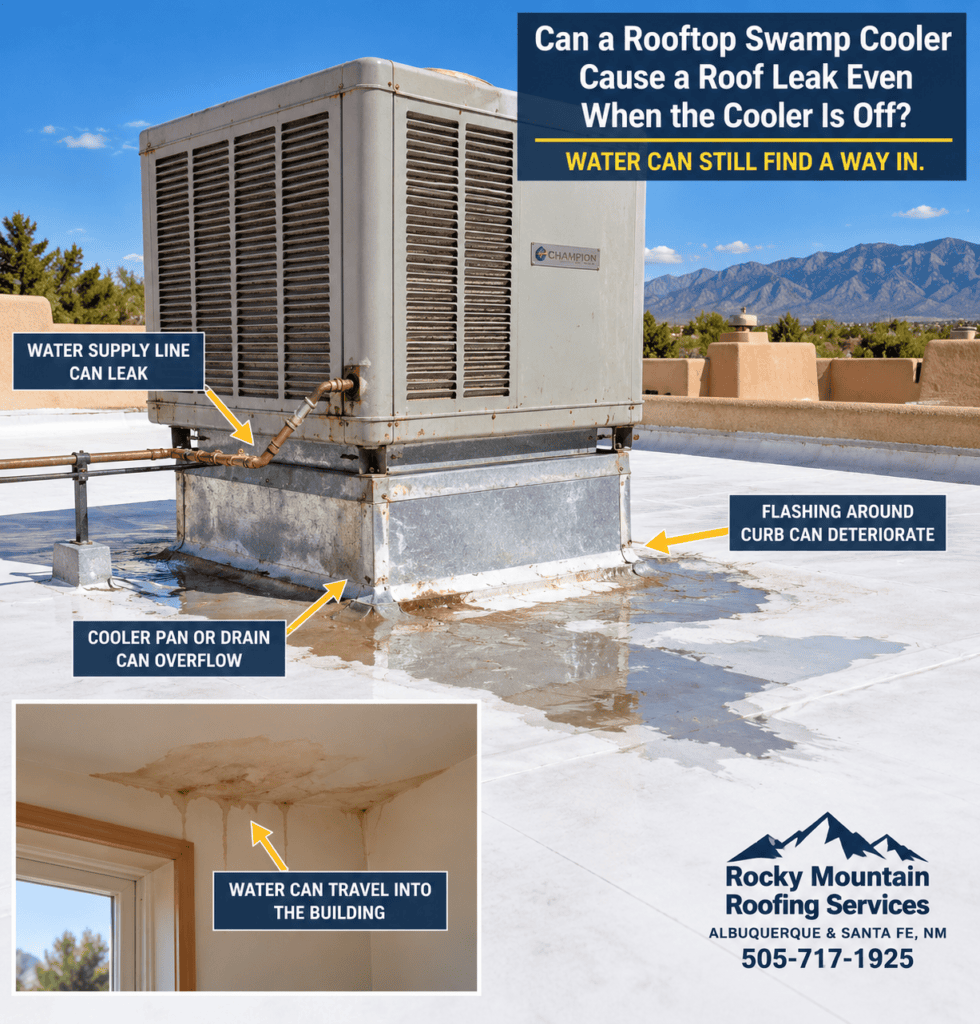
Yes. A rooftop swamp cooler can still be associated with a roof leak even when the cooler is turned off. The reason is simple: switching off the fan or pump does not necessarily shut off the water supply, empty the cooler pan, or stop rain from entering around the roof penetration.
That distinction is especially important on New Mexico homes. A leak that appears below or near a rooftop evaporative cooler may come from the cooler’s plumbing, the pan or overflow system, the roof flashing around the duct or curb, or another nearby roofing defect. The location of the stain gives you a place to investigate, but it does not prove the source.
Can a Swamp Cooler Leak Even When It Is Off?
It can. “Off” can mean different things. A wall switch, thermostat, or control may stop the blower and circulation pump while the water supply to the cooler remains open. If a fitting, water line, float valve, or other water-handling component is leaking, water can continue reaching the cooler even though it is not cooling the house.
The U.S. Department of Energy’s Federal Energy Management Program specifically advises operators of evaporative coolers to locate and repair plumbing leaks and, where applicable, turn off the water supply when the equipment is not operating. That guidance matters because the electrical controls and the water supply are separate systems.
First Clarify What “Off” Means
The Fan and Pump Are Off
If the fan and pump are off, the cooler is not actively circulating water through the pads or moving air through the home. But that does not tell you whether water is still entering the cabinet. A pressurized supply line may still be connected and open.
The Water Supply Is Still On
If the supply valve remains open, a loose fitting, damaged line, leaking float valve, or connection inside the cooler can still release water. Manufacturer instructions for evaporative coolers show that the float valve, water supply line, reservoir and overflow assembly are separate components from the fan and pump controls.
Champion Cooler guidance, for example, instructs users to set the float so the water level remains below the overflow tube and warns that an over-tightened water connection can lead to leakage. That is a useful reminder that a cooler can have a water-handling problem without the fan running.
The Water Supply Is Shut Off and the Cooler Is Drained
If the water supply has actually been isolated and the cooler has been drained, a continuing leak during dry weather becomes less likely to be coming from the cooler’s water system. At that point, the investigation should shift toward residual moisture, the roof penetration, curb or duct flashing, adjacent roofing material, or another source.
If the leak shows up only when it rains, the roofing side of the system becomes more important to inspect.
Cooler-Side Causes That Can Still Put Water on the Roof
A Water-Supply Line or Fitting Leak
A rooftop swamp cooler normally has a small water-supply line feeding the reservoir. If that line remains pressurized after the cooler is switched off, a loose fitting, cracked line, worn connection, or leaking valve can continue dripping onto the roof.
A dry-weather leak is an important clue. If water appears on the roof or inside the house when there has been no rain and the cooler has not been running, the water-supply side deserves attention.
A Float Valve, Overflow or Pan Problem
The float valve controls the water level in the reservoir. If the float is misadjusted, damaged, or not shutting the supply off correctly, the water level can rise too high. Water can then reach the overflow or escape from the pan area.
Older or weathered pans and overflow connections can also leak. This is a mechanical or plumbing issue, not a roof diagnosis. A qualified HVAC or evaporative-cooler professional may be needed to repair the equipment.
Residual Water After Recent Operation
Turning the cooler off does not instantly remove every drop of water from the unit or roof area around it. Water can remain in the reservoir, overflow path, drain connection, or on a low area of the roof. If the roof surface or flashing is already vulnerable, that remaining moisture can continue finding a path into the building after shutdown.
RMRS covers the consequences of repeated water exposure in more detail in What Happens When a Swamp Cooler Constantly Leaks on a Roof?.
Roof-Side Causes That Have Nothing to Do With the Cooler Running
Curb, Duct or Flashing Leakage
A rooftop cooler creates an opening through the roof for the duct or curb assembly. That transition has to keep weather out whether the cooler is running or not. If the flashing around that penetration is cracked, separated, poorly sealed, or deteriorated, rainwater can enter even when the cooler has been shut down for days.
This is one reason a homeowner may reasonably think the cooler is leaking when the real problem is the roofing detail around it.
Failed Sealant, Coating or Adjacent Roofing
The source may be a few inches or several feet away from the cooler. On flat or low-slope roofs, water can move along seams, under coatings, around previous repairs, or through a damaged area before appearing at the cooler opening or below the duct.
New Mexico sunlight and temperature swings can age sealants and coatings over time, while monsoon storms can expose a weakness that was not obvious during dry weather.
Rainwater Can Follow the Penetration Into the Roof Assembly
Water rarely respects the spot where the interior stain appears. Once it enters the roof assembly, it can move along decking, insulation, framing, ductwork, or other building components. A stain directly below the cooler is a clue, but the exterior entry point may be somewhere else.
For the broader diagnostic problem, see How Do I Spot a Roof Leak vs. Swamp Cooler Leak in ABQ?.
Use Timing to Narrow Down the Source
| When the leak appears | More plausible source | What should be inspected |
| Dry weather, cooler off | Water-supply line, fitting, float, pan, overflow, or residual cooler water | Cooler water supply and mechanical water-handling components; roof area where water is landing |
| Only during rain | Roof penetration, flashing, sealant, curb/duct transition, or another nearby roofing defect | Flashing around the cooler, adjacent membrane/coating, seams, drains and nearby roof details |
| Soon after the cooler was running | Residual water, overflow, drain path, or wet roof materials | Pan/overflow/drain condition and surrounding roofing |
| After wind-driven rain | A vulnerable flashing, curb edge, opening or adjacent roof detail | Roof-to-cooler transition and nearby weather-exposed details |
These patterns help narrow the search, but they are not a substitute for inspection. A water line can leak intermittently. Rain can coincide with cooler operation. Water can also travel before it becomes visible indoors.
Swamp Cooler Leak or Roof Leak: What Should Be Inspected?
A useful inspection should separate the equipment from the roof rather than assuming one trade is responsible for everything.
On the cooler side, the water-supply line, fittings, float valve, reservoir, overflow and drain connections may need to be checked. On the roofing side, the curb or duct flashing, sealant, nearby roof membrane or coating, previous repairs, drainage and the condition of the roof around the penetration should be evaluated.
If the symptom is clearly tied to the cooler’s plumbing, an HVAC, plumbing or evaporative-cooler professional is the appropriate trade. If the symptom follows rain or the roofing detail is suspect, a roofer should inspect the roof penetration and surrounding system. When the source is unclear, coordinated diagnosis can save time and prevent one side from repairing the wrong problem.
Rocky Mountain Roofing Services provides roof inspections in Albuquerque that include leak detection, roof penetrations, flashing and flat-roof drainage. The goal is to identify the actual water path before deciding what needs repair.
Can the Roof Be Repaired Without Replacing It?
Often, yes. A leak near a swamp cooler does not automatically mean the entire roof needs replacement. If the roofing problem is limited to a flashing transition, a small membrane area, a localized coating failure, or another isolated detail, a focused repair may be possible.
The answer changes when moisture has spread into a larger area, the surrounding roofing system is badly deteriorated, or repeated repairs have failed. Condition—not the presence of a single leak—should drive the repair-versus-replacement decision.
For homeowners in the Albuquerque area, roof leak repair may involve the roof penetration, flashing, membrane or other nearby roofing components after the source is confirmed.
Why New Mexico Conditions Matter
Evaporative coolers are closely associated with New Mexico because they work well in dry climates. Many are mounted on flat or low-slope roofs, which puts the cooler, its water line and the roof penetration directly in the weather.
Albuquerque roofs face intense UV exposure, summer monsoon rain, high winds, dust and large temperature swings. Santa Fe and higher-elevation areas add colder winters and freeze-thaw conditions. Those factors can age sealants, flashing, coatings and water connections, but they do not prove that climate caused a specific leak.
The practical point is to inspect both systems. A cooler-side water problem can wet the roof during clear weather. A roof-side flashing problem can leak during rain with the cooler completely shut down.
What Should You Do If the Leak Continues With the Cooler Off?
Start with information you can gather safely. Note whether it has rained, whether the cooler recently ran, whether the water supply to the cooler is actually shut off, and whether the stain changes during dry weather. If you can observe the roof from the ground or another safe location, note whether water is visibly present around the cooler.
Do not climb onto a wet, hot, high, fragile, or unfamiliar roof to investigate. Rooftop evaporative coolers also involve electrical and mechanical equipment. If water is near electrical fixtures or wiring inside the home, keep people away from the affected area and contact the appropriate qualified professional.
If the symptom follows rain, the roof penetration or surrounding roofing should be inspected. If water appears in dry weather with the supply still on, the cooler’s water system deserves attention. If the source is not obvious, have the roof and cooler evaluated before anyone starts sealing or replacing components.
Frequently Asked Questions
Does turning off a swamp cooler shut off the water supply?
Not necessarily. Turning off the fan, pump or main control may stop operation while the cooler’s water-supply line remains open. The water supply has to be isolated separately unless the installation has an automatic control that does so.
Can a swamp cooler leak in dry weather while it is off?
Yes. If the water supply remains open, a leaking supply line, fitting, float valve, reservoir, overflow or drain connection can still release water. Dry-weather leakage makes the cooler’s water-handling components more important to inspect.
Can rain leak around a swamp cooler that is not running?
Yes. Rainwater can enter around deteriorated flashing, a curb or duct transition, failed sealant, an adjacent membrane seam, coating damage, or another nearby roof defect. The cooler does not have to be operating for a roof penetration to leak.
Can leftover water in the pan cause a roof leak?
It can contribute if water escapes from the reservoir, overflow or drain path and reaches a vulnerable roof area. But leftover water should not be assumed to be the cause without checking the cooler and the roofing detail.
Should a roofer or HVAC technician fix a leak around a rooftop swamp cooler?
It depends on the source. Cooler plumbing, float, pan, overflow and mechanical problems belong on the HVAC/plumbing side. Flashing, membrane, coating, penetration and drainage problems belong on the roofing side. When the source is uncertain, both trades may need to coordinate.
Schedule a Roof Leak Inspection in Albuquerque or Santa Fe
If water is appearing on the roof, ceiling or wall near a rooftop swamp cooler—even when the cooler is off—do not assume the electrical switch eliminated the source. Rocky Mountain Roofing Services provides residential and commercial roof inspections, leak detection, roof repair, flat-roof service, flashing repair and preventative maintenance throughout Albuquerque, Santa Fe and surrounding New Mexico communities.
The company has more than 35 years of combined roofing experience and focuses on diagnosing the condition of the roofing system before recommending repair or replacement.
Call Rocky Mountain Roofing Services at 505-717-1925 to schedule a professional roof inspection or leak evaluation. If the evidence points to the cooler’s water supply, pan, float, drain or other mechanical component, coordinate that repair with the appropriate qualified HVAC or plumbing professional.
External Sources Used & Why They Matter
U.S. Department of Energy, Federal Energy Management Program – Best Management Practice #13: Confirms that evaporative coolers use a water reservoir/pan, recommends locating and repairing plumbing leaks, and advises turning off the water supply when equipment is not operating where applicable.
Champion Cooler – Evaporative Cooler Owner’s Manual / Float Valve Guidance: Supports the distinction between fan/pump controls and the cooler’s water-supply/float system, and documents the float valve, supply connection and overflow level.
Essick Air / Champion – Commercial Evaporative Cooler Manual: Shows the bottom pan, overflow assembly, water connection and roof/duct installation context for evaporative coolers.