
Full TPO Replacement vs. Silicone Coating for NM Warehouse Roofs
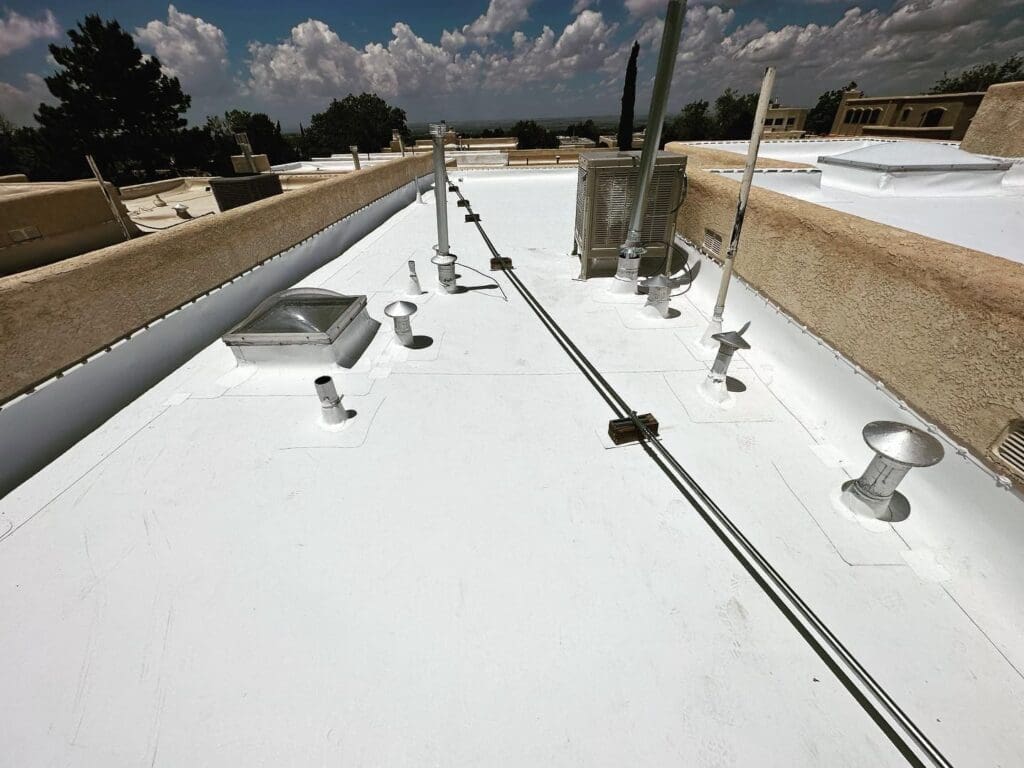
If you manage a large-scale distribution facility or manufacturing plant in the West I-40 Corridor, the North I-25 Industrial Park, or down by the Airport Corridor, you are sitting on top of an enormous financial liability: your flat roof footprint. When that expansive membrane begins to show its age, you will inevitably be pitched two wildly different paths by roofing contractors: a Full TPO Replacement or a Fluid-Applied Silicone Roof Coating.
Out-of-state corporate sales reps love to pitch silicone coatings as a magical, low-cost cure-all for every ageing asset. But local warehouse operators who understand high-desert structural dynamics know better.
At Rocky Mountain Roofing Services, we have more than 35 years tracking how different low-slope systems hold up against New Mexico weather. Let’s look at a brutally honest, engineering-focused cost-benefit analysis of full TPO re-roofing versus fluid-applied silicone coatings specifically for Albuquerque and Santa Fe commercial buildings and warehouses.
The Baseline Options: Commercial Building Re-Roofing vs. Restoration
Before diving into the financial math of each option, we must define exactly what these two processes entail when dealing with large-scale industrial facility envelopes.
Full TPO Replacement (The Complete Overhaul)
A full TPO (Thermoplastic Polyolefin) roof replacement involves mechanically removing the existing compromised roof membrane down to the underlying structural deck or insulation layers. Any water-saturated insulation boards are discarded, the drainage geometry is updated (often utilizing engineered tapered ISO insulation to solve chronic flat roof ponding problems), and a brand-new, heavy-duty single-ply TPO membrane is installed. The seams are hot-air welded to form a continuous, molecularly fused, waterproof monolithic sheet.
Silicone Coating Restoration (The Fluid Shield)
Silicone coating is a fluid-applied chemical restoration process. It is designed to be installed directly over an existing roof membrane that is structurally sound but reaching the end of its natural life cycle. The process involves power-washing the existing deck, treating the seams and flashings with specialized flashing grade reinforcement, and applying a thick, seamless layer of liquid silicone across the entire field. Once cured, it forms a rubberized, monolithic moisture barrier.
The Brutal Financial Matrix: Upfront Capital vs. Life Cycle Costs
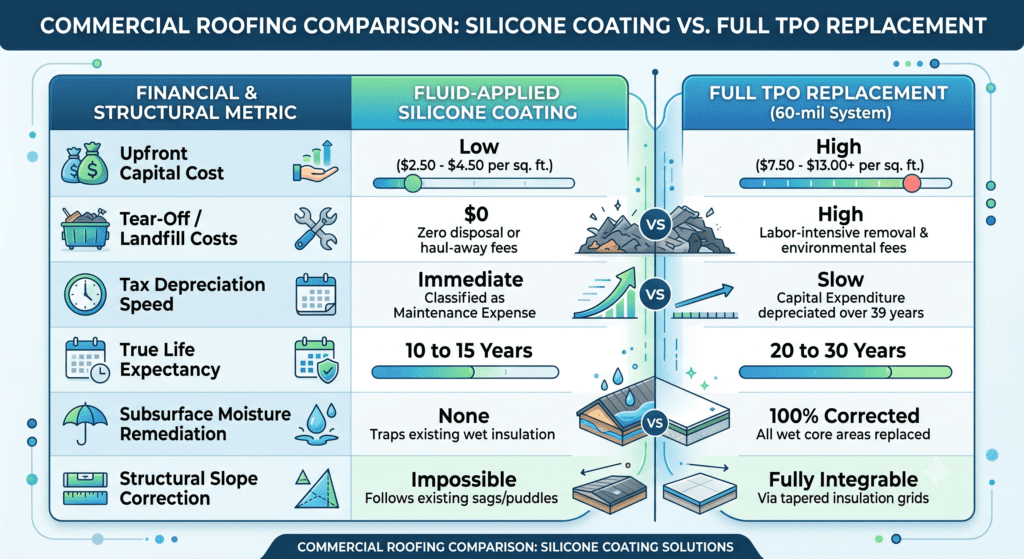
When looking purely at an asset sheet, silicone coatings look like an immediate home run for a facility manager’s budget. However, long-term operational costs paint a very different picture.
The High-Desert Catch: Why Roof Coatings Fail on New Mexico Warehouses
To understand why silicone is a high-risk gamble for a New Mexico commercial building, you must look past the upfront price tag and examine the unique climate variables of Bernalillo and Santa Fe counties. The Bernalillo County elevation is over 5,000 feet above sea level and Santa Fe County is above 7,000 feet sea level. Higher elevations mean super high UV rays which translate into faster decline in roof coatings than almost anywhere else in the world.
1. Trapped Moisture and Subsurface Rot
Silicone is a non-porous vapor barrier. If your warehouse roof currently suffers from unresolved flashing leaks or micro-tears around its industrial HVAC curbs, the insulation layers beneath the membrane are likely to hold moisture.
Before installing a coating, a certified roofer must perform a comprehensive core test or infrared moisture scan to map wet areas. If a contractor rolls liquid silicone over an unsampled roof, they are permanently trapping water inside your building envelope. Under Albuquerque’s intense afternoon heat, that trapped moisture vaporizes, expands, and generates immense upward pressure. This creates massive tension blisters that rupture the new coating and rot your underlying steel or wood roof deck from the inside out.
2. The Flat Roof Ponding Loop
As we’ve established in previous guides, flat warehouse roofs settle over decades, creating depressions that collect water. Silicone coatings are engineered to withstand standing water immersion better than acrylic coatings, but they do not fix the structural geometry of your roof.
If your warehouse deck has poor pitch, liquid silicone simply settles into the existing low spots. The 2,000+ pounds of dead weight from a July monsoon rain will continue to stress your structural joists. A full TPO roof replacement allows us to install a tapered ISO sloped system to force water out of your scuppers permanently; a coating just keeps your swimming pool waterproof.
3. High-Altitude UV Degradation and Maintenance Traps
Albuquerque’s 5,000-foot elevation exposes roof systems to severe ultraviolet cooking. Bright white silicone coatings are highly reflective, which drastically lowers your building’s cooling load. However, silicone is naturally static and acts like a magnet for wind-driven southwestern dust, sand, and cottonwood debris.
Within a few seasons, a silicone roof can become covered in dirt, turning from bright white to dark grey. This dirt accumulation drastically degrades its reflective capabilities, increasing your warehouse cooling costs. Furthermore, once a roof is coated in silicone, nothing else will stick to it. If you get a puncture or mechanical damage later, repairs must be performed using premium, highly expensive silicone sealants—standard commercial roofing adhesives will not bond to the surface.
Engineering Code Limitations: The Two-Layer Rule
Before you sign a contract for installing full re-roof or fluid coating, your facility manager must check the building’s historical cross-section records. According to the New Mexico Commercial Building Code, a commercial structure is legally permitted a maximum of two roofing layers.
- If your warehouse currently has its original single-ply TPO roof, or a tar & gravel built-up roof, you can legally install a second layer (either a TPO lay-over or a fluid coating).
- If your building has already been re-roofed once in its history and currently holds two distinct layers, a coating is no longer a legal or structurally sound option. Rolling liquid silicone over a multi-layered, failing roof matrix adds unnecessary weight and violates state building codes. In this scenario, a total tear-off down to the structural deck is your only viable engineering path.
The Final Verdict: When to Coat and When to Replace
To protect your industrial asset without bleeding capital, use this strict rule of thumb:
Choose a Silicone Coating Restoration If:
Your warehouse roof is less than 15 years old, a professional core test proves the underlying insulation layers are 100% dry, your facility has excellent natural slope drainage with no structural sagging, and you are looking for an immediate, tax-deductible maintenance write-off to extend the asset’s life by another decade.
Choose a Full TPO Roof Replacement If:
Your current roof deck has widespread subsurface moisture, you suffer from severe ponding water due to a lack of structural pitch, the building already carries two layers of roofing, or you want a permanent, 20-to-30-year structural solution that protects sensitive interior business inventory from catastrophic monsoon failures.
Don’t let a slick presentation strip your warehouse of its structural integrity. Get a local eye on your roof deck who can pull a core sample, calculate your true effective R-value, and design a drainage strategy tailored to your facility’s long-term operational budget.
If you need a definitive engineering assessment on whether your industrial property is a candidate for a fluid restoration or requires a complete structural overhaul, call Rocky Mountain Roofing Services today at 505-717-1925 to schedule a professional asset consultation.
Frequently Asked Questions: Commercial Re-Roofing vs. Silicone Coatings
Can a silicone roof coating be applied if my warehouse roof already has multiple layers?
No. According to the New Mexico Commercial Building Code, a commercial structure is legally permitted a maximum of two roofing layers. A fluid-applied silicone coating is considered an additional layer. If your facility has already undergone a previous re-roofing project and carries two distinct roof systems, rolling a fluid coating over that failing matrix violates state building codes and adds unnecessary structural weight. In this scenario, a complete tear-off down to the structural deck is your only legal and engineering path.
What is a core test, and why is it mandatory before deciding to coat a roof?
A core test involves cutting a physical cross-section sample out of your commercial roof assembly, all the way down to the wood or steel structural deck, to inspect the hidden subsurface layers. Immediately after extraction, the sample hole is professionally patched and sealed. This test is mandatory because silicone acts as a completely non-porous vapor barrier. If a contractor applies silicone over an unsampled roof with hidden, moisture-saturated insulation, that trapped water will vaporize under Albuquerque’s intense afternoon sun, creating massive tension blisters that rupture the coating and rot your structural deck from the inside out.
Will a silicone coating fix the chronic ponding water issues on my flat roof?
Absolutely not. Fluid-applied silicone coatings are highly resilient against standing water immersion, but they cannot alter or correct the physical geometry of your roof deck. If your warehouse roof has settled over several decades or was built with poor pitch, liquid silicone will simply follow the contours of the existing sags and puddles. The 2,000+ pounds of dead weight from a heavy monsoon downpour will continue to stress your structural joists. To completely eliminate low spots, you must opt for a full TPO roof replacement that integrates an engineered, tapered ISO insulation grid to force water toward your drainage exits.
Why do white silicone coatings sometimes lose their energy efficiency in New Mexico?
While a bright white silicone coating offers excellent initial reflectivity to lower your warehouse cooling loads, silicone possesses a high static charge. In our high-desert environment, this material acts like a literal magnet for wind-driven southwestern dust, sand, tumbleweed fragments, and cottonwood debris. Within just a few seasons, this dirt accumulation can turn a bright white roof dark, dull grey. This discoloration drastically degrades its cool-roof reflective capabilities, driving your building’s ambient temperature and energy bills right back up.
How do these two options differ regarding tax write-offs and depreciation?
This is one of the biggest operational distinctions for asset managers. A fluid-applied silicone coating is legally classified as a “roof restoration” or maintenance expense, allowing you to write off 100% of the upfront capital cost immediately in the same tax year. Conversely, a full TPO roof replacement is classified as a major capital expenditure, requiring the building owner to depreciate the asset slowly over a standard 39-year commercial schedule.
If my silicone roof gets punctured by a dropped tool or wind-blown debris, how is it repaired?
Silicone is a highly specialized chemical material, and once it cures across a roof field, nothing else will adhere to it. Traditional commercial roofing adhesives, TPO patches, or standard plastic roof cement will completely fail to bond to a silicone surface. If your coated roof suffers mechanical damage or there is a roof puncture happening later on, all structural repairs must be executed using premium, highly expensive silicone sealants and flashing-grade liquids, making your long-term spot maintenance costs significantly higher than a standard single-ply system.