Fixing Flat Roof Ponding Issues on Albuquerque Commercial Roofs
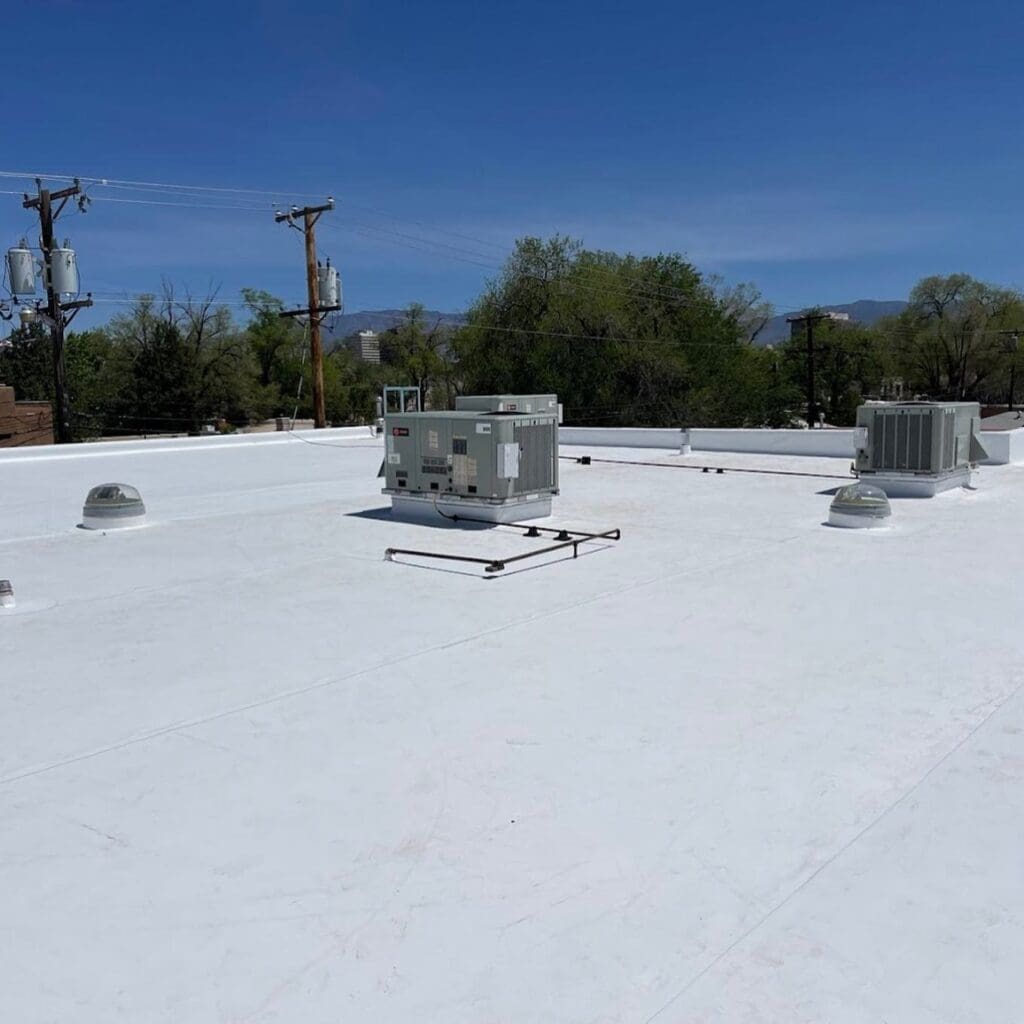
If you’ve owned or managed a commercial building here in the Albuquerque area for any length of time, you already know our weather isn’t gentle. Out-of-state contractors look at our high-desert climate and think, “It barely rains out there, how tough can flat commercial roofing be?”
Any local asset manager who has been on top of a warehouse or retail facility in the middle of a July monsoon knows exactly how wrong that is.
At Rocky Mountain Roofing Services, we have worked for more than 35 years walking flat commercial roofs doing roof inspections across Albuquerque, Rio Rancho, and Santa Fe. We have seen what happens when two inches of torrential rain dumps on a building facility in less than an hour. If that water doesn’t have a clear, immediate path off your roof, you’re looking at a ticking time bomb for your inventory, your operations, and your structural safety.
Let’s talk straight about ponding water—what it really is, the brutal damage it does to Albuquerque commercial properties and commercial properties throughout New Mexico, and the only permanent ways to fix it so you can stop chasing the same facility leaks year after year.
Understanding Flat Roof Geometry and the 48-Hour Rule
What Counts as True “Ponding” Water on a Commercial Roof?
Let’s clear up a myth right away: just because a commercial roof is called “flat” doesn’t mean it should actually be flat. A properly engineered commercial low-slope roof always has a slight slope—at least a quarter-inch per foot—designed to direct water toward your primary drains, scuppers, or collection points. The flat roof ponding water dilemma happens when the water sticks around long after the storm has passed.
Rainwater Evaporation Timeframe on Albuquerque Commercial Buildings
When rain hits a flat roof in Albuquerque, it’s normal to see some water collect during the storm. But here is the industry standard boundary: if that water is still standing on your commercial roof 48 hours after the rain stops, you have a ponding problem.
In our New Mexico heat, a little puddle should evaporate quickly. If it hangs around for two or three days, something is structurally or mechanically wrong with your facility’s drainage system.
The Southwestern Downward Spiral: An Impending Roof Disaster
Ponding water doesn’t just sit there innocently; it actively works to destroy your commercial roof system. In my three and a half decades fixing these issues with the team at Rocky Mountain Roofing Services, the destruction usually follows a very predictable, painful pattern:
1. The Amplified UV Cooking Effect
Albuquerque sits at over 5,000 feet of elevation. Our UV rays are intense, and standing water acts like a magnifying glass. The sun beats down on those puddles, heating the water and cooking the roofing membrane underneath. If your facility has an older asphalt or coal tar built-up roof, this accelerated baking process dries out the oils, causing the membrane to crack, blister, and alligator. Even newer single-ply commercial roofs see accelerated seam degradation when constantly submerged under cooked water.
2. Thermal Shock and the “Push-Pull”
In the high desert, we regularly see daily temperature swings of 30 to 40 degrees. When a commercial roof goes from 140°F in the blazing afternoon sun to 60°F during a sudden evening downpour, the materials rapidly contract. Standing water exacerbates this stress. The constant expanding and contracting pulls at the commercial seams, the flashing around your parapet walls, and the seals around your industrial HVAC units until something snaps.
3. The Crushing Weight of Standing Water
This is where we transition from a facility leak to a structural emergency. Water is incredibly heavy. A single gallon of water weighs about 8.34 pounds. If you have a ponding area over a warehouse bay that is 20 feet by 20 feet, and the water is just one inch deep, you are adding over 2,000 pounds of dead weight to your structural roof deck.
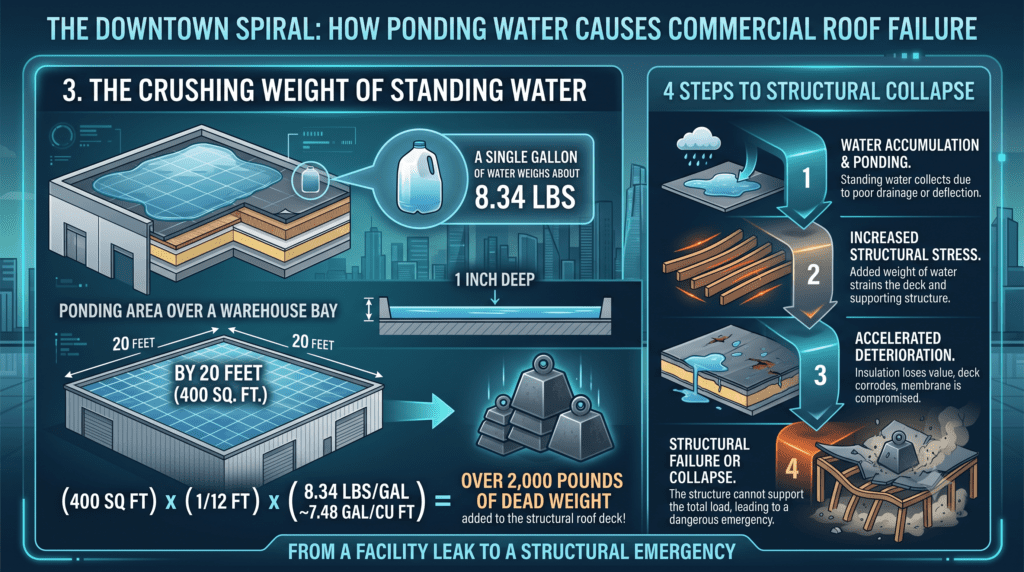
As that weight sits there, the structural steel metal pans or heavy commercial decking underneath begin to deflect (sag). Once the roof deck sags, it creates an even deeper bowl. The next time it rains, more water collects in that exact spot, creating a vicious cycle that eventually ends in warped decking, compromised structural joists, or a catastrophic ceiling collapse over your business inventory.
Why Water Ponds on Albuquerque Commercial Roofs
When I get called out to inspect an Albuquerque commercial property with massive puddles on the roof, the root cause almost always comes down to one of three issues:
Older Albuquerque Commercial Buildings with Little to No Pitch
The commercial building may have settled over the decades, or the original installation crew simply didn’t install the structural framing or insulation with enough pitch to guide water cleanly to the drainage exits.
Rainwater Flow Blocked by HVAC and Commercial Components
Commercial roofs are crowded. Huge air conditioning units, heavy ductwork, and industrial piping are often installed right in the natural path of the water flow. If the equipment installer didn’t add a “cricket” (a diverted ridge) behind the unit, it acts like a dam, backing up water for yards across the roof membrane.
Neglected Maintenance: Clogged Canales and Commercial Drains
In Albuquerque, Santa Fe, and throughout New Mexico, wind-driven dirt, dust, and cottonwood debris love to collect on flat commercial roofs. If your facility maintenance crew isn’t regularly clearing out the scuppers (the drainage openings through the parapet walls) and internal drains, water has nowhere to go. Furthermore, I often see older buildings where the scuppers were cut too high relative to the actual low point of the commercial roof deck.
How Rocky Mountain Roofing Services Eliminates Flat Roof Ponding Permanently
If a commercial roofer comes out to your facility and suggests just slapping a bucket of mastic or plastic roof cement over a ponding area, your first job is to fire them on the spot. Caulk and coatings over a low spot are temporary fixes that will wash out or crack within a single season under commercial wear.
To solve ponding permanently, you need to fix the geometry of the roof or install a modern commercial system engineered to handle water immersion. Here is how we do it right:
Solution A: Tapered Polyisocyanurate (ISO) Insulation Sloping
If your commercial roof structure lacks a natural slope, we can build one on top of the existing deck without changing the building’s framing. We use rigid foam panels called tapered ISO insulation. These panels are engineered to gradually increase in thickness (for example, starting at 1/2 inch and sloping up to 4 inches). We layout a custom grid that forces water to flow directly to your existing commercial drains or scuppers. Once the slope is built with insulation, we install the new commercial roofing membrane over it, completely eliminating the low spots.
Solution B: Commercial Crickets
If a massive rooftop HVAC unit is damming up water, we construct a roofing “cricket.” This is a diamond-shaped, elevated structure built out of insulation and commercial roofing material placed directly upslope from the obstruction. It acts like the bow of a ship, splitting the water flow and forcing it around the mechanical unit toward the edges of the roof.
Solution C: Upgrading to Commercial PVC or Heavy-Duty TPO
If you have a flat commercial roof that is prone to slight water retention due to the architectural layout of the building, the material you choose matters immensely. Old-school asphalt and modified bitumen roofs hate standing water. Instead, we install heavy-duty TPO (Thermoplastic Polyolefin) or premium PVC (Polyvinyl Chloride) membranes. The seams on these modern single-ply commercial roofs aren’t glued or taped; they are hot-air welded together to form a single, continuous, molecular bond. Commercial PVC, in particular, is highly resilient and heavily engineered to withstand long periods of water submersion and chemical or grease exposure without breaking down.
Hire Rocky Mountain Roofing Services to Fix Your Flat Roof Ponding Problem
A flat commercial roof shouldn’t be a swimming pool. If you’ve got water hanging around on your Albuquerque or Santa Fe commercial building days after our New Mexico storms have passed, you are actively losing structural integrity and risking business interruption.
We see this exact crisis play out constantly across Albuquerque’s primary industrial hubs. From the campus-style flex parks in the North I-25 Corridor and Journal Center, to the massive distribution warehouses with vast flat roof footprints along the West I-40 Corridor, low-slope systems are the architectural standard. Whether your facility is a heavy manufacturing plant down by the South I-25 & Airport Corridor (including Mesa Del Sol), a light industrial workshop in the Near North Valley zones like Renaissance and Candelaria, or a mature logistics center off Broadway in the Southeast Heights, your building relies on flawless drainage. Because these commercial properties feature such expansive flat rooflines—often burdened with heavy industrial HVAC units—business owners across these local trade zones frequently depend on durable TPO roofing, PVC membranes, or fluid-applied restorations to handle the intense New Mexico sun and prevent catastrophic ponding failure.
Don’t wait until a small drainage problem turns into a call to your insurance company for a collapsed ceiling over your commercial floor. Get a local eye on it who knows how to read the pitch of a southwest roof, clear out the restrictions, and design a drainage flow that keeps your facility dry for the next three decades.
If you are dealing with stubborn standing water on your commercial property, call Rocky Mountain Roofing Services today at 505-717-1925 for an honest, expert assessment and a permanent fix.