
How White TPO Roofing Slashes NM Commercial Cooling Costs
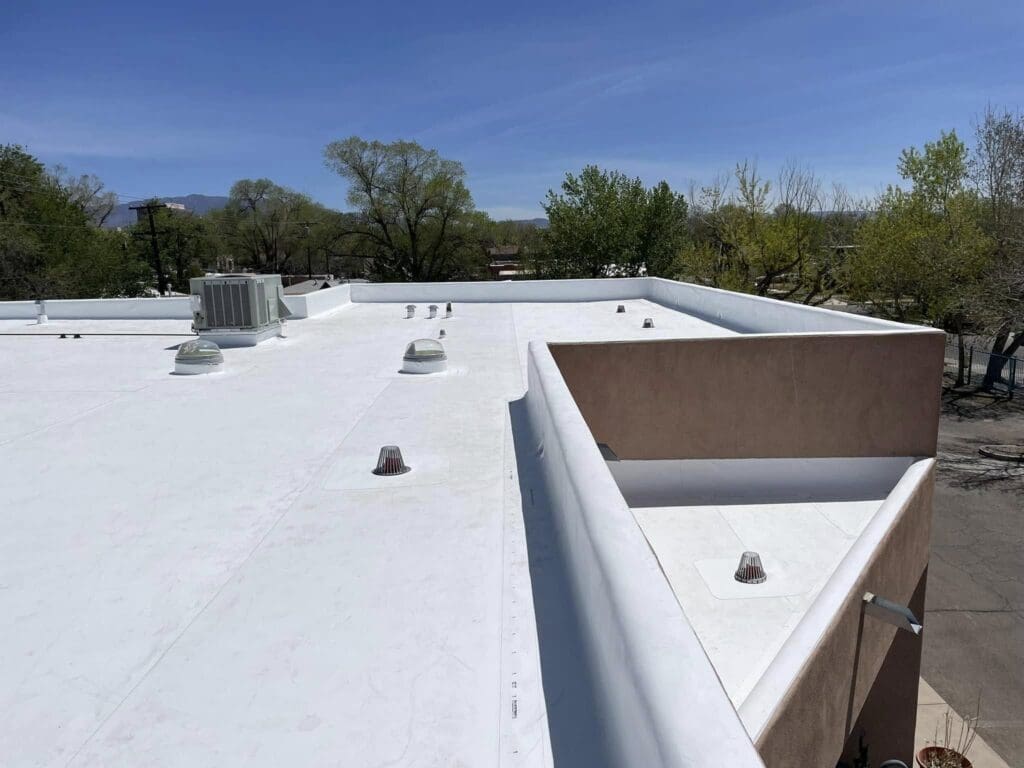
If you manage a commercial facility or industrial warehouse in the Albuquerque or Santa Fe area, your building is constantly fighting an uphill battle against the elements. Out-of-state property managers often underestimate the sheer operational strain of running a facility in the high desert. They look at our peak summer temperatures and assume our cooling bills are comparable to other hot states like Texas or Arizona.
But local asset managers know better: the real drain on your operational budget doesn’t just come from ambient heat—it comes from the compounding atmospheric forces unique to the New Mexico landscape.
At Rocky Mountain Roofing Services, I’ve spent over 35 years tracking how high-desert atmospheric conditions interact with low-slope commercial structures. When it comes to slashing commercial cooling costs, implementing an Energy Star-certified reflective white TPO (Thermoplastic Polyolefin) roofing system is the single most effective engineering upgrade you can make to your building envelope.
Let’s look at the hard science of high-desert atmospheric impacts on flat roofs and analyze how reflective single-ply systems alter your facility’s bottom line.
The High-Desert Atmospheric Multiplier: Why New Mexico Roofs Cook
To understand why a traditional dark asphalt or modified bitumen roof destroys your energy budget, you have to look at the unique atmospheric physics of the middle Rio Grande valley and the northern high plateaus.
1. High Elevation and Thin Air
Albuquerque sits at an elevation of over 5,000 feet, and Santa Fe soars to over 7,000 feet. At these high altitudes, the Earth’s atmosphere is significantly thinner than it is at sea level. With less atmospheric density to filter incoming solar energy, solar radiation strikes your commercial roof deck with unfiltered velocity.
2. Extreme Ultraviolet (UV) Radiation
Because of our high elevation, New Mexico experiences some of the highest UV index ratings in the United States. This intense UV radiation acts as a dual threat: it rapidly degrades and destabilizes non-reflective roofing materials through chemical breakdown, while simultaneously pumping immense thermal energy straight down into your building’s structural steel deck or wooden joists.
3. Low Humidity and the Lack of a Cloud Buffer
Unlike humid climates where moisture in the air scatters sunlight, New Mexico’s low humidity means our skies are completely clear the majority of the year. This lack of humidity creates a direct, unobstructed pathway for solar heat gain. Without a vapor buffer in the air, a dark-colored commercial roof absorbs up to 90% of the sun’s radiant energy, causing roof surface temperatures when it’s 95° outside to skyrocket to a blistering 140° to 170°.
The Science of Albedo: Solar Reflectance vs. Thermal Emittance
Energy Star-certified white TPO membranes combat this extreme atmospheric solar loading through two distinct scientific properties: Solar Reflectance and Thermal Emittance. Together, these metrics determine a material’s Solar Reflectance Index (SRI).
High Solar Reflectance (The Shield)
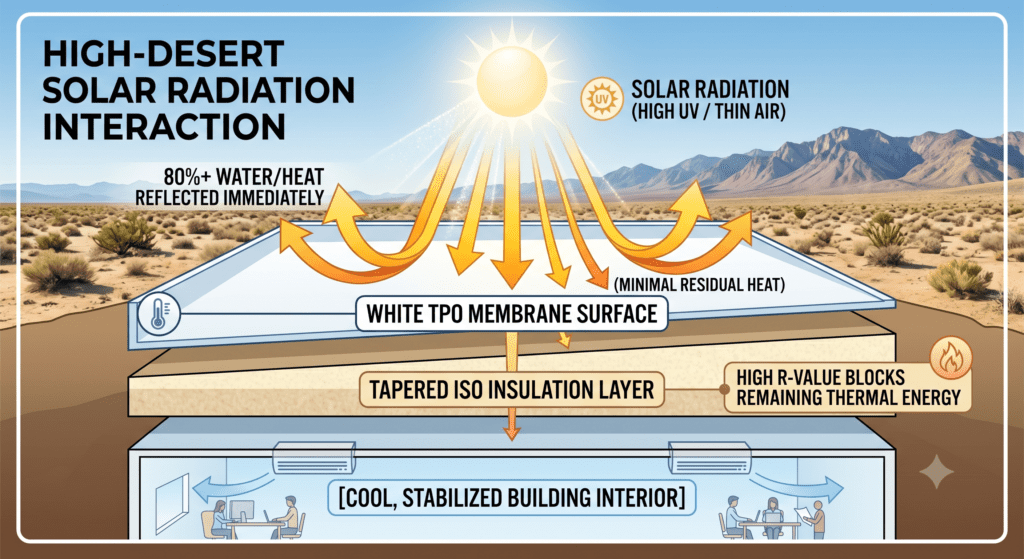
Solar reflectance is the ability of a roofing material to reflect solar energy back into the atmosphere immediately upon impact. While a dark asphalt roof acts like a thermal sponge, an Energy Star-compliant white TPO membrane reflects more than 80% of ambient solar radiation away from your warehouse or facility floor.
High Thermal Emittance (The Release Valve)
No material reflects 100% of light; a small fraction of heat will always be absorbed. Thermal emittance is the roof’s ability to rapidly release whatever residual heat it does absorb. Premium TPO roof membranes feature an emittance rating of over 90%, meaning the system actively sheds heat back into the sky rather than allowing it to migrate downward into your facility’s conditioned space.
By combining high reflectance with high emittance, the surface temperature of a white TPO roof remains within 10° to 15° of the ambient air temperature, completely neutralizing the “oven effect” that plagues uninsulated or dark-roofed industrial complexes.
How Reflective TPO Roofs Slash Commercial Cooling Costs
When you lower your roof’s surface temperature by 50° Fahrenheit or more, the financial relief scales across your entire commercial enterprise:
- Drastic Reduction in HVAC Run Time: When your roof surface is kept cool, your commercial rooftop HVAC units don’t have to work double-time to overcome conductive heat transferring through the ceiling. This slashes facility electrical consumption during peak afternoon billing hours.
- Extending the Life of Mechanical Equipment: Industrial cooling units are expensive assets. By reducing the overall cooling load of the building envelope, your HVAC systems cycle less frequently, experiencing fewer mechanical breakdowns and extending their operational lifespans by years.
- Preventing the “AC Air Intake” Trap: Most commercial flat roofs house massive HVAC air intake fans. On a dark roof, the air surrounding the units is heavily superheated (often exceeding 130°. The HVAC unit is forced to pull this scorching air inward and cool it down to 68°, drawing massive amounts of electricity. A highly reflective white TPO roof keeps the micro-climate ambient air above the roof deck significantly cooler, allowing your HVAC units to pull in cooler air and run at peak efficiency.
Balancing the System: Reflective TPO + Tapered ISO Insulation
To maximize your Energy Star savings, the reflective membrane must be paired with a high-performance substrate. Across key local industrial zones—like the massive logistics warehouses along the West I-40 Corridor or the corporate flex parks in the Journal Center—we optimize this performance by installing a custom-engineered tapered ISO insulation grid directly beneath the white TPO sheet.
While the white TPO membrane acts as the primary reflective defense system against high-altitude UV rays, the underlying polyisocyanurate (ISO) insulation boards establish a high R-value (thermal resistance). This dual-action design ensures that the minimal residual heat passing through the membrane is stopped cold before it can penetrate your facility deck, while simultaneously providing a precision-engineered slope that guides rainwater away from low spots to prevent flat roof ponding disasters.
Conclusion: Turn Your New Mexico Roof into an Environmental Asset
In the harsh climate of the southwestern high desert, a flat commercial roof shouldn’t be a financial drain. Leaving an aging, dark, or uninsulated roof system on your commercial building is the operational equivalent of letting your profits evaporate directly into the thin New Mexico air. Upgrading to an Energy Star-certified white TPO system transforms your building envelope from a massive thermal liability into an energy-saving asset.
Don’t let out-of-state contractors apply generic roofing solutions to a building facing unique high-altitude atmospheric conditions. Trust a local expert, like the pros at Rocky Mountain Roofing Services, who understands how to balance solar physics, state energy codes, and local drainage dynamics to keep your facility dry and your utility bills predictable.
If you are ready to evaluate your building envelope and calculate how much an engineered TPO system can save your enterprise this summer, call Rocky Mountain Roofing Services today at 505-717-1925 to schedule a professional commercial asset and energy consultation.