
Albuquerque TPO & PVC Roofs: Stop Thermal Shock Leaks
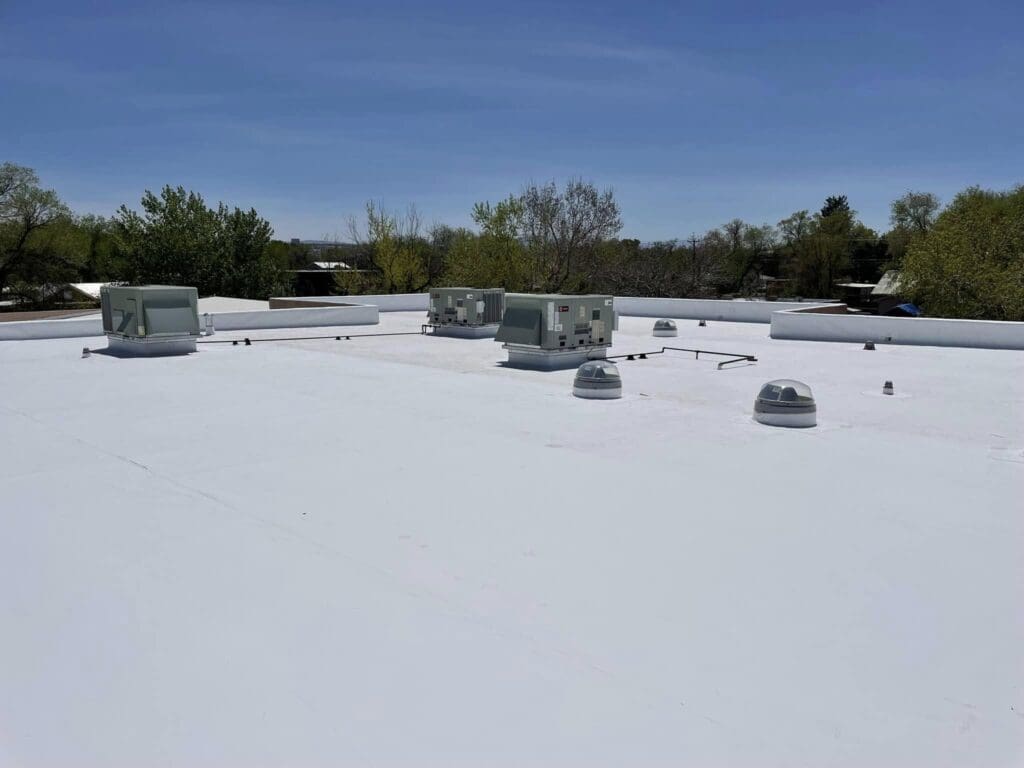
If you manage a commercial facility or an industrial warehouse in the high desert of New Mexico, your property is under constant, silent mechanical strain. Out-of-state property owners frequently view the desert as a stable, predictable climate. But local asset managers know that our atmosphere doesn’t offer a gentle environment for a building envelope.
The true threat to a flat commercial roof in our region isn’t just the summer heat or the winter snow—it is thermal shock.
Because of the high-desert climate, New Mexico experiences dramatic temperature variations both daily and seasonally. These rapid, extreme daily fluctuations act as a physical “push-pull” mechanism that can tear cheap commercial roofing materials apart at the seams.
At Rocky Mountain Roofing Services, we have spent more than 35 years tracking how different low-slope building materials hold up against this relentless thermal stress. Let’s look at the science of thermal shock, the extreme historical climate benchmarks of the Albuquerque and Santa Fe regions, and why modern single-ply TPO and PVC membranes are engineered to survive the high-desert temperature rollercoaster.
The High-Desert Atmosphere: A Climate of Extremes
To understand why flat roofs degrade so rapidly in New Mexico, you have to look at the unique physics of our high-desert atmosphere. The region experiences significant day-to-night (diurnal) temperature variations, with daily swings commonly reaching 25° to 35°. This happens because our exceptionally dry air cannot trap heat at night, allowing temperatures to plummet after sunset. Conversely, the thin air allows the intense, high-altitude sun to heat the ground and building structures rapidly during the day.
Because of their differing altitudes, Albuquerque and Santa Fe feature distinct historical records and seasonal temperature swings that subject commercial envelopes to intense structural movement:
Albuquerque (Elevation ~5,300 ft)
In the Rio Grande Valley, average temperatures span from winter lows near 27° to summer highs of 105°. Daily temperature drops of 30 degrees are entirely standard. Looking at the historical all-time extremes, the Duke City holds a record high of 107° (June 26, 1994) and a record low of 17°(January 7, 1971). This creates a massive 124° variance between the all-time record high and low.
Santa Fe (Elevation ~7,000 ft)
Up at a higher elevation, average temperatures span from winter lows near 18° to summer highs of 83°. Because of the thin air at 7,000 feet, Santa Fe remains cooler but experiences similarly large daily temperature swings. Historically, its all-time records show a high of 102° (June 27, 2013) and historical lows that dropped as far as -18°, representing a total historical swing that exceeds a 120° difference.
The Yearly Temperature Rollercoaster
- Spring (March–May): This transition period yields the largest daily swings of the year. A property manager can easily experience sub-freezing morning temperatures and warm afternoon conditions in the 70s on the exact same day.
- Summer (June–August): The warmest part of the year, with June historically tracking as the hottest and driest month just before the monsoon season arrives. While Santa Fe rarely hits 90°, Albuquerque routinely sees the 90’s and occasional 100° days.
- Fall (Sept–Nov) & Winter (Dec–Feb): Autumn brings gradual cooling with occasional warm “rollercoaster” swings, leading directly into cold, snowy winters with sub-freezing nights.
The Mechanics of Thermal Shock: How Cheap Roofs Fail
Every building material expands when it is heated and contracts when it cools. The rate at which a material shifts is governed by its thermal expansion coefficient.
Thermal shock occurs when a rapid, drastic temperature shift forces a roofing system to expand or contract faster than its physical composition can handle. This structural violence plays out in two distinct ways on cheap, old-school commercial roofs:
1. Split Seams on Built-Up and Asphalt Roofs
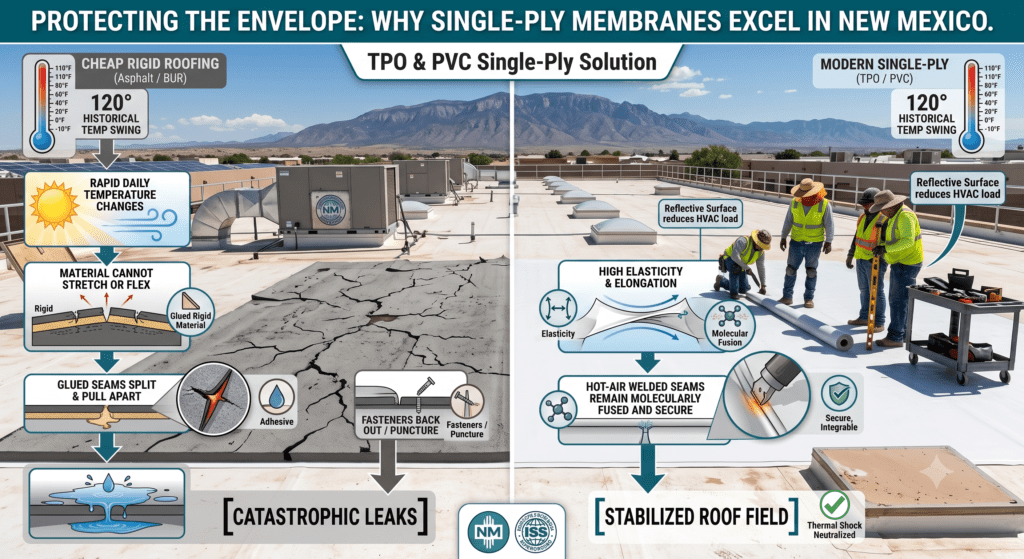
Cheap asphalt, tar, or multi-ply built-up roofs (BUR) are rigid systems. They utilize overlapping sheets of material bound together by adhesives, glues, or cold-applied tars.
When an Albuquerque roof field goes from a blistering $140^\circ\text{F}$ surface temperature in the mid-afternoon sun down to $60^\circ\text{F}$ during a sudden evening monsoon downpour, the material undergoes an immediate, violent contraction. Because the rigid asphalt cannot stretch, this intense physical pulling force concentrates directly on the overlapping seams. Over a few seasons of this daily tug-of-war, the dried-out adhesives give way, causing the seams to split open and create direct paths for water infiltration.
2. Fastener Backout and “Alligatoring”
As a cheap roof expands and contracts daily, it slides microscopically against the underlying insulation panels and structural deck. These continuous shifting places immense lateral pressure on the mechanical screws and stress plates holding the system down.
Over time, this movement causes the structural fasteners to back out, rising up out of the deck like small pimples. These backed-out screws can easily puncture the roof membrane from the inside out. Furthermore, the constant surface movement dries out the natural oils in asphalt coatings, causing the surface to crack and form dense patterns resembling reptile scales—a severe degradation failure known in the industry as alligatoring.
The Single-Ply Solution: Why TPO and PVC Excel
To protect a commercial facility against a 120° historical temperature swing, you cannot rely on rigid, glued materials. You must install a flexible, highly engineered single-ply membrane like TPO (Thermoplastic Polyolefin) or premium PVC (Polyvinyl Chloride). These modern systems are engineered specifically to neutralize thermal shock:
High Elasticity and Elongation Ratings
Unlike brittle asphalt, commercial TPO and PVC membranes are manufactured with advanced elastomeric polymers and reinforced scrim layers. This gives them exceptionally high elongation ratings, allowing the sheets to stretch safely during rapid contraction cycles and snap back into their original shape without cracking, splitting, or distorting.
Molecularly Fused, Hot-Air Welded Seams
The absolute greatest advantage of single-ply TPO and PVC systems is how the seams are joined. These systems do not rely on glues, tapes, or liquid sealants that dry out and fail under high-altitude UV rays.
Instead, a certified commercial roofer uses robotic hot-air welders to melt the overlapping edges together. This process molecularly fuses the two separate sheets into a singular, continuous, monolithic barrier. The resulting seam is actually stronger than the field membrane itself and cannot be pulled apart by thermal shock.
Highly Reflective “Cool Roof” Pigments
Energy Star certified white TPO and PVC membranes feature high solar reflectance, bouncing up to 80% or more of radiant solar energy away from your building footprint. By keeping the roof’s surface temperature significantly closer to the ambient air temperature, white single-ply membranes drastically reduce the overall magnitude of the daily thermal swing. Less heat absorption means less physical movement, safeguarding your structural flashings and fasteners from premature fatigue.
Conclusion: Stop Re-Patching a Failing Matrix
If your warehouse or commercial facility suffers from recurring seam splits or perimeter leaks during the spring and summer transition months, your roof is likely losing its battle with thermal shock. Slapping a bucket of temporary roof cement over a split seam is a short-sighted fix that will simply crack open again during the next major diurnal temperature swing.
To secure your asset long-term, you need a highly flexible single-ply envelope designed to move in total harmony with the New Mexico climate. Don’t guess on material performance or trust your facility to out-of-state crews who don’t understand high-desert physics. Get an experienced local commercial professional to pull a core test, analyze your system’s elasticity, and engineer a permanent, heat-welded solution.
If you are ready to audit your property’s structural integrity and protect your inventory from thermal shock failures, call Rocky Mountain Roofing Services today at 505-717-1925 to schedule a professional commercial flat roof assessment.
Commercial Roofing FAQ: Thermal Shock
Why are spring and summer transition months so brutal on New Mexico commercial roofs?
Spring and early summer feature the largest day-to-night (diurnal) temperature variations in the region, with daily swings easily stretching between 25°F and 35°F. A commercial roof deck can endure freezing temperatures in the early morning and jump to a scorching surface temperature well over 100°F by the afternoon. This rapid daily expansion and contraction put intense physical stress on roofing materials, causing rigid, cheap roofs to fail at their weakest points.
What exactly is “fastener backout” and what causes it?
Fastener backout happens when the continuous, daily sliding movement of a thermally active roof membrane places repetitive lateral pressure on the heavy-duty screws holding the insulation panels down. Over time, this shifting temperature causes the screws to back up out of the structural deck. As they rise, the sharp screw heads press directly into the underside of the roofing membrane, eventually puncturing the field sheet from the inside out and creating a direct path for leaks.
Why can’t traditional asphalt or built-up roofs handle thermal shock?
Traditional asphalt and built-up roofs are highly rigid and contain natural oils that dry out over time due to the intense, unfiltered UV rays found at high elevations. When a sudden cold downpour hits a hot asphalt roof, the material contracts violently. Because the brittle asphalt cannot stretch or flex, the immense pulling force concentrates along the overlapping seams, snapping the glued or tarred joints open.
How does hot-air welding make TPO and PVC seams immune to thermal splitting?
Unlike cheap roofing systems that rely on tapes, glues, or liquid cements that degrade in the desert heat, single-ply TPO and PVC membranes are joined using robotic hot-air welders. This process uses precise heat to melt the overlapping edges, molecularly fusing the separate sheets into a singular, continuous sheet of material. Because the seam becomes a single unit rather than a glued joint, it cannot dry out, delaminate, or split apart under thermal tension.
Does a reflective white roof actually prevent structural movement?
Yes. A traditional dark commercial roof absorbs up to 90% of solar radiation, driving surface temperatures up to 150°F or more on a hot day. An Energy Star certified white TPO roof reflects 80% or more of that solar energy back into the atmosphere. By keeping the roof surface significantly cooler and closer to the actual ambient air temperature, you minimize the total temperature differential, which drastically reduces the physical expanding and contracting of the entire building envelope.
What is the historical all-time temperature swing that Albuquerque commercial roofs must withstand?
Albuquerque features a massive historical all-time temperature variance of 124°. This range spans from an all-time record high of 107° (set on June 26, 1994) down to an all-time record low of -17° (set on January 7, 1971). Cheap, rigid materials expand and contract continuously across this extreme baseline, causing rapid material fatigue and structural failure over time.
How do the atmospheric conditions in Santa Fe impact low-slope roof degradation?
Santa Fe sits at an elevation of approximately 7,000 feet. While its higher altitude keeps average summer highs cooler at around 83°, the thinner atmosphere provides significantly less mass to filter out intense solar radiation. This creates similarly large, violent daily temperature swings and an historical all-time temperature variance exceeding 120°. This constant ambient thermal rollercoaster accelerates the breakdown of traditional, lower-grade roofing materials.
What exactly is “fastener backout,” and how does thermal shock cause it?
As a flat commercial roof undergoes daily temperature swings, the membrane microscopically slides and shifts against the underlying insulation panels and structural deck. This continuous thermal movement places repetitive lateral pressure on the mechanical screws and stress plates holding the roof down. Over time, these shifting temperatures backs the screws up out of the structural deck. As they rise, the sharp screw heads can easily puncture the roof membrane from the inside out, creating immediate paths for leaks.
Why can’t traditional asphalt or built-up roofs (BUR) handle New Mexico’s diurnal temperature shifts?
Traditional asphalt and built-up roofs are highly rigid systems that utilize overlapping sheets bound together by adhesives, glues, or cold-applied tars. The intense, high-altitude UV rays bake these materials over time, drying out their natural oils and making them brittle. When a sudden, cold afternoon monsoon downpour hits a sun-cooked, 140° asphalt roof, the system contracts violently. Because the brittle material cannot stretch or flex, the intense pulling forces concentrate on the seams, snapping the dried-out glued joints wide open.
How do hot-air welded TPO and PVC single-ply systems eliminate thermal splitting?
Unlike cheap roofing systems that rely on tapes, glues, or liquid cements that dry out and degrade in the high-desert climate, modern single-ply TPO and PVC membranes are joined using robotic hot-air welders. This process uses precise heat to melt the overlapping edges, molecularly fusing the separate sheets into a singular, continuous, monolithic barrier. The resulting seam is actually stronger than the field membrane itself, making it immune to delamination or splitting under intense thermal tension.
Does installing an Energy Star certified white roof actually limit structural expansion and contraction?
Yes, dramatically. A traditional dark commercial roof acts like a thermal battery, absorbing up to 90% of solar radiation and driving surface temperatures up to 150° or more. An Energy Star certified white TPO or PVC roof reflects 80% or more of that radiant solar energy back into the atmosphere. By keeping the roof surface significantly cooler and closer to the actual ambient air temperature, you minimize the total temperature differential, which drastically reduces the physical expanding and contracting of the entire building envelope.