
Should I Have My Roof Inspected After a Hailstorm Even If It Is Not Leaking?
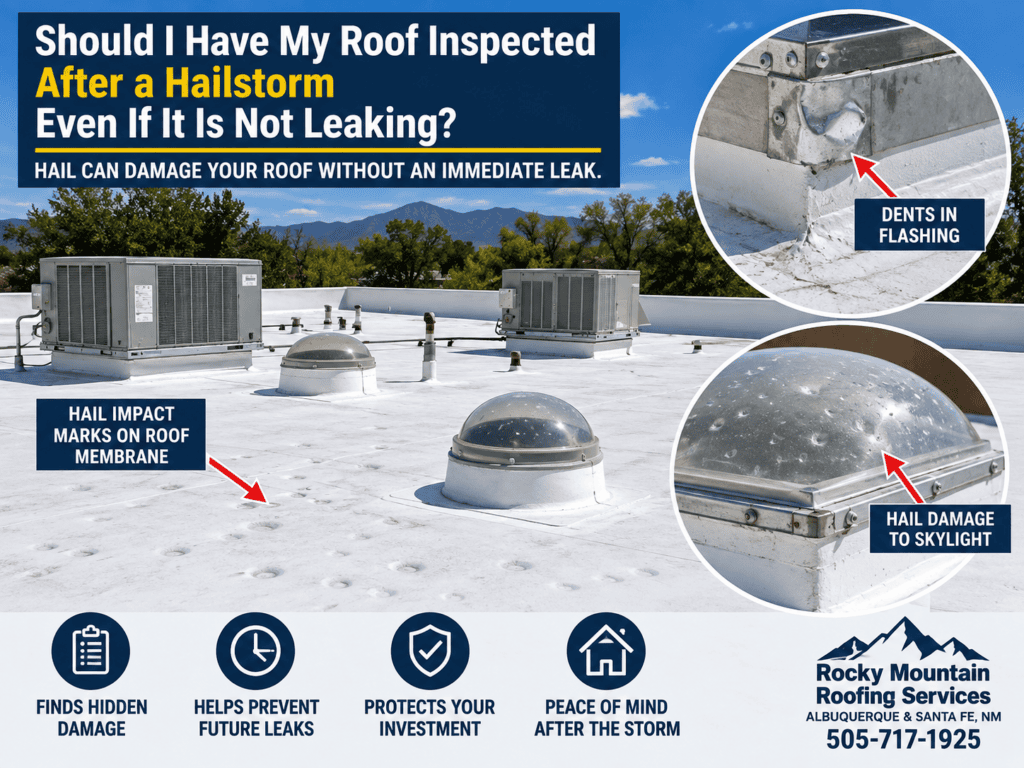
Yes. After a significant hailstorm, having your roof professionally inspected can be worthwhile even when nothing is leaking inside your home or building. A dry ceiling tells you that water is not reaching that interior location now. It does not tell you whether hail affected shingles, tile, a roof membrane, foam or coating, flashing, vents, skylights, rooftop equipment, or other exposed components.
That does not mean every hailstorm damages every roof. It also does not mean a post-storm inspection should automatically lead to an insurance claim or roof replacement. The useful purpose of an inspection is to find out what actually happened.
A professional inspection may show no significant storm damage. It may identify conditions worth documenting and monitoring. It may uncover a localized repair. Or it may find broader damage that deserves further evaluation. The decision should follow the evidence rather than the fear that hail must have caused a major problem.
Why No Roof Leak Does Not Mean No Hail Damage
A roof can remain watertight immediately after a storm and still have impact-related changes that deserve attention. Hail damage is not always an instant hole through the roof. The effect depends on the roofing material, the hail, wind, impact angle, condition of the roof, and the complete roof assembly.
Research from the Insurance Institute for Business & Home Safety (IBHS) illustrates why the distinction matters. On asphalt shingles, hail can cause dents, granule displacement, and tears or cracks. IBHS research has also found that more severe shingle dents and tears can increase water-leakage vulnerability. A roof therefore can show an impact condition before an interior leak becomes the first obvious symptom.
The opposite is equally important: evidence that hail hit a roof is not proof that the roof has lost its ability to perform. IBHS notes that hail damage varies by roof-cover material. For example, metal roofing can dent cosmetically without evidence that the dent itself has impaired roof function. An inspection has to distinguish appearance from performance.
When Is a Post-Hail Roof Inspection Most Useful?
The National Roofing Contractors Association (NRCA) recommends professional inspection of roofs affected by severe weather regardless of outward appearance. It also advises homeowners and building owners to limit their own roof checks to ground level because of fall hazards.
An inspection becomes especially useful when the storm produced enough hail or wind to damage other exposed parts of the property, when the roof is older or already has known vulnerabilities, when you cannot see much of the roof from the ground, or when the building has a flat or low-slope roof with penetrations and rooftop equipment that are difficult to evaluate without safe roof access.
You do not need an active drip to make the inspection worthwhile. The question is whether the roof was exposed to a storm that may have changed its condition.
What Should a Roofer Check After a Hailstorm?
A post-hail inspection should look at the roofing system as a whole rather than searching for one stereotypical hail mark. The inspector should consider the storm-exposed roof surfaces, transitions, flashings, penetrations, drainage components, rooftop equipment, and other materials that can help establish the pattern and extent of impact.
For residential properties, that may include shingles or tile, ridges, valleys, pipe flashings, skylights, vents, metal edges, gutters and downspouts. On flat and commercial roofs, the inspection may include membranes, coatings, foam surfaces, seams, parapets, equipment curbs, drains, scuppers, canales, flashings, and the condition around rooftop mechanical equipment.
Documentation matters even when no repair is recommended. Photographs and written observations create a point-in-time record of roof condition. IBHS survey guidance specifically identifies documenting observed conditions and comparing them with prior records when available as useful parts of evaluating storm-related damage.
Rocky Mountain Roofing Services provides professional roof inspections in Albuquerque for residential and commercial properties, including photo documentation and storm-damage assessments.
Hail Does Not Affect Every Roofing Material the Same Way
One reason a professional inspection is more useful than a quick ground-level glance is that the same storm can leave very different evidence on different roofing systems.
Asphalt Shingles
On asphalt shingles, an inspector may evaluate impact marks, granule displacement, dents, bruising, cracks or tears, and whether the shingle mat or surrounding components appear compromised. The pattern matters. Normal aging, foot traffic, manufacturing characteristics and older damage can sometimes resemble storm effects, so one isolated mark should not be treated as automatic proof of functional hail damage.
Tile Roofs
Clay and concrete tile can crack, fracture, chip or break when struck hard enough. But a visible chip is not automatically the same as a water-entry path. Tile roofs also depend on the underlayment and flashing beneath and around the tile. Inspection should consider whether the tile damage is recent, whether pieces are displaced, and whether the underlying water-management system may have been exposed.
TPO, PVC and Other Low-Slope Membranes
On a single-ply roof, hail may affect the membrane, seams, flashings, cover board, insulation, or other parts of the assembly. A puncture is an obvious concern, but impact effects are not always obvious from a distance. The inspector should look at the roof surface and at vulnerable details around penetrations, curbs and transitions.
RMRS discusses this roof-system-specific issue in more detail in Does Hail Damage Affect Flat Roofs in Albuquerque? and its current TPO roofing resources.
Foam and Roof Coatings
Spray polyurethane foam and coated roof systems should be checked for impact marks, coating fractures, exposed or damaged foam, and conditions around penetrations and transitions. The important question is whether the protective surface and underlying roofing system still perform as intended, not simply whether the surface looks different after the storm.
Metal Roofing
Metal panels can show dents after hail. IBHS notes that denting changes appearance but, by itself, is not evidence that roof function has been impaired. A useful inspection therefore looks beyond cosmetic denting to seams, fasteners, flashings, coatings, penetrations and other details that can affect weather protection.
A Post-Hail Inspection Can Have Four Legitimate Outcomes
A roof inspection after hail is a decision tool, not a predetermined path to replacement. A balanced inspection can reasonably end in any of these outcomes:
| Inspection outcome | What it means | Reasonable next step |
| No significant storm damage identified | The roof may show normal aging or no meaningful hail-related condition. | Keep the documentation and continue normal maintenance. |
| Document and monitor | Minor, cosmetic, uncertain, or non-urgent conditions are recorded without evidence that immediate repair is needed. | Keep photos/notes and watch the condition during future inspections. |
| Localized repair | Damage is limited to a repairable area or component. | Repair the affected area and document the completed work. |
| Broader evaluation | Damage appears widespread or affects multiple parts of the roofing system. | Evaluate repair versus replacement scope and, if appropriate, review insurance options. |
What Can You Safely Look for From the Ground?
After the storm has passed, you can document conditions without climbing onto the roof. New Mexico’s Office of Superintendent of Insurance recommends safely checking roofs, gutters, skylights and window screens after hail, using binoculars or a professional rather than climbing onto a damaged roof.
From the ground, look for obviously displaced roofing, broken tile pieces, unusual areas of missing shingle granules that are visible from a distance, dented gutters or downspouts, damaged vent covers, skylight damage, or impact marks on other exposed surfaces. Also note the approximate hail size if you can do so safely and take photographs of visible property damage.
These observations can tell you that the property experienced meaningful impact. They cannot tell you the full condition of the roof. Many roof surfaces and details are simply not visible well enough from the ground to make that determination.
Should I File an Insurance Claim Just Because the Roof Was Hailed On?
Not automatically. A roof inspection and an insurance claim are separate decisions.
Start with documentation and facts. If an inspection identifies storm-related damage, review your own policy, deductible, exclusions, reporting requirements and coverage terms. The New Mexico Office of Superintendent of Insurance advises consumers to review their policy and document visible damage, but whether a particular roof condition is covered is ultimately determined under the individual policy and claim process.
Do not assume that every dent or impact mark is covered damage, and do not assume that a roof must be replaced because hail fell at the property. If the inspection finds no significant damage, the useful result may simply be documentation showing the roof’s post-storm condition.
If an insurance discussion becomes appropriate, Rocky Mountain Roofing Services’ approved service materials include storm-damage inspections and insurance-claim assistance documentation. The roofing evaluation should still remain focused on the roof’s actual condition.
Why New Mexico Roofs Need a Material-Specific Hail Inspection
New Mexico combines hail with several other stresses that can complicate roof evaluation: high winds, monsoon thunderstorms, intense UV exposure, high elevation, large temperature swings, and, in Santa Fe and higher-elevation areas, snow and freeze-thaw cycles.
Wind-driven hail can also strike roof slopes and vertical components unevenly. One side of a building may show more evidence than another. Flat roofs common in Albuquerque and Santa Fe add another variable because membranes, foam, coatings, parapets, canales, drains, skylights and rooftop HVAC equipment can all be part of the exposed roofing system.
That is why a post-hail inspection should match the roof in front of the inspector. A shingle-roof checklist should not be copied onto a TPO roof, and cosmetic denting on metal should not be evaluated the same way as a crack in tile or a breach in a membrane.
What If the Inspection Finds Damage but the Roof Still Is Not Leaking?
The absence of a leak is good news, but the repair decision should be based on the type, location and extent of the damage. A localized condition may be repairable. A cosmetic condition may only need documentation or monitoring. More extensive damage may justify a broader repair-versus-replacement evaluation.
For commercial single-ply roofs, condition matters more than the simple fact that a storm occurred. RMRS’s TPO repair-versus-replacement guide explains that localized punctures, seams and flashing problems may be repairable, while widespread deterioration, trapped moisture, drainage problems or repeated failures can change the decision.
The same principle applies broadly: inspect first, define the scope, then decide. Hail exposure alone is not a diagnosis.
Frequently Asked Questions
Can hail damage a roof without causing an immediate leak?
Yes. Hail can affect roofing materials or components without creating an immediate path for water into the building. Whether that condition is cosmetic, monitorable or functionally significant depends on the material and the extent of damage.
How soon after a hailstorm should I have the roof checked?
There is no universal inspection deadline that applies to every storm and every roof. Once conditions are safe, a timely inspection can document the roof before weathering, later storms or unrelated damage make the post-storm condition harder to interpret. If you may have an insurance issue, review your own policy for reporting requirements.
Can I inspect hail damage myself?
You can document visible conditions from the ground, but NRCA advises homeowners and building owners not to climb onto storm-affected roofs without proper safety systems. Professional roofers are trained to inspect roof surfaces and details that are difficult or unsafe to evaluate from below.
Does a dented metal roof mean it needs to be replaced?
No. Dents can be cosmetic. IBHS states that there currently is no evidence that dents alone impair the functionality of metal roofing. Seams, fasteners, coatings, penetrations and other performance-related details should also be evaluated.
What if the roofer finds no hail damage?
That is a legitimate and useful outcome. Keep the inspection documentation with your property records and continue normal roof maintenance. A post-storm inspection does not need to produce a repair recommendation to have value.
Should commercial flat roofs be inspected after hail even if there are no leaks?
Yes, inspection can be useful because flat and low-slope systems contain membranes, seams, flashings, curbs, drains, coatings and penetrations that may not be visible from the ground. The inspection should be specific to the installed roofing system and its condition.
Schedule a Post-Hail Roof Inspection in Albuquerque or Santa Fe
If your property was hit by hail but the roof is not leaking, you do not have to wait for a ceiling stain to learn whether the roof was affected. You also should not assume that hail automatically means damage or replacement.
Rocky Mountain Roofing Services is a locally owned New Mexico roofing contractor providing residential and commercial roof inspections, storm-damage assessments, roof repair, roof replacement and preventative maintenance throughout Albuquerque, Santa Fe and surrounding communities. The company works with flat roofs, TPO and PVC systems, spray foam, metal, shingles and tile and has more than 35 years of combined roofing experience.
Call Rocky Mountain Roofing Services at 505-717-1925 to schedule a professional roof inspection after a hailstorm.
You can also request a roofing quote or inspection online.
External Sources Used & Why They Matter
National Roofing Contractors Association (NRCA) – Severe-weather roof inspection guidance. Used to support the recommendation for professional post-storm inspection, including inspection regardless of outward appearance, and the safety recommendation that property owners limit their own inspection to ground level.
NRCA: Roof Repairs After a Storm
Insurance Institute for Business & Home Safety (IBHS) – Hail and roof research. Used to distinguish hail damage modes by roofing material, explain asphalt-shingle dents/granule loss/tears, and support the distinction between cosmetic metal denting and evidence that affects roof function.
IBHS: Hail & How It Damages Roofs
IBHS: Water Leakage Vulnerabilities for Shingles with Hail Damage
New Mexico Office of Superintendent of Insurance – Hail & Wind Storm Awareness & Readiness Checklist. Used for New Mexico-specific safety and documentation guidance, including checking visible damage safely, avoiding climbing onto a damaged roof, documenting hail size and damage, and reviewing the individual insurance policy.
New Mexico OSI: Hail & Wind Storm Awareness & Readiness Checklist